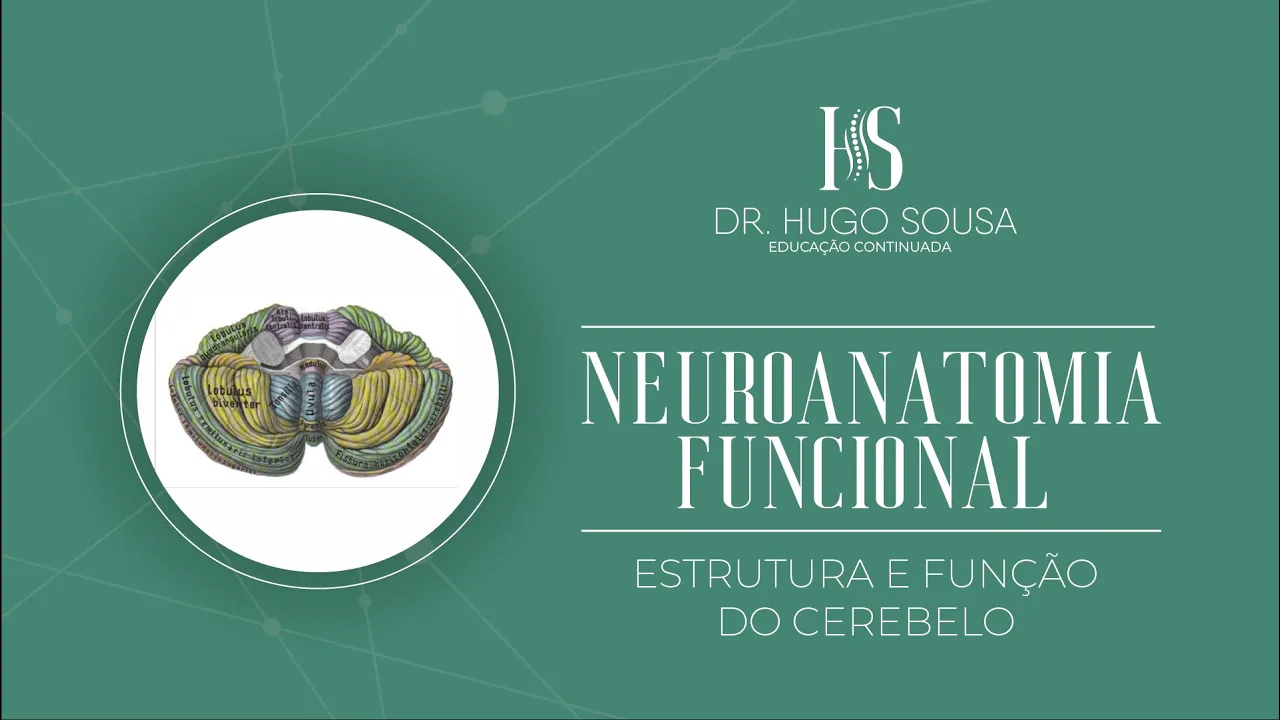
ESTRUTURA E FUNÇÃO DO CEREBELO PARTE 1
Cerebellum Functions and Anatomy
Overview of the Cerebellum
- The cerebellum is described as a supra-segmental organ, meaning it does not have direct nerve projections from the brain but receives various tracts and projections.
- It plays a crucial role in ensuring movements are uniform and harmonious, contributing significantly to motor coordination.
Motor Coordination and Ataxia
- The cerebellum acts as a major coordinator for movements; dysfunction can lead to ataxias, which are characterized by motor incoordination.
- Ataxias cerebelares specifically indicate issues with motor coordination stemming from cerebellar dysfunction.
Anatomical Positioning
- The cerebellum is located dorsally to the pons and contributes to forming the roof of the fourth ventricle.
- It rests on the occipital bone, separated from the occipital lobe by a fold of dura mater known as the tentorium cerebelli.
Tentorium Cerebelli and Related Structures
- The tentorium divides structures into supratentorial (above) related to cerebral components and infratentorial (below), including parts of the brainstem.
- Understanding these anatomical divisions helps clarify discussions about lesions or tumors affecting either region.
Key Structures within the Cerebellum
Major Components
- Important structures include:
- Vermis: A medial structure connecting both hemispheres of the cerebellum.
- Hemispheres: Left and right sides that facilitate various functions.
- Nodule: A projection associated with vermis functionality.
Flocculus Structure
- The flocculus consists of two lateral projections that play roles in balance and spatial orientation, closely linked with cranial nerves like vestibulocochlear.
Cerebellar Lobes and Fissures
Lobes Description
- There are three main lobes:
- Flocculo-nodular Lobe: Formed by merging flocculi with nodules, significant for balance.
- Anterior Lobe: Identified in red; involved in voluntary movement control.
- Posterior Lobe: Largest lobe represented in green; critical for fine-tuning motor activity.
Fissures Identification
- Key fissures include:
- Primary Fissure: Divides anterior from posterior lobes.
- Horizontal Fissure: Located between different sections of lobes.
- Posterolateral Fissure: Separates flocculo-nodular lobe from posterior lobe.
Internal Structure of Cerebellum
Internal Composition
Cerebellar Anatomy and Function
Overview of Cerebellar Structure
- The cerebellum's medullary center is discussed, highlighting the three layers constituting the cerebellar cortex.
- Historically referred to as the "tree of life" due to its resemblance to trees, this term reflects early beliefs about its role in vital functions.
- Observations from historical battles indicated that injuries to the posterior head region did not always lead to death, suggesting a protective function of the cerebellum.
Vital Functions and Misconceptions
- It is clarified that vital processes are managed by the reticular formation in the brainstem rather than solely by the cerebellum.
- The term "medullary center" is now preferred over "tree of life," emphasizing a more accurate understanding of cerebellar anatomy.
Cerebellar Nuclei
- Within the white matter of the cerebellum, four main nuclei are identified: dentate nucleus (largest), emboliform nucleus, globose nuclei, and fastigial nucleus.
- The arrangement of these nuclei from medial to lateral is: fastigial, globose, emboliform, and dentate.
Peduncles and Structural Connections
- The three pairs of cerebellar peduncles (superior, middle, inferior) facilitate communication between different parts of the brain.
- These peduncles play crucial roles in integrating sensory information and coordinating motor control.
Phylogenetic Classification of Cerebellum
- The development stages classify the cerebellum into three types: archicerebellum (primitive), paleocerebellum (intermediate), and neocerebellum (most advanced).
- Each lobe corresponds with phylogenetic evolution; for instance, flocculonodular lobe relates to archicerebellum functions.
Vestibulocerebello Connections
- Flocculonodular lobe connects with vestibular structures via vestibulocochlear nerve fibers for balance regulation.
- This connection plays a critical role in maintaining equilibrium by processing spatial orientation signals from semicircular canals.
Functional Implications
- The vestibulocerebello system primarily manages balance through feedback mechanisms related to head positioning.
Cerebellar Functions and Connections
Overview of Cerebellar Lobes
- The anterior lobe of the cerebellum, known as the paleocerebellum, connects with the spinal cord, providing essential information for muscle tone regulation and posture adjustments.
- The paleocerebellum plays a crucial role in maintaining muscle tone and posture, emphasizing its importance in motor control.
Neocerebellum and Its Role
- The posterior lobe, or neocerebellum, establishes connections with the cerebral cortex, integrating signals from various brain areas beyond just motor functions.
- There is a reciprocal connection between the cerebral cortex and cerebellar structures (paleocerebellum and neocerebellum), highlighting their interdependence in movement coordination.
- The neocerebellum is primarily responsible for coordinating voluntary movements to ensure they are smooth and harmonious.
Motor Control Mechanisms
- Fine control over muscle synergy is necessary for effective movement execution; this involves collaboration between agonist muscles (executing movement), stabilizing muscles, and antagonists (inhibiting opposing actions).
- The neocerebellum's involvement extends to motor learning processes, indicating its critical function in adapting movements based on experience.
Cerebellar Structure
- The cerebellar structure includes distinct lobes such as the flocculonodular lobe which contributes to balance and spatial orientation.
- Visual representation shows that the anterior lobe is well-defined while also illustrating connections within different cerebellar regions including vermis portions.
Vascularization of the Cerebellum
- Three main arteries supply blood to the cerebellum: superior cerebellar artery (from basilar artery), anterior inferior cerebellar artery, and posterior inferior cerebellar artery.
- Each artery has specific territories it vascularizes; notably, the superior cerebellar artery irrigates both paleocerebellic areas as well as parts of the neocerebellic region.
- Understanding these vascular territories aids in comprehending potential impacts of cerebrovascular accidents on motor functions due to compromised blood flow.
Summary of Arterial Supply
- The anterior inferior cerebellar artery originates from basilar arteries while posterior inferior supplies regions not covered by other arteries.
- This arterial network emphasizes how interconnected structures influence overall brain functionality related to movement coordination.
Turn any video into a summary like this
YouTube links, meetings, lectures. With transcripts, search, and chat.