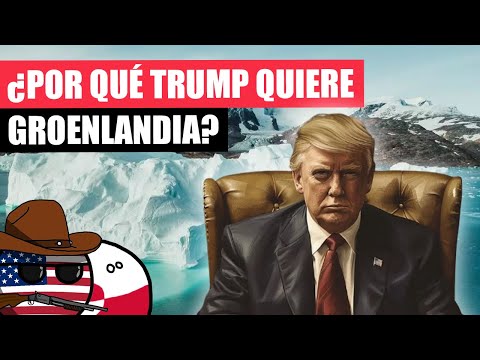
✅ ¿Por qué TRUMP necesita GROENLANDIA? | La guerra por el ÁRTICO explicada
Greenland: A Resource-Rich Yet Inhospitable Territory
Overview of Greenland's Political Status
- Greenland is a vast island rich in natural resources, including rare earth elements and oil, yet it remains one of the most inhospitable places on Earth.
- It operates as an autonomous territory within the Kingdom of Denmark, having gained self-governance through laws enacted in 1979 and expanded in 2009.
- The local parliament (Inatsisartut) consists of 31 members, while the executive government (Naalakkersuisut) is led by a Prime Minister. Defense and foreign policy are still under Danish control.
Geographical Significance and Strategic Value
- Covering over 2 million km², Greenland is the world's largest island; however, 84% of its landmass is covered by ice up to 3 km thick.
- Denmark claimed nearly 1 million km² of Arctic territory in 2004, which includes areas contested by Russia and Canada. This region holds significant strategic value due to its location between North America, Russia, and Europe.
Demographics and Socioeconomic Challenges
- With a population density of only 0.14 people per km², Greenland has a sparse population that is significantly smaller than Denmark's despite being much larger in area.
- The local populace faces numerous challenges such as low educational levels, lack of infrastructure (no roads), negative trade balance heavily reliant on fishing, high alcoholism rates, and elevated suicide rates.
Economic Dependency and Resource Exploitation
- There’s a growing sentiment among some inhabitants that Denmark may be more problematic than beneficial; major political parties advocate for economic autonomy.
- Historically significant for mineral exploitation since the mid-19th century with resources like copper and cryolite; mining expanded to include zinc, lead, silver from the early to late 20th century.
Oil Exploration and Environmental Concerns
- Oil exploration began in the 1970s but was halted before resuming in the '90s due to substantial offshore reserves estimated at half of global reserves.
- The potential economic impact from these resources could be profound; however, reliance on oil can lead to adverse outcomes if not managed properly.
Infrastructure Needs vs. Economic Viability
- Effective resource extraction requires robust infrastructure; many mining sites are hard to access which complicates operations due to limited labor availability and high transportation costs.
Uranium Mining Controversy
- Although uranium mining was previously banned by Denmark for safety reasons related to nuclear energy concerns, this ban was lifted briefly before reinstating it amid environmental worries linked with rare earth mining projects.
Rare Earth Elements Potential
- Greenland possesses about 10% of global rare earth elements; Quarner Suite may become one of the largest mines globally for both rare earth elements and uranium.
This structured overview captures key insights into Greenland's unique geopolitical status while highlighting its socio-economic challenges amidst resource wealth.
The Future of Greenland's Independence and Global Interests
Current Status of Uranium and Rare Earth Exploitation
- The uranium and rare earth exploitation has been canceled, but the debate about the future of the mine remains open. This discussion involves not only the few indigenous people in the region but also major global powers who have a stake in it.
Desire for Independence vs. Quality of Life
- Recent surveys indicate that there is a majority desire for independence among Greenlanders, provided it does not lead to a decline in their quality of life. The country is heavily subsidized, making resource exploitation seem like a viable path to achieving independence. However, this situation is complicated by a lack of experienced political leaders in Greenland.
Vulnerability and Support Needs
- An emerging Inuit state could be very vulnerable in an unstable global context, requiring solid backing that may not differ significantly from what Denmark currently offers. U.S. support could enhance Greenland's claims over 895,000 km² of Arctic Ocean territory, which conflicts with Canada and Russia's claims.
Geopolitical Interests: United States
- The U.S. views mineral resources and strategic positioning in the Arctic as crucial for its control efforts in the region. Good relations with Greenland are noted, along with geological ties to North America; military presence is also significant (e.g., Thule Air Base). Historical interest dates back to President Andrew Johnson’s acknowledgment of Greenland’s importance in 1860 and Truman’s 1946 offer to buy it for $100 million in gold.
China's Strategic Positioning
- China considers itself an almost Arctic power despite being geographically distant compared to Russia and the U.S., focusing on Greenland as key to its polar silk road initiative which would shorten transport times between Asian and European ports significantly while providing an alternative route to Malacca Strait. Chinese investments present an opportunity for Greenlanders to reduce dependence on Denmark while supporting nationalist aspirations on the island through mining initiatives aligned with China's geopolitical goals. Projects include rare earth extraction at Baneckfield among others.
Russia's Military Dominance
- Although Russia plays a less prominent role concerning Greenland specifically, it maintains significant military presence throughout the Arctic region using Soviet-era facilities; it dominates northern shipping routes considered vital by Moscow for national communication channels despite these routes currently lacking viability compared to alternatives like Malacca Strait—this dynamic contributes to ongoing tensions among major powers vying for control over largely uncharted territories as climate change opens new opportunities for exploration and commerce globally.
Emerging Cold War Dynamics
- A new cold war appears underway among major powers including the U.S., EU, Russia, and China over control of previously unexplored areas within the Arctic Circle—a conflict that could escalate into broader confrontations given rising stakes tied directly into global trade dynamics shaped by technological advancements alongside climate change impacts reshaping traditional maritime routes historically dominated by land-based pathways such as those established during colonial eras involving Portuguese-Spanish trade networks across Asia via Africa until modern developments shifted focus towards more efficient maritime solutions post-Suez Canal completion around 1869 facilitating faster connections between continents today amidst evolving geopolitical landscapes marked increasingly by competition rather than cooperation moving forward into uncertain futures ahead where potential flashpoints abound across various fronts impacting international relations overall going forward into next decades ahead potentially leading toward unforeseen consequences if left unchecked or unresolved adequately through diplomatic means instead relying solely upon military might alone without addressing root causes underlying tensions driving conflicts arising therein ultimately affecting all parties involved directly or indirectly alike regardless thereof ultimately shaping outcomes yet unseen still unfolding gradually before our eyes now presently unfolding continuously onward henceforth indefinitely thereafter too!
The Importance of the Arctic
Key Reasons for Arctic Significance
- The Arctic serves as a crucial commercial route between Asia and Europe, with many ships from Asia destined for Rotterdam, Netherlands. This route's perceived length is influenced by the spherical representation of Earth on maps.
- The Arctic's extreme climate has resulted in limited exploration, leaving its natural resources largely untouched. This presents significant opportunities for major powers.
- Estimates suggest that the Arctic may contain around 90 billion barrels of oil, equating to approximately 13% of known global reserves, potentially rivaling Middle Eastern supplies. Shell has already invested heavily in Arctic explorations.
- In addition to fossil fuels, the Arctic is believed to hold diamonds (notably mined in Canada), gold, rare earth elements, and abundant fish stocks due to melting ice opening new fishing territories.
Territorial Claims and Geopolitical Tensions
- The competition over the Arctic involves Denmark, Canada, Russia, Norway, and the United States making territorial claims based on maritime law regarding continental shelves extending beyond 320 km from coastlines.
- Russia is currently leading in preparations for control over the region with strategic air patrols and a robust fleet of over 40 icebreakers. Their goal includes increasing traffic along new shipping routes significantly by 2024.
- The U.S. maintains a different stance than Russia; it advocates for international waters while conducting NATO military exercises in the region to assert its interests against Russian advances.
Canada's Position and Denmark's Interests
- Canada asserts ownership over its archipelago and claims that parts of Lomonosov Ridge are connected to its continental shelf. However, this claim faces opposition from multiple nations including Russia and the EU.
- To defend its claims against incursions from other countries like the U.S., Canada has begun militarizing its presence in disputed areas.
- Denmark has invested significantly in research regarding its continental shelf north of Greenland and claimed an extensive area that includes Lomonosov Ridge. Notably, past political events such as Trump's interest in purchasing Greenland have heightened tensions surrounding these territorial disputes.
Arctic Navigation and Global Interests
Norway's Role in Arctic Navigation
- Norway is home to the Svalbard archipelago, which houses the World Seed Bank, a crucial facility for preserving biodiversity against potential global catastrophes.
- The country has successfully reached an agreement with Russia regarding its borders in the Barents Sea, resolving a long-standing dispute.
China's Emerging Influence in the Arctic
- Despite being 900 miles from its coast, China has developed an Arctic policy and aims to engage in this new commercial route.
- China operates an icebreaker and has acquired licenses from Russia to exploit oil resources in the Arctic, indicating a strategic partnership for resource extraction.
Economic Motivations Behind Russian-Chinese Cooperation
- Russia recognizes its economic limitations and views China as a vital investment partner for developing technologies and infrastructure necessary for large-scale resource extraction.
- In December 2017, Putin invited Xi Jinping to connect China's Silk Road with the Arctic route, proposing a "Polar Silk Road" that would benefit both nations economically.
Environmental Concerns and Activism
- Greenpeace's symbolic actions have significant global repercussions, influencing public opinion against Arctic resource exploitation and potentially affecting Western democratic policies.
Future Implications of Arctic Control
- As technological advancements continue and ice melts, military escalation over control of Arctic resources is anticipated. The question remains whether the U.S., Europe, and Canada can counteract Russian expansionism and Chinese influence.