(Production Possibility Frontier/Curve, PPF, PPC) Why can't things be free?
Why Can't Things Be Free?
Understanding Finite Resources
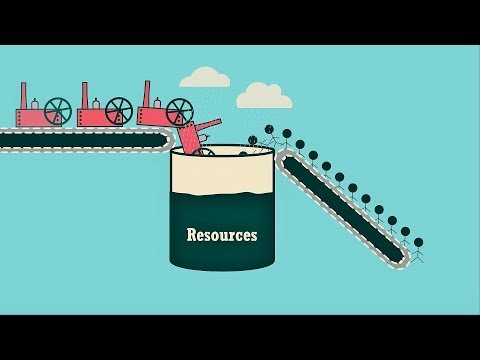
- The speaker introduces the concept of finite resources, emphasizing that while desires may be infinite (e.g., fish, water, cars), the actual availability of these resources is limited.
- Key resources mentioned include land, labor, and capital, which are essential for production but are not limitless.
Production Possibility Curve
- The discussion shifts to the production possibility curve (PPC), illustrating trade-offs in resource allocation. For example, producing tablets instead of bread demonstrates opportunity costs.
- The opportunity cost is quantified: giving up 500 units of bread to produce one tablet results in an opportunity cost of 10 bread per tablet.
Inverse Relationship in Production
- As more tablets are produced, less bread can be made; this inverse relationship highlights the scarcity principle in economics.
- The model's limitations are discussed—resources like labor and machinery vary in efficiency and capability. This leads to a concave PPC rather than a straight line.
Efficiency and Capability
- Initially efficient workers (e.g., those with engineering PhDs) yield high productivity. However, as production increases and less skilled workers are employed, efficiency declines significantly.