Lecture 1-Mobile
Meeting Introduction and Recording Details
Meeting Setup
- The meeting is not conducted on the usual channel, indicating a need for alternative communication methods.
- The speaker expresses intent to collaborate with attendees through shared links.
- Acknowledgment of recording issues; a link will be sent out later for access to the meeting content.
Scheduling and Attendance
- Future meetings will be scheduled weekly for each team, ensuring everyone has access to recordings individually.
- Introduction of participants, including Michael Ibrahim, who emphasizes previous interactions.
Overview of Mobile Communication Networks
Course Content
- Discussion on mobile and wireless communication networks as part of the curriculum for third-year students.
- Focus on historical evolution from first generation (1G) to fifth generation (5G), highlighting potential exam formats.
Exam Preparation
- Emphasis on understanding key concepts rather than rote definitions; likely exam questions will be true/false or multiple-choice.
Evolution of Mobile Communication
Historical Context
- Mobile communication has significantly expanded globally over the past 40 years.
- Reference to Ericsson's report indicating 8 billion mobile subscriptions worldwide.
Generational Changes
- Transition from basic voice calls in earlier generations to essential mobile services today.
- New generations emerge approximately every ten years, reflecting technological advancements.
First Generation (1G)
Characteristics of 1G
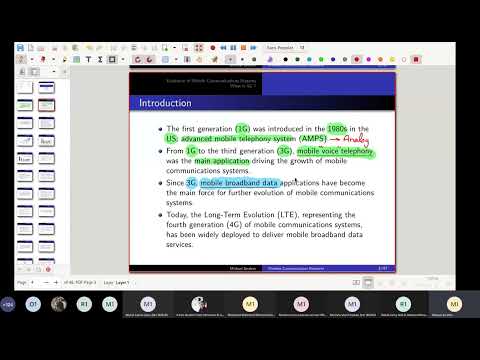
- Introduced in the 1980s as Advanced Mobile Telephony System (AMPS).
- Utilized analog signals with FM modulation for voice communication only.
Advancements Through Generations
From 2G to 3G and Beyond
- Shift towards data transmission began with 3G, enhancing internet browsing capabilities compared to earlier technologies.
Current Trends in Data Usage
- Modern applications require higher bandwidth and faster speeds due to increased demand for video streaming and online activities.
Understanding LTE and Its Importance
Long Term Evolution (LTE)
- LTE represents a significant leap in mobile broadband data services, focusing on both voice and data transmission needs.
Emerging Applications with 5G
- New applications are emerging that leverage the capabilities of 5G technology beyond traditional uses.
Fourth Industrial Revolution Impact
Technological Integration
- The integration of machines and advanced technologies is reshaping industries during this revolution.
Internet of Things (IoT)
- IoT demands new requirements from wireless communications systems like 5G.
Key Scenarios in Enhanced Mobile Broadband
Application Requirements
- Enhanced Mobile Broadband focuses on high data rates necessary for modern applications such as video conferencing.
Low Latency Needs
- Applications requiring low latency include remote surgeries where real-time responsiveness is critical.
Diverse Application Requirements
Flexibility in Network Design
- Networks must adapt flexibly to support various application requirements ranging from high data rates to ultra-reliable low-latency communications.
Evolution of Mobile Communication Technologies
Introduction to Mobile Communication
- The discussion begins with the early days of computers and their evolution into mobile communication systems.
- In the 1990s, the introduction of 2G technology marked a significant shift towards digital communication (GSM).
- This era initiated the concept of digital communication, paving the way for more advanced technologies.
Transition to 3G Technology
- The conversation shifts to 3G technology, which emerged around the year 2000.
- Users began to experience internet browsing capabilities on mobile devices, enhancing connectivity.
- Voice over IP (VoIP) became integrated into mobile networks, allowing for more efficient data transmission.
Packet Switching vs. Circuit Switching
- The transition from circuit switching to packet switching is highlighted as a crucial development in network efficiency.
- Circuit switching was primarily used for voice calls while packet switching allowed larger data volumes for internet use.
- Packet switching enables multiple data packets to traverse different paths across a network, optimizing bandwidth usage.
Advancements in Data Rates
- By 2010, advancements led to fourth-generation (4G LTE), significantly increasing data rates up to hundreds of megabits per second.
- High data rates facilitated streaming services and online gaming experiences due to improved bandwidth availability.
Emergence of 5G Technology
- In 2020, the rollout of 5G technology began, promising even higher speeds and lower latency.
- The concept of "Internet of Everything" emerged, aiming for seamless connectivity among smart homes and cities.
Future Prospects: Beyond 5G
- Discussions about future technologies like Beyond 5G and potential developments in sixth-generation (6G).
- Predictions suggest that by 2030, new standards will emerge that could revolutionize connectivity further.
Historical Context: From Analog to Digital
- A brief overview highlights how mobile phones evolved from analog systems in the late '80s through various generations up until now.
- The introduction of smartphones like the iPhone in 2007 marked a pivotal moment in mobile technology evolution.
Understanding Network Protocol Types
- Two main protocols are discussed: TCP (Transmission Control Protocol), which ensures reliable delivery; and UDP (User Datagram Protocol), which allows faster transmission at the cost of reliability.
This structured summary captures key insights from discussions on mobile communication technologies while providing timestamps for easy reference.
Understanding Digital Communication and Its Evolution
The Basics of Communication
- Discusses the significance of understanding communication, emphasizing its various forms and implications.
- Highlights the presence of messages in all interactions, indicating that communication is omnipresent.
- Introduces the concept of "communication" and its relevance in modern contexts.
Quality in Digital vs. Analog Communication
- Compares quality between digital and analog systems, noting that noise affects both but differently.
- Questions assumptions about digital superiority over analog due to inherent noise issues present in both systems.
Discrete Amplitudes and Signal Processing
- Explains discrete amplitudes as a foundational concept for understanding signal processing in digital communications.
- Describes how voltage levels (e.g., 0.5V, 2.5V) determine logical states (Logic 1 or Logic 0), crucial for binary communication.
Noise Management Techniques
- Discusses challenges faced by analog communication due to continuous amplitude variations leading to potential errors.
- Emphasizes the importance of separating noise from signals in receivers for effective communication.
Error Detection and Correction
- Introduces error detection and correction mechanisms as vital features of digital communication systems.
- Asserts that digital systems generally offer higher quality than first-generation analog systems due to these capabilities.
Advancements from First Generation to Second Generation
Transitioning Technologies
- Notes differences between early mobile technologies compared to current standards, highlighting advancements in compatibility across networks.
Introduction of SMS and Multimedia Messaging
- Discusses how SMS, MMS, and voice messages have contributed significantly to mobile phone popularity.
The Emergence of GSM Technology
GSM Standards Overview
- Identifies GSM as a key standard for second-generation mobile technology with data rates up to 9.6 kbps introduced in the 1990s.
Data Packet Switching
- Explains how packet switching technology became essential for data connectivity within third-generation networks.
The Role of Internet Connectivity
Enhancements with 3G Technology
- Highlights improvements brought by 3G technology enabling services like Voice over IP which were not feasible before.
Standardization Efforts in Mobile Communications
UMTS Development
- Introduces Universal Mobile Telecommunications System (UMTS), a significant advancement within third-generation standards established around 2001.
Exploring CDMA Technology
Multiple Access Techniques
- Clarifies different multiple access techniques such as TDMA, FDMA, and CDMA used across generations for efficient spectrum utilization.
Transitioning from Third Generation to Fourth Generation
Real-Time Streaming Capabilities
- Discusses how fourth generation allows real-time video streaming which was challenging under previous technologies.
New Services Enabled by High Data Rates
- Mentions new services like high-definition video streaming made possible through advancements in data rates with fourth generation technology.
Mobile Communication Evolution and 5G Insights
Overview of Mobile Generations
- Discussion on the transition from previous mobile generations, focusing on aspects like channel characteristics and fading types.
- In 4G, the target data rate is around 100 Mbps, influenced by various bandwidth options available in LTE.
- Introduction of LTE Advanced as a higher standard (4.5G), aiming for improved speeds up to 1 Gbps.
Evolution of Voice and Data Services
- The evolution from 1G (analog voice only) to 4G (digital voice with data services), highlighting key milestones such as SMS and MMS integration.
- In 4G, voice is transmitted as data packets through the Evolved Packet Core (EPC), contrasting with earlier generations where voice used circuit switching.
Transition to 5G
- Introduction to discussions about the upcoming generation, 5G, emphasizing its significance in current projects.
- Expectations for 5G include much higher data rates, lower latencies, greater capacity, and support for diverse applications.
Key Applications of 5G
Enhanced Mobile Broadband Services
- Focus on enhanced mobile broadband services that enable advanced technologies like augmented reality and virtual reality.
Ultra-Reliable Low Latency Communication
- This application is crucial for industries requiring high reliability and low latency, such as autonomous vehicles and industrial automation.
Massive Machine Type Communication
- Characterized by a large number of devices with low cost and power consumption requirements; ideal for IoT applications in smart homes and cities.
Flexibility in Network Design
- Emphasis on flexibility within the network architecture to adapt to varying application requirements dynamically.
- Introduction of Software Defined Networking (SDN), separating hardware from software functionalities to enhance adaptability.
Technical Requirements for 5G
- Overview of IMT 2020 specifications outlining expectations for performance improvements over previous generations.
- Anticipated enhancements include tenfold increases in data rates compared to 4G while achieving significantly lower latency levels.
This structured summary captures essential insights into mobile communication's evolution towards the anticipated capabilities of 5G technology.
تقسيمة الفريقونسي
Overview of Frequency and Bandwidth
- Discussion on the importance of precise frequency allocation in communication systems.
- Mention of the ability to exceed standard frequency limits for enhanced performance.
- Introduction to the concept of data rates and their relation to bandwidth.
Digital Modulation and Spectral Efficiency
- Explanation that different types of digital modulation have varying spectral efficiencies, which is crucial for optimizing signal transmission.
- Reference to specific modulation schemes that can achieve higher data rates within the same bandwidth.
5G Technology and Its Requirements
- Emphasis on the need for 5G networks to exhibit high spectral efficiency while maintaining low latency.
- Overview of OFDM (Orthogonal Frequency Division Multiplexing) as a foundational technology for 5G, with enhancements for improved performance.
Latency and Reliability in Communication
- Discussion on latency requirements across different applications, highlighting the need for ultra-reliable low-latency communication (URLLC).
- The network's flexibility to adapt to various latency needs based on application demands is crucial.
Machine Learning and Data Analysis in 5G
- Inquiry into whether networks should utilize machine learning or AI to adapt to their environments.
- Acknowledgment that while machine learning may not yet be standard in 5G, it could play a significant role in future generations of mobile networks.
Components of 5G Networks
- Introduction to the key components of 5G networks, focusing on radio access and core network functionalities.
- Explanation of how the radio access network connects users' devices with base stations, facilitating wireless communication.
5G Radio Access and Spectrum Flexibility
Introduction to 5G Technology
- The discussion begins with an overview of the Third Generation Partnership Project (3GPP), which is crucial for understanding 5G technology.
- The focus is on 5G radio access, highlighting its significance in modern telecommunications.
Key Features of 5G
- One of the primary features discussed is Spectrum Flexibility, allowing 5G to utilize multiple frequency bands effectively.
- Unlike previous generations (4G, 3G), which were limited to specific spectrum bands, 5G can operate across various spectrums, enhancing its application potential.
Duplexing Options in 5G
- The concept of Flexible Duplexing is introduced, explaining how it allows switching between Time Division Multiplexing (TDM) and Frequency Division Multiplexing (FDM).
- Simplex communication is contrasted with duplex communication, emphasizing the ability to transmit and receive simultaneously in duplex systems.
Spectrum Utilization Challenges
- The speaker notes that while 5G can operate from sub-1 GHz up to millimeter wave bands (30 - 300 GHz), there are challenges related to coverage and signal strength at higher frequencies.
- A significant issue raised is the current spectrum crunch, where lower frequency ranges are congested, necessitating a shift towards utilizing higher frequency bands.
Coverage and Signal Strength Considerations
- As frequency increases, power received decreases due to propagation losses; thus, more base stations are required for adequate coverage.
- The discussion highlights that while millimeter waves offer high data rates, they have limited range compared to lower frequencies like sub-1 GHz.
Transition Between Frequencies
- The ability of 5G networks to switch seamlessly between different frequency bands based on user needs—high data rates versus broader coverage—is emphasized as a key advantage.
- This flexibility allows operators to optimize network performance according to varying application requirements.
This structured summary captures essential insights from the transcript regarding the advancements and challenges associated with 5G technology. Each point links back directly to relevant timestamps for further exploration.
5G Propagation and Link Budget Analysis
Overview of Frequency Bands
- The discussion introduces the different frequency bands used in 5G technology, specifically highlighting three main categories: Low Band, Mid Band, and High Band. Each band has distinct propagation characteristics that affect signal transmission.
Free Space Loss Concept
- The concept of free space loss is introduced as a critical factor in understanding signal degradation over distance.
- A significant equation related to free space loss is mentioned, emphasizing its importance in calculating losses when signals travel through free space.
Impact of Frequency on Signal Loss
- It is noted that power loss due to free space propagation is proportional to the square of the frequency (f²), which will be proven during the lecture.
- As frequencies increase (e.g., at 30 GHz), the losses become substantial, leading to smaller cell coverage areas compared to lower frequencies like those used in 4G.
Cell Size and Coverage Implications
- The small cell sizes required for 5G operating at millimeter wave frequencies are discussed, contrasting them with larger cells used in previous generations like 4G.
- The session aims to teach how to calculate these parameters effectively for practical applications.
Link Budget Fundamentals
- An introduction to link budget calculations is provided, explaining how transmitted power and receiver gain play crucial roles.
- Free Space Propagation Loss is reiterated as a key component affecting overall link performance.
Understanding Signal Strength and Distance Effects
Relationship Between Distance and Loss
- It’s explained that signal loss increases with distance; thus, longer distances result in greater losses. This relationship also holds true for frequency variations.
Frequency Considerations
- At millimeter wave frequencies, higher losses are expected compared to lower frequencies under similar conditions. This highlights challenges faced by high-frequency transmissions.
Data Rate vs. Coverage Trade-offs
- While millimeter waves can provide higher bandwidth and data rates, they come with reduced coverage area due to increased path loss.
Bandwidth Efficiency in Different Frequencies
Sub-GHz vs. Higher Frequencies
- Sub-GHz bands are suitable for wide-area coverage but offer limited data rates compared to higher frequency bands which provide better efficiency but require more infrastructure due to their shorter range.
Spectral Efficiency Expectations
- Predictions indicate that 5G could achieve significantly improved spectral efficiency—upwards of twenty times greater than previous technologies—leading to enhanced data rates even within constrained bandwidth scenarios.
Core Network Functions Explained
Core Network Responsibilities
- The core network facilitates end-to-end connectivity between devices by managing calls and ensuring proper routing based on user location within various cells.
Mobility Management Insights
- Mobility management ensures seamless transitions between cells as users move; this function is vital for maintaining service quality during mobility events such as driving or commuting via public transport.
This structured markdown file captures essential insights from the transcript while providing clear timestamps for reference.
5G Core Network Flexibility and Virtualization
Importance of Flexibility in 5G Core Networks
- The 5G Core Network requires flexibility to adapt to a wide range of services and varied performance requirements.
- Flexibility is more pronounced in the core network compared to radio access networks, allowing for detailed discussions on its implementation.
Achieving Flexibility
- Achieving flexibility involves critical components that enhance adaptability within the network architecture.
- Specific functions, such as mobile switching centers, are essential for maintaining mobility within the network.
Hardware and Software Separation
- Each component interacts with specific functions, emphasizing the separation between hardware and software in 5G networks.
- The concept of "Network Soft Weaverization" allows for complete software integration into all aspects of networking.
Software Defined Networks (SDN)
Overview of SDN
- Software Defined Networks (SDN) separate control from data planes, enabling centralized management across various hardware devices.
- Once configured, controllers can automatically manage switches and routers without manual intervention.
Programmable Networking
- Programmable switches allow for dynamic routing based on latency or data rate requirements, enhancing overall network efficiency.
Network Function Virtualization (NFV)
Understanding NFV
- Network Function Virtualization refers to replacing traditional hardware-based routers and switches with virtualized instances.
- This virtualization enables greater flexibility by allowing multiple virtual machines to operate on shared physical resources.
Benefits of NFV
- NFV facilitates rapid deployment of new services while reducing costs associated with physical hardware maintenance.
Network Slicing in 5G
Concept of Network Slicing
- Network slicing represents a manifestation of previous concepts discussed, optimizing resource allocation for different service types within the same infrastructure.
Implementation Challenges
- Creating virtual machines tailored for specific applications like low-latency communication enhances service reliability but poses challenges in management.
Future Directions and Course Structure
Upcoming Topics
- Future lectures will cover wireless channel impairments and frequency planning relevant to 2G/3G technologies alongside MIMO techniques.
Course Logistics
- Discussions about scheduling future classes indicate an emphasis on accommodating student needs while ensuring comprehensive coverage of course material.