How does Satellite Television work? | ICT #11
Satellite Television and Broadcasting
This video explores how satellite television works and the financial aspects of the broadcasting business. It also explains why there is no buffering in TV broadcasts like there is in internet videos.
Understanding Satellite TV Broadcasting
- The Earth revolves around the Sun in an elliptical orbit and rotates on its own axis.
- The satellite used for TV broadcasting should rotate at the same speed as the Earth to maintain a fixed position relative to your house.
- This requires the satellite to be placed in a geostationary orbit, which is approximately 42,164 kilometers above the Earth's surface.
- All satellites used for satellite TV purposes are parked in this orbit.
Components of a Satellite
- Satellites derive their energy from solar panels, but they also have battery packs for operation when not facing the sun.
- Satellites have small engines called thrusters that help maintain their orientation and position due to irregularities in the Earth's gravitational field.
- The transponder is an essential part of a satellite for communication purposes. It receives signals from base stations, amplifies them, removes noise, and transmits them back to Earth at a different frequency.
Ku Band Signals and Rain Interference
- Ku Band signals are commonly used for satellite TV as they have good power and allow for smaller receiver antennas compared to C Band signals.
- In earlier days, C Band signals were used but required larger antennas. However, Ku Band signals can be affected by rain.
- Scientists have made improvements in satellite technology to overcome rain interference issues with Ku Band signals.
How TV Channels Reach Your Home via Satellite TV
- TV channels act as program sources that produce content for mass viewing.
- These channels beam their signals to rented transponders in geostationary orbit, inserting advertisements as a source of income.
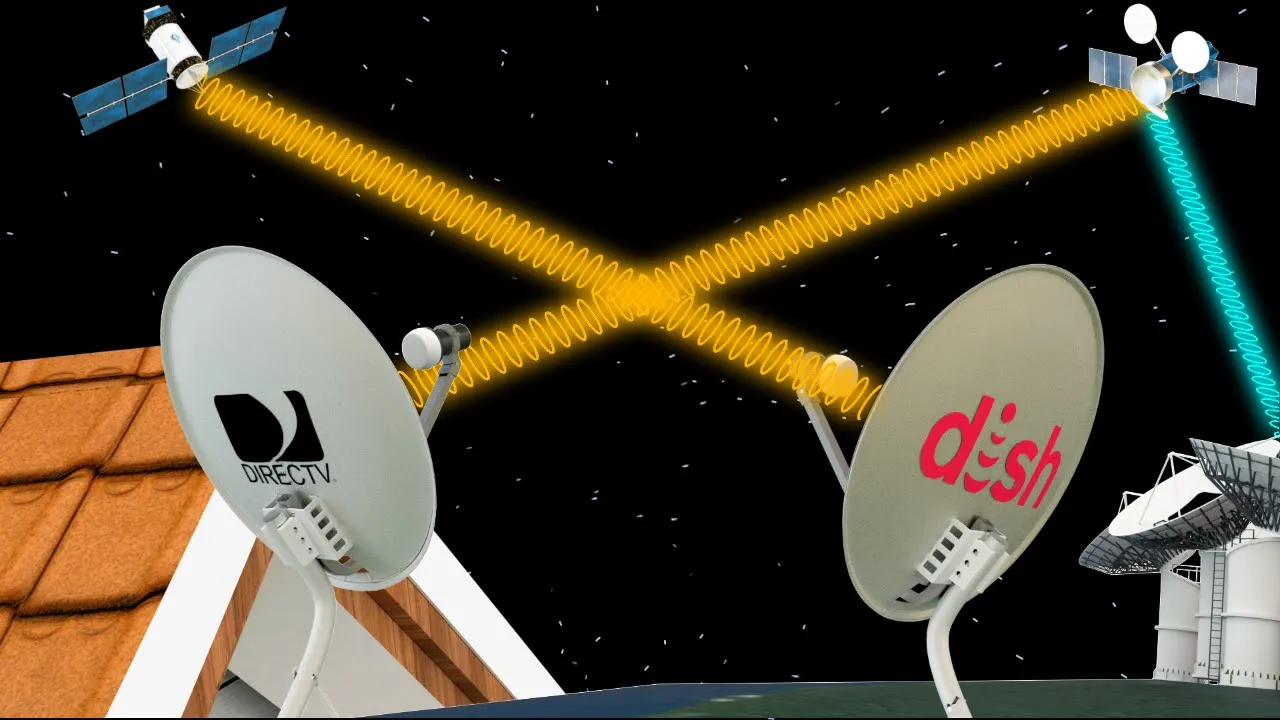
- DBS providers collect signals from multiple program sources and broadcast them after video formatting, compression, standardization of bit rate, and encryption.
- The DBS provider's satellite transmits the signals to end users who need to angle their dish antennas towards the specific DBS provider's satellite.
Conclusion
- Different DBS providers may use different satellites for transmitting their signals, which is why dish angles can vary even at the same location.
Timestamps are approximate and may not be 100% accurate.
Do you know that the live events you are watching on your satellite television are actually delayed by a few seconds?
This section discusses the delay in live events on satellite television and the reasons behind it.
Delay in Satellite Television
- The signal leaving the broadcast center has to travel a huge distance via two satellites before it reaches the viewer.
- Even though the signal travels at the speed of light, such a huge distance causes a delay of around 0.5 seconds.
- Additionally, live broadcasters may add a specific profanity delay on top of the normal delay.
Comparison between internet videos and satellite TV
This section compares internet videos and satellite TV in terms of buffering and traffic handling.
Buffering on Internet Videos vs Satellite TV
- Both television and internet technologies transmit data in a digital format as zeros and ones.
- On satellite television, there is no buffering like what is seen on YouTube or Facebook videos.
- The reason for this is that TV broadcasters offer only 300 to 400 channels or video streams, allowing users to select from a small collection.
- On the other hand, the demands of each user on the internet are very different with millions of videos available to choose from.
- The volume of traffic handled by TV broadcasters is much lower compared to internet traffic, which can lead to congestion and buffering issues.
Traffic congestion and buffering on the internet
This section explains how high levels of internet traffic can cause congestion and buffering.
Internet Traffic Congestion
- The huge level of traffic on the internet can sometimes cause congestion and buffering.
- Unlike satellite TV with limited channels, there are millions of videos available online, leading to varying demands from users.
- This high volume of traffic contributes to congestion issues on the internet.