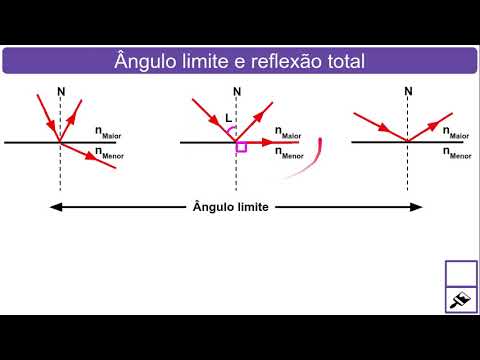
Refração da luz: Ângulo limite e reflexão total. 3/4
Reflection Total: Understanding the Concept
What is Reflection Total?
- The term "reflection total" indicates that all incident light undergoes reflection, ceasing refraction.
- Reflection occurs when light transitions from a more refractive medium to a less refractive one, but this is just one of several prerequisites for total reflection.
Conditions for Total Reflection
- Not every transition from a more to a less refractive medium guarantees total reflection; it must meet specific conditions.
- A visual example illustrates how light behaves when moving from higher to lower refractive indices, showing both refraction and reflection.
The Role of Angles in Total Reflection
- Adjusting the angle of incidence can lead to scenarios where only reflection occurs, demonstrating the concept of an "angle limit."
- The angle limit represents the boundary between refraction and total reflection; exceeding this angle results in only reflection.
Calculating the Angle Limit
- To find the angle limit, use the formula involving indices of refraction: sine of the angle limit equals the index of refraction of the less dense medium divided by that of the denser medium.
- For instance, if an angle limit is calculated as 30 degrees, angles below this will result in both refraction and reflection while angles above will yield only total reflection.
Practical Applications and Importance
- Understanding these principles is crucial for applications like fiber optics, where total internal reflection plays a key role.