Systèmes Répartis | 09 - Etat Global d'un SR
Global State Determination in Distributed Systems
Introduction to Global State
- The speaker introduces the concept of determining the global state of a distributed system, emphasizing its importance for detecting properties and characterizing executions.
- It is noted that performance measurements can be taken, which help capture states that serve as recovery points in case of failures.
Challenges in Observing Global States
- The difficulty of observing a global state in distributed contexts is highlighted due to the lack of a common clock and shared memory among components.
- The speaker discusses how this lack of synchronization complicates simultaneous observations across multiple sites.
Defining Local and Global States
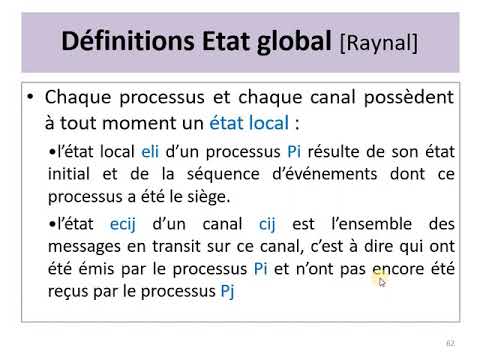
- A coherent global state consists of local states from various sites and communication channels, which carry messages exchanged between these sites.
- Each process at every site maintains a local state influenced by its initial conditions and the sequence of events it undergoes.
Events and State Transitions
- Local states are described as resulting from initial conditions and event sequences; transitions occur based on internal processes.
- The concept of message transit is introduced, where messages emitted by one process may not yet be received by another, affecting overall system state.
Understanding Event Types
- Definitions related to processes are discussed, including how events lead to changes in local states within distributed systems.
- The distinction between local events (internal to a site) and their impact on overall system dynamics is emphasized.
This structured approach provides clarity on key concepts surrounding global state determination in distributed systems while linking directly back to specific moments in the transcript for further exploration.
Understanding Message Reception and State Changes in Distributed Systems
The Nature of Message Reception
- The discussion begins with the acknowledgment that a dramatic event has already occurred, indicating that message reception is contingent on prior states within the system.
- It highlights how data reception can lead to state transitions, emphasizing that the receiving site will undergo changes based on incoming messages.
Local vs. Global Observations
- The concept of local observability is introduced, where an observer can only perceive the state of a process locally, not globally.
- It is noted that global observers cannot access instantaneous information about all processes due to inherent limitations in observation capabilities.
Implications of Local States
- The text discusses how immediate observations are limited to local contexts and cannot reflect global states accurately.
- A critical point made is that the overall state of a distributed system comprises all local states from various processes and channels.
Event Emission and Reception Dynamics
- The relationship between emitted messages and their reception at different sites is explored, stressing the importance of understanding these dynamics for coherent system behavior.
- Conditions under which events are emitted or received are discussed, particularly focusing on scenarios where messages may not be captured effectively.
Consistency and Coherence in Distributed Systems
- The notion of "cut" in distributed systems is introduced as a way to define consistent states across different components.
- A "coherent cut" refers to a set of events that maintain consistency with respect to past events within the system's history.
Characterization of Cuts
- Cuts are characterized by their ability to remain closed concerning past events; this closure ensures no inconsistencies arise from historical interactions.
- An example illustrates how cuts relate to message receptions and emissions, reinforcing their significance in maintaining coherent system operations.
This structured overview captures key insights from the transcript while providing timestamps for easy reference.
Understanding Vectorial Stamping and Event Management
Overview of Recent Events and Systematic Challenges
- The speaker discusses the recent events related to a specific site, emphasizing the challenges posed by system biases that affect event management.
- A reference is made to "estampé vectorielle," indicating its importance in geographical assessments and how it relates to managing events effectively.
- The speaker provides an example involving a location (Marina Baie des Anges), illustrating inconsistencies in event reliability and management practices.
- There is mention of causal relationships between events, highlighting the need for consistency in handling these occurrences within the established framework.
- The discussion touches on various elements associated with vectorial stamping, including specific identifiers for recent events and their implications.
Key Elements of Vectorial Stamping
- The concept of "estampé victor" is introduced, which plays a crucial role in associating different elements within the event management system.
- The speaker elaborates on legal aspects concerning substratum elements involved in vectorial stamping, stressing their significance in maintaining order during events.
- An analysis of equality among certain variables is presented, showcasing how discrepancies can arise within systematic evaluations.
- The necessity for thorough verification processes is emphasized to ensure consistency when studying historical data related to vectorial stamping.
- Finally, the speaker invites questions from the audience regarding any unclear points or further clarifications needed about the discussed topics.