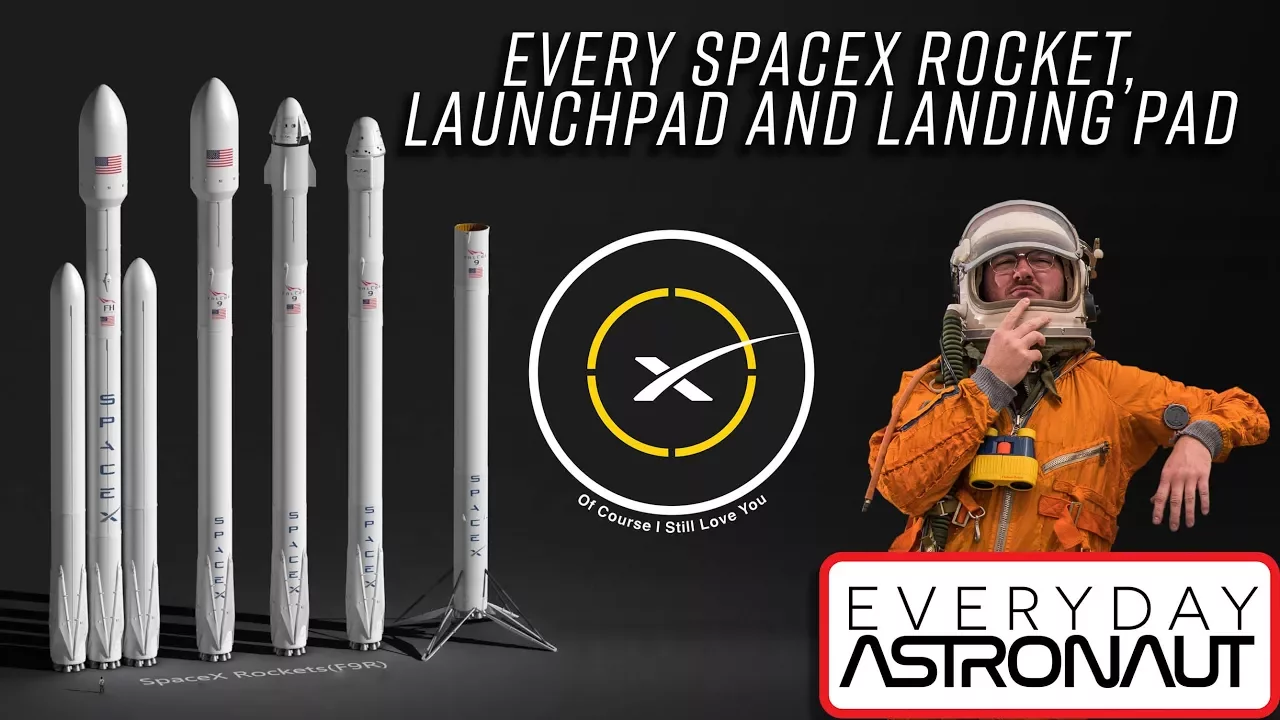
Complete SpaceX Guide Part I - What rockets SpaceX launches, where they launch & where they land
A Complete Guide to SpaceX's Webcasts
In this section, Tim Dodd, also known as the Everyday Astronaut, introduces the topic of SpaceX's webcasts and provides an overview of what will be covered in the guide.
Introduction to SpaceX's Webcasts
- SpaceX has gained popularity by providing well-produced live webcasts of their launches.
- They have revolutionized access to rocket launches and set a new standard for other companies.
- SpaceX is a private rocket and spacecraft company founded by Elon Musk in 2002.
- They have developed some of the largest and most powerful rockets currently flying.
- SpaceX has achieved autonomous landing and reusability of their rockets' first stages, which is a significant accomplishment.
- The company has increased its launch frequency over the years and is on track to surpass all other US competitors combined.
Knowing When SpaceX Launches
This section explains how to stay updated on upcoming SpaceX launches.
Staying Updated on Launch Schedules
- Follow SpaceX and Elon Musk on Twitter for regular updates.
- Visit www.reddit.com/r/spacex or spaceflightnow.com for up-to-date launch schedules.
- Download the Launch Alarm app for notifications about upcoming launches.
- Join Tim Dodd's live streams of SpaceX launches for real-time updates and Q&A sessions.
What to Expect During a Live Stream
This section describes what viewers can expect when watching a live stream of a SpaceX launch.
Live Stream Sequence
- The webcast starts about 20 to 30 minutes before the intended launch time with SpaceX radio playing music by "Test Shot Starfish."
- A promotional intro video is shown around 10 to 20 minutes before T minus zero.
- The host provides updates on the mission and other launch details.
- The live stream typically features a single host who gives a simple rundown of the launch.
- The camera shows shots of the rocket on the pad, ready for launch.
SpaceX Rockets
This section provides an overview of the different rockets launched by SpaceX.
Falcon 9 and Future Rockets
- Currently, SpaceX primarily launches their two-stage Falcon 9 rocket.
- Falcon 9 has been their workhorse vehicle since its first launch in 2010.
- SpaceX plans to introduce two future rockets: Falcon Heavy and Big Falcon Rocket (BFR).
- Falcon Heavy is expected to be three Falcon 9 rockets combined, with similar thrust to the historic Saturn V moon rocket.
- BFR/ITS is anticipated to be the largest rocket ever flown but may not launch before 2022.
Previous SpaceX Rockets
This section discusses previous rockets developed by SpaceX.
Falcon 1
- Prior to Falcon 9, SpaceX developed a smaller rocket called Falcon 1.
- Falcon 1 had one Merlin engine on its first stage and a vacuum optimized engine known as Kestrel on its second stage.
New Section
This section discusses the success of SpaceX's Falcon 1 rocket and its importance in securing contracts. It also mentions the launch pad in Kwajalein, Marshall Islands, which has remained unused since 2009.
Falcon 1 Success and Launch Pad
- The success of Falcon 1 was crucial for SpaceX to secure contracts.
- Falcon 1 launched from a small launch pad in Kwajalein, Marshall Islands.
- The launch pad has remained unused since 2009.
New Section
This section provides information about the launch pads used by SpaceX for Falcon 9 missions.
Launch Pads for Falcon 9
- The inaugural launch of Falcon 9 took place at Space Launch Complex 40 (SLC-40) in Cape Canaveral Air Force Station, Florida.
- SLC-40 is adjacent to Kennedy Space Center on Merritt Island.
- SLC denotes the launch pad on the Air Force side, while LC denotes the launch pad at Kennedy Space Center.
- SLC-40 is recognizable by its four large lightning towers and relatively flat design.
New Section
This section focuses on Space Launch Complex (SLC)-40 as the primary site for SpaceX launches. It also mentions an incident that caused SLC-40 to be offline temporarily.
SLC-40 and Incident
- SLC-40 is the site of the majority of SpaceX launches.
- It is used for launches heading to Low Earth Orbit, Geostationary orbit, or sun synchronous orbit.
New Section
This section discusses an incident that occurred at SLC-40 resulting in its temporary shutdown.
Incident at SLC-40
- On September 1st, 2016, a Composite Overwrapped Pressure Vessel (COPV) exploded inside the second stage of a Falcon 9 rocket during fueling.
- This caused a complete loss of the vehicle and its payload, the Amos-6 satellite.
- SLC-40 has been offline since then but is expected to return online by late summer 2017.
New Section
This section provides information about Vandenberg Air Force Base as another launch site for SpaceX.
Vandenberg Air Force Base
- SpaceX acquired launch pad SLC-4 at Vandenberg Air Force Base in central California.
- The first Falcon 9 launch from Vandenberg took place on September 28th, 2013, for the Cassiope mission.
- Launches from Vandenberg typically head southward and are often on polar or sun synchronous orbits.
New Section
This section mentions future plans for Vandenberg Air Force Base and introduces LC-39a at Kennedy Space Center.
Future Plans for Vandenberg and LC-39a
- SpaceX plans to launch and maintain an upcoming global internet satellite constellation from Vandenberg, potentially leading to several launches per year.
- LC-39a at Kennedy Space Center is referred to as historic due to its association with moon missions and Space Shuttle launches.
New Section
This section provides details about LC-39a at Kennedy Space Center and its significance in space exploration history.
LC-39a at Kennedy Space Center
- SpaceX officially leased LC-39a on April 14, 2014.
- LC-39a was used for human missions to the moon as well as numerous Space Shuttle launches.
New Section
This section shares a personal experience at LC-39a and describes its recognizable features.
Personal Experience at LC-39a
- The speaker was present during the lease signing of LC-39a and even took a selfie with SpaceX president, Gwynne Shotwell.
- LC-39a is easily recognizable by the remains of the Space Shuttle Fixed Service Structure (FSS) and Rotating Service Structure (RSS).
New Section
This section discusses the modifications made to LC-39a by SpaceX and its future use for crew access.
Modifications to LC-39a
- SpaceX has modified LC-39a but has been slow to dismantle the large rotating service structure.
- The fixed service structure will remain and function as the new crew access tower for future astronauts.
New Section
This section highlights additional features of LC-39a, including lightning protection and a large Horizontal Integration Facility.
Additional Features of LC-39a
- A 24.4-meter (80-foot) lightning mast provides lightning protection to the vehicle and pad.
- There is a large Horizontal Integration Facility with "SPACEX" written on the side, capable of housing multiple cores simultaneously.
New Section
This section mentions SpaceX's launch history from LC-39a since February 2017.
Launches from LC-39a
- Since February 19th, 2017, SpaceX has conducted eight launches from LC-39a in just six months.
SpaceX Launch Sites
This section provides an overview of SpaceX's launch sites and their future plans.
SpaceX Launch Sites
- SpaceX has three launch sites, including Cape Canaveral Air Force Station (LC-40), Vandenberg Air Force Base (SLC-4E), and Kennedy Space Center (Pad 39A).
- Pad 39A is being converted for Falcon Heavy flights and will be used for launches to Low Earth Orbit (LEO) and Geostationary orbit.
- In the future, SpaceX plans to establish a new launch site called South Texas Launch Site in Boca Chica, Texas. This will be their first entirely private space launch facility.
Flight Paths and Missions
This section discusses the flight paths and missions of SpaceX launches.
Flight Paths and Missions
- Launches from Cape Canaveral (LC-40) and Kennedy Space Center (Pad 39A) are primarily heading to LEO or Geostationary orbit.
- Occasionally, they also undertake sun synchronous or interplanetary missions.
- The flight paths from Boca Chica will have some limitations due to the presence of Caribbean islands, Florida, and oil platforms. However, it is suitable for LEO launches as well as Geostationary or interplanetary missions.
Landing Pads and Autonomous Spaceport Drone Ships
This section explains the landing pads used by SpaceX for rocket landings.
Landing Pads
- SpaceX currently has two landing pads: LZ-1 at Cape Canaveral and another landing pad at Vandenberg.
- These sites have smaller pads around the primary pad specifically designed for Falcon Heavy missions where two cores return to land simultaneously.
- SpaceX also utilizes two autonomous spaceport drone ships (ASDS) named "Of Course I Still Love You" and "Just Read The Instructions" for landing rockets at sea.
Smoke from Rockets
This section addresses the presence of smoke during rocket launches.
Smoke from Rockets
- The smoke observed during rocket launches is caused by the boil-off of liquid oxygen.
- Liquid oxygen boils at extremely low temperatures (-183 degrees Celsius or -297 degrees Fahrenheit).
- As the rocket sits on the ground, ambient air heats up the liquid oxygen, causing it to boil off and create visible smoke or steam.
- Venting this boiled-off oxygen prevents over pressurization of the tanks and ensures safety.
Webcast Details and Viewer Opinions
This section discusses specific details about SpaceX's webcasts and seeks viewer opinions.
Webcast Details and Viewer Opinions
- Part two of "a complete guide to SpaceX's webcasts" will cover what viewers see during the countdown and hear over the radio.
- Viewers are encouraged to share any questions they have about SpaceX's webcasts for inclusion in future parts of the series.
- The presenter asks for opinions regarding wearing a flight suit throughout the video or opting for different combinations, seeking feedback through a poll.
Feedback on Wearing Flight Suit
This section focuses on gathering viewer opinions regarding wearing a flight suit during videos.
Feedback on Wearing Flight Suit
- The presenter seeks feedback on whether they should wear their iconic flight suit throughout the entire video or opt for different combinations, including not wearing it at all.
- A poll is provided for viewers to express their preferences.
Conclusion and Acknowledgments
This section concludes the video and acknowledges Patreon supporters.
Conclusion and Acknowledgments
- The presenter thanks Patreon supporters for their contributions, which help create content like this video.
- Viewers are encouraged to visit the Everyday Astronaut webstore for merchandise.
- The music used in the video is original and available for free download on SoundCloud.
- The presenter expresses gratitude to the audience and concludes the video.