Quantum Mechanics and the Schrödinger Equation
Introduction to the Schrodinger Equation
In this section, Professor Dave introduces the Schrodinger equation and its significance in quantum mechanics.
The Wave-Particle Duality of Matter
- Energy is quantized, and light exhibits wave-particle duality.
- De Broglie extended this duality to include matter, meaning that all matter has a wavelength.
- An object's wavelength is inversely proportional to its mass.
- Electrons are incredibly small and have a relevant wavelength, so they must be viewed as both particles and waves.
Standing Waves in Atoms
- Electrons in atoms can be regarded as circular standing waves surrounding the nucleus.
- A circular standing wave must have an integer number of wavelengths to exist.
- The Bohr model for the hydrogen atom emerges from considering different numbers of wavelengths in the standing wave.
Quantization of Energy Levels
- An electron in an atom can only inhabit a discrete set of energy levels due to the quantization of energy.
- When an electron absorbs a photon with specific energy, it is promoted to a higher energy state with more wavelengths in the standing wave.
Wave Function and Probability Amplitude
- Erwin Schrodinger developed his Schrodinger equation in 1925 to describe the wave behavior of electrons.
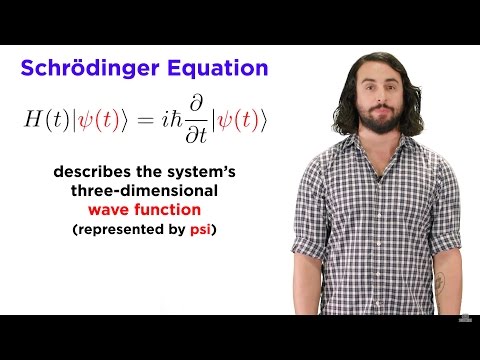
- The Schrodinger equation calculates the three-dimensional wave function represented by psi (Ψ).
- Max Born proposed interpreting the wave function as a probability amplitude.
- The square magnitude of the wave function describes the probability of finding an electron at a particular location.
Conceptual Implications of the Schrodinger Equation
In this section, Professor Dave discusses some conceptual implications of the Schrodinger equation and interpretations of quantum mechanics.
Hamiltonian Operator and Total Energy
- The Schrodinger equation incorporates the Hamiltonian operator, which describes all interactions affecting the state of a quantum system.
- The Hamiltonian operator can be interpreted as the total energy of a particle.
Probabilistic Nature of Quantum Mechanics
- The Schrodinger equation determines the wave function deterministically but provides probabilistic information.
- Nature is probabilistic on the most fundamental level, as illustrated by experiments like the double-slit experiment.
- Different interpretations of quantum mechanics exist, involving various views on the relationship between the wave function, experimental results, and the nature of reality.
Conclusion
Professor Dave concludes by mentioning Werner Heisenberg and invites viewers to continue exploring quantum mechanics.
Further Exploration
- Werner Heisenberg's contributions to quantum mechanics will be discussed in future videos.
- There are different interpretations of quantum mechanics, and no firm consensus has been reached yet.
- Viewers are encouraged to subscribe to Professor Dave's channel for more tutorials on physics.
Timestamps have been associated with relevant sections in accordance with their provided timestamps.