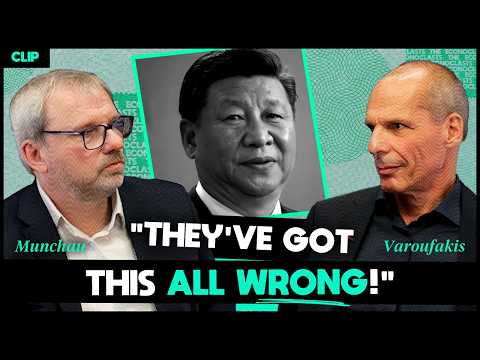
China's real plan for the dollar - Yanis Varoufakis & Wolfgang Munchau | The Econoclasts
China's Currency Ambitions: A Challenge to the Dollar?
Introduction to the Discussion
- The hosts, Janisuakis and Wulf Kanga, introduce the topic of whether China is actively pursuing the replacement of the American dollar with its own currency.
- They reference various financial publications discussing China's potential to replace the US dollar as a dominant global currency.
Understanding Reserve Currency Dynamics
- The concept of a reserve currency is explained; it is not only used by central banks but also demanded globally for transactions unrelated to American goods or services.
- The "exorbitant privilege" of the dollar is highlighted, emphasizing its role in international trade, particularly in oil transactions.
Decline of U.S. Economic Hegemony
- Discussion on how the U.S. economy has diminished in industrial dominance and how this affects perceptions of its currency.
- The argument posits that while China may want to reduce U.S. influence through sanctions, it does not seek to make its currency a global reserve.
Misconceptions About China's Intentions
- The hosts argue against the notion that China aims to emulate America's dominance through its currency; instead, they suggest China seeks different methods for economic influence.
- They clarify that while China wants to diminish dollar dominance, it does not intend for its own currency to take over as a single global standard.
Future Financial Landscape Considerations
- There’s speculation about entering an era where no single currency dominates due to advancements like cryptocurrency and blockchain technology.
- Historical perspectives on monetary dominance are discussed, suggesting that past frameworks may no longer apply in today's evolving financial landscape.
Chinese Economic Interests and Risk Management
- A conversation with a Chinese official reveals concerns about reliance on any single banking system or currency amidst potential crises.
- Various interests within China (e.g., big tech vs. heavy industry exporters) show differing reactions towards threats against the dollar's status and highlight risk management strategies regarding diversification away from USD.
Stable Coin Crisis and BRICS Payment Systems
Potential Issues with Stable Coins
- Discussion on the looming crisis surrounding stable coins, highlighting the risks involved in their implementation.
- Mention of China's central bank digital currency (CBDC) and its implications for global finance.
BRICS Payment Infrastructure
- Introduction of a new payment system by BRICS that operates on blockchain technology, distinct from Bitcoin and private currencies.
- Explanation of how this system allows transactions among BRICS nations using their own currencies, bypassing traditional systems like SWIFT.
Comparison to Western Financial Systems
- Critique of SWIFT as an outdated method for international money transfers, likening it to an archaic email system for financial institutions.
- Observation that while China prefers limited use of alternative systems, recent geopolitical events have increased their necessity.
Diversification from Dollar Dependency
- Analysis of China's strategy to diversify trade relationships away from reliance on the US dollar when dealing with countries like Brazil and Russia.
- Acknowledgment that while there is potential for growth in these alternative systems, clarity in China's long-term financial strategy remains uncertain.
The Role of Currency in Global Economics
- Discussion on why China may not want the renminbi to become a leading global currency due to associated responsibilities and market liberalization concerns.
- Insight into how becoming a reserve currency could limit China's control over its monetary policy.
Shared Perspectives Between Economists
- Notable similarities between views held by Trump's economic advisors and some Chinese officials regarding the burdensome nature of being a reserve currency issuer.
- Examination of how this perspective frames the US dollar's role as both a privilege and a burden within global economics.
Implications for Future Economic Strategies
- Commentary on Trump's approach to monetary policy, emphasizing actions over rhetoric as more indicative of his administration's stance.
- Reflection on historical economic issues tied to dollar dominance, including de-industrialization in America linked to globalization trends.
Global Currency Dynamics and China's Strategy
The Future of the Dollar as a Global Currency
- The U.S. does not aim to weaken the dollar's status but seeks to manage its global responsibilities while encouraging diversification in currency use.
- Various global players, including China and Europe, are shifting their roles, leading to reduced reliance on the dollar for transactions.
- A future discussion is planned regarding why the dollar's reserve currency status has been crucial for the U.S., indicating its importance beyond macroeconomic consensus.
China's Monetary Strategy and Global Positioning
- There is uncertainty about China's strategy under President Xi regarding international monetary systems; discussions suggest a potential plan B amid escalating tensions with the West.
- Conversations hint at a possible new Bretton Woods-like system centered around China if financial crises necessitate decoupling from Western economies.
Capital Controls and Reserve Currency Status
- The notion that capital controls preclude having a reserve currency is challenged; historical context shows that such controls existed during the original Bretton Woods system.
- A proposed system could involve controlled exchange rates among BRICS nations, allowing for trade without full reliance on fixed rates or unrestricted capital flows.
Current Economic Challenges Facing China
- Despite understanding global economic dynamics, there appears to be no fully developed strategy within China regarding reducing dependence on the dollar.
- Chinese leadership prioritizes industrial independence over financial strategies due to significant investments in dollars and concerns about potential crashes.
Implications of Financial Crises on Currency Regimes
- Future discussions about currency regimes will likely intensify during financial crises, potentially altering opposition stances as urgency increases.
- Speculation exists that geopolitical moves (e.g., Taiwan) may occur before any significant shift towards a BRICS currency emerges.
Understanding Economic Models and Global Trade
Critique of Current Economic Models
- The speaker expresses disappointment in the lack of insightful discussions among economists regarding the dollar and its relationship with capital and trade flows, noting that only certain groups (like the Chinese and Trump supporters) seem to engage meaningfully with these topics.
- A liberal participant shares their unease about current economic conditions, suggesting that traditional global macroeconomics is inadequate for understanding the complexities of today's economy.
- The discussion highlights a failure of global macroeconomic predictions, particularly regarding Trump's tariffs, which were expected to cause inflation and a collapse in trade but did not materialize as forecasted.
- The speaker argues that both macroeconomic models and monetary theories are flawed; they fail to account for financial dominance and unprecedented innovation shaping modern economies.
- There is a call for reassessment of economic issues outside traditional frameworks, emphasizing that mainstream macroeconomists often overlook critical factors affecting economies today.
Flaws in Traditional Economic Assumptions
- The speaker critiques the IS-LM model used in teaching economics, arguing it incorrectly assumes investment always equals savings without sufficient proof or consideration of real-world discrepancies.
- This assumption leads to erroneous consensus within economic theory, necessitating a debunking of widely accepted yet fundamentally flawed economic models to better understand contemporary realities.
Conclusion on China's Position
- It is concluded that while China does not aim to replace the dollar, it actively seeks independence from U.S. sanctions, indicating a strategic approach towards maintaining its economic sovereignty.