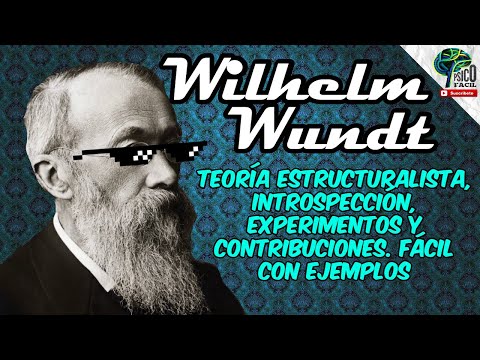
WILHELM WUNDT | PADRE DE LA PSICOLOGÍA |TEORÍA RESUMIDA CON EJEMPLOS Y EXPERIMENTOS FT. @psicovlog
Introduction to William Wundt
The introduction highlights William Wundt as the first experimental psychologist and his significant contributions to psychology.
William Wundt: The Pioneer
- William Wundt founded the first experimental psychology laboratory in Leipzig, Germany, marking the beginning of a scientific approach to psychology.
- He was a prolific writer, contributing extensively to experimental psychology, metaphysics, and social psychology.
- Wundt views psychology as the science of experience focusing on consciousness and immediate experience.
Wundt's Experimental Approach
This section delves into Wundt's experimental methods and his focus on immediate conscious experience.
Understanding Consciousness
- Wundt emphasized analyzing immediate experiences by identifying elements such as sensory perceptions or feelings.
- He conducted experiments measuring how many elements individuals could perceive simultaneously, highlighting limitations in immediate conscious experience.
Synthesis of Elements in Consciousness
Explores Wundt's concept of creative synthesis in consciousness and perception.
Creative Synthesis
- Wundt's experiments revealed that organizing elements like letters into words enhances perceptual capacity.
- Organized elements allow for greater cognitive processing compared to isolated elements like individual letters or words.
Perception and Integration
Discusses Wundts' theory on perception and integration of information in consciousness.
Perception Dynamics
- Introduces the concept of two levels of consciousness: total conscious experience versus focused attention on specific stimuli for forming concepts.
[Voluntarism in Conscious Experience](358 s)
Explores voluntarism in perception and how attention influences conscious experiences.
Voluntary Perception
- [](358 s) Demonstrates how attention affects perception through optical illusions, showcasing subjective interpretations based on selective focus.
Explanation of Psychological Theories
In this section, the speaker delves into the relationship between elements through perception and will. They discuss formulating laws based on subjective experiences and touch upon the limitations of experimental methods in studying psychological dimensions.
Determining Relationships Between Elements
- The speaker discusses how understanding the relationship between elements through perception and will allows for formulating laws based on subjective experiences.
Limitations of Experimental Methods
- Acknowledgment of the difficulty in experimentally measuring subjective experiences due to limitations in the experimental methods available during that time.
Historical and Cultural Analysis
- Emphasis on the necessity of historical and cultural analysis for studying higher conscious elements beyond simple conscious elements like sensations experimentally.
Psychology of Social Groups
This part focuses on exploring "Psychology of Social Groups" within the context of cultural development, language, myths, rituals, and their impact on individual psyche.
Cultural Development and Individual Psyche
- The speaker explains that culture represents human historical development, aiding in understanding individual psyche by studying language, myths, and customs as they reflect species evolution.
Importance of Myths and Rituals
- Myths and rituals are highlighted as crucial expressions reflecting affective perceptions creatively. They lead to a peak in perception termed "creative synthesis."
Evolution of Language
- Language is discussed with its dual aspects: external phenomena perceived or stated, and internal cognitive processes underlying word chains' formation.
Understanding Human Evolution Through Psychology
This segment delves into how human tribes evolved from basic expressions to complex thought systems through graphical representations evolving into modern language.
Evolutionary Progression in Human Thought Systems
- Human evolution is traced from basic mental configurations expressed through graphics to sophisticated thought systems represented by modern languages.
Study Approach for Complex Processes
- Due to limitations at that time, evaluating superior cognitive processes experimentally was challenging; hence historical-cultural analysis was preferred over experimental approaches.
Conclusion & Next Steps
The conclusion wraps up key points discussed by Dr. Mont regarding psychological theories while hinting at future explorations into schools like Kirchner's structuralism.
Wrapping Up Psychological Theories Discussion
Turn any video into a summary like this
YouTube links, meetings, lectures — with transcripts, search, and chat.