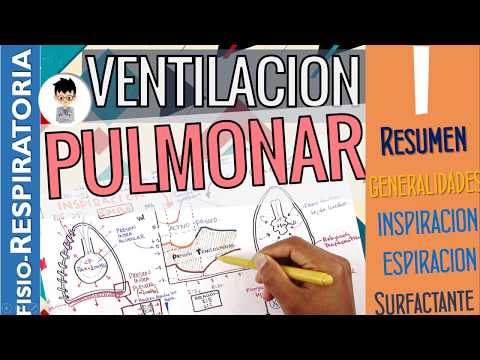
VENTILACIÓN Pulmonar, MECÁNICA RESPIRATORIA, INSPIRACIÓN ESPIRACIÓN, Fisiología Respiratoria | P1
Introduction and Overview
The video introduces the topic of respiratory physiology, specifically focusing on pulmonary ventilation, inspiration, and expiration.
Ventilation Pulmonar
- The video transitions to discussing pulmonary ventilation, emphasizing the importance of summarizing the topic for better understanding and exam preparation.
- Mechanica de la respiración is defined as the airflow from the atmosphere to the lungs during inspiration and vice versa during expiration.
- Essential anatomical structures required for the process include an airway for airflow passage, a rigid chest cavity provided by ribs, intercostal muscles for expansion support, and accessory muscles aiding in inspiration.
Anatomical Structures and Function
- The role of intercostal muscles in expanding the chest cavity during contraction is highlighted, along with accessory muscles supporting inspiration efforts.
- Discussion shifts to the phrenic nerve's role in innervating these respiratory muscles and ensuring their functionality.
- Details about lung parenchyma (functional part of lungs), alveoli (important for gas exchange), elastic tissue characteristics aiding lung retraction are explained.
Respiratory Processes
- The significance of anatomical structures in facilitating airflow movement for gas exchange is emphasized through processes like inspiration and expiration.
- Distinction between active (contraction-involved) inspiration and passive (elastic-recoil-driven) expiration processes is discussed alongside forced inspirations requiring accessory muscle involvement.
Function Tests and Diagnostic Tools
This section delves into tests used to study lung function such as spirometry, highlighting their relevance in diagnosing respiratory conditions.
Pulmonary Function Testing
- Spirometry is introduced as a diagnostic tool measuring air volume entering alveoli to assess lung function.
- Alterations in airflow or volumes can indicate obstructive (e.g., asthma, COPD) or restrictive (e.g., fibrosis) respiratory diseases respectively.
Gas Exchange Assessment
- Evaluating gas diffusion across alveolar-capillary membranes using techniques like gasometry aids in assessing lung function efficiency.
Detailed Explanation of Inspiratory Processes
In this section, the speaker delves into the detailed explanation of inspiratory processes, starting with basic physics concepts related to atmospheric pressure and moving on to discuss the mechanics of inspiration.
Physics Concepts and Atmospheric Pressure
- The atmospheric pressure at sea level is 760 mmHg.
- The pressure in a tube connected to the atmosphere is equal to atmospheric pressure.
- When there is a connection between a system and the ambient air, the pressures are equal.
Basal State and Inspiration Mechanics
- In the basal state, intraocular pressure equals atmospheric pressure.
- During inspiration, lung expansion leads to a decrease in alveolar pressure.
- Lung expansion causes external air pressure to be higher than alveolar pressure, resulting in airflow into the lungs.
Inspiratory Muscles and Pressure Changes
This section focuses on inspiratory muscles' role in lung expansion and how pressure changes facilitate airflow during inspiration.
Inspiratory Muscle Function
- Diaphragmatic contraction expands the lungs downwards while intercostal muscles expand them outwards.
- Simple inspiration involves diaphragmatic contraction and external intercostal muscle action.
Pressure Changes during Inspiration
- Alveolar pressure decreases during inspiration, allowing air entry into the lungs.
- Decreased intrapleural pressure aids in lung expansion by drawing pleural layers apart.
Forced Inspiration Mechanisms
The discussion shifts towards forced inspiration mechanisms involving additional muscle groups for increased airflow capacity.
Forced Inspiration Process
Anatomy and Physiology of Respiration
In this section, the speaker discusses the anatomy and physiology of respiration, focusing on muscles involved in expanding the chest and the process of expiration.
Muscles Involved in Chest Expansion
- The pectoral muscles, including the pectoralis minor and major, along with the serratus muscles, play a crucial role in expanding the chest laterally.
Process of Expiration
- During expiration, key muscles such as the scalene and sternocleidomastoid are engaged.
- Exhalation involves a decrease in thoracic space due to the closure of specific points leading to increased pressure within the thorax.
- The collapse or closing off of alveoli during expiration is facilitated by diaphragmatic relaxation.
Respiratory Processes
- Respiration is primarily a passive process due to elastic fibers and connective tissue aiding in lung recoil.
- Unlike inspiration which involves active contraction, expiration relies on passive processes like diaphragmatic relaxation and recoil mechanisms.