Lecture 13.2 Equilibrium Constant Equation
Lecture 13.2: Understanding the Equilibrium Constant
Goals of the Lecture
- The lecture aims to teach how to derive the expression for the equilibrium constant for any chemical reaction, including both homogeneous and heterogeneous reactions.
- Students will learn to calculate the equilibrium constant using concentration (molarity) or partial pressure, depending on whether the reactants are in aqueous solution or gaseous state.
- The relationship between the magnitude of an equilibrium constant and properties of a chemical system will also be explored.
Writing the Equilibrium Constant Expression
- The general form of an equilibrium reaction is presented as aA + bB rightleftharpoons cC + dD , where A and B are reactants, and C and D are products.
- The equilibrium constant ( K_C ) is defined as the ratio of product concentrations to reactant concentrations raised to their respective stoichiometric coefficients:
[
K_C = [C]^c[D]^d/[A]^a[B]^b
]
where brackets denote concentration in molarity.
Interpreting Equilibrium Constants
- If K > 1 , it indicates that products are favored at equilibrium; thus, reactions tend to proceed from left (reactants) to right (products).
- If K = 1 , neither reactants nor products are favored; forward and backward reaction rates are equal.
- If K < 1 , it suggests that reactants are favored, indicating a shift from right (products) back to left (reactants). This highlights that equilibrium does not imply equal concentrations of reactants and products.
Example Calculation of Equilibrium Constant
- An example reaction is provided with given concentrations for NO2 and N2O4 at equilibrium.
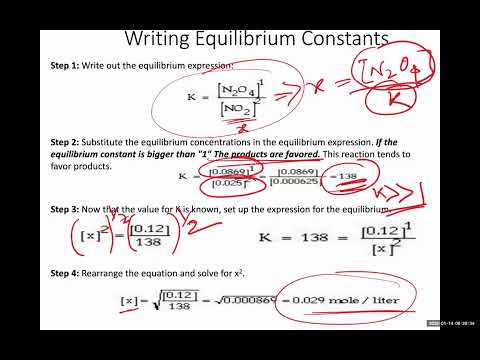
- To find K_C :
- Use the expression derived earlier:
[
K_C = [N_2O_4]/[NO_2]^2
]
- Substitute known values into this equation based on provided data:
- For instance, if [N2O4] = 0.08 M and [NO2] = 0.02 M, then calculations yield K_C = 138. This indicates a product-favored reaction since K >> 1.
Finding Concentration at Equilibrium
- A follow-up question involves determining what concentration of NO2 would result if N204's concentration was set at a specific value.
- This reinforces understanding by applying previously learned concepts about calculating equilibria based on initial conditions provided in problems.
Equilibrium Constant Calculations
Understanding Equilibrium Constants
- The equilibrium constant is calculated under the assumption that it remains unchanged for different cases, allowing for concentration calculations of NO2.
- By rearranging the equation, the unknown concentration (X) can be expressed as the concentration of N2O4 divided by the equilibrium constant (138), leading to a straightforward calculation.
- Taking the square root of both sides simplifies finding X, which represents the concentration of NO2 at equilibrium.
Writing Equilibrium Expressions
- The process begins with writing equilibrium expressions for various reactions; starting with O3 and O2 where K_eq = [O3]^2 / [O2]^3.
- For NH3 and N2 reactions, K_eq is represented as [NH3]^2 / ([N2] * [H2]^3).
- In HI reactions, K_eq is defined as [HI]^2 / ([H2] * [I2]).
More Complex Reactions
- For PCl3 and Cl2 reactions, K_eq = [PCl3] / [PCl5].
- SO3 and SO2 concentrations are related through their respective moles in K_eq = [SO3] / ([SO2]^1 * [O2]^(1/2)).
Adjusting Equilibrium Expressions
- To avoid fractional exponents in expressions, multiplying through by 2 allows simplification while maintaining equivalence in K'_eq.
- This adjustment leads to a new expression: K'_eq = ([SO3]^n)/([SO^n][O^m]), simplifying calculations.
Relationships Between Forward and Reverse Reactions
- Flipping an equation results in an inverse relationship between forward (K_F) and backward (K_B); thus, K_B = 1/K_F.
- When adding two equations together, such as A + B producing E and A + C producing D, the new equilibrium constant (K_new) equals the product of individual constants: K_new = K_1 * K_2.
Multiplying Equations by Coefficients
- If an equation is multiplied by a coefficient n, then its corresponding equilibrium constant becomes raised to that power: K_new = K^n.
Understanding Equilibrium Constants in Chemical Reactions
Concept of K Equilibrium
- The equilibrium constant (K) is affected by the stoichiometry of a reaction. If both reactants and products are multiplied by a constant value, the new equilibrium constant (K') will equal the old K raised to the power of n, where n is that constant.
- This means that if you multiply all coefficients in a balanced equation by 2, then K' becomes K^2. Understanding this relationship is crucial for solving problems related to equilibrium constants.
Application in Reaction Calculations
- The concept of calculating K is essential throughout the chapter. An example involves calculating K for the reaction between hydrogen and bromine atoms to form HBr.
- In this specific problem, three reactions are provided with their respective equilibrium constants: K1, K2, and K3. The task is to find the overall equilibrium constant for the desired reaction.
Manipulating Reactions
- To calculate K for HBr formation from hydrogen and bromine, one must consider reversing some reactions. For instance, if H2 dissociates into 2H, its reverse would be represented as 1/K2.
- Similarly, flipping another reaction also requires taking its inverse (1/K3). This manipulation allows combining multiple reactions to derive an overall equation.
Summation of Reactions
- By adding these manipulated equations together (equations 1 + 4 + 5), certain species cancel out—specifically hydrogen and bromine—resulting in a simplified final equation producing HBr.
- The calculation of the final equilibrium constant (K') involves multiplying all individual constants together: K' = K_1 times 1/K_2 times 1/K_3.
Transitioning Between Concentration and Pressure
- When dealing with gaseous species instead of aqueous solutions, it’s more convenient to express concentrations in terms of partial pressures rather than molarity.
- The notation changes from K_C, which represents concentration-based equilibrium constants, to K_P, indicating pressure-based constants while maintaining similar mathematical relationships.
Key Differences Between KC and KP
- While both K_C and K_P serve similar purposes in representing equilibria, they differ primarily in how concentrations are expressed—molarity versus partial pressure.
- In calculations involving partial pressures for gases, each component's pressure is raised to its stoichiometric coefficient when forming the expression for K_P.
This structured approach provides clarity on how chemical equilibria can be analyzed through various methods while emphasizing key concepts necessary for understanding chemical reactions.
Understanding Equilibrium Constants in Chemical Reactions
Importance of Equilibrium Constants
- The distinction between K_C and K_P is crucial, as they are temperature-dependent. This concept is fundamental for understanding chemical equilibria.
- Mastery of writing equilibrium constant expressions is essential for the semester, emphasizing its significance in future studies.
Obtaining Equilibrium Constants
- Experimental determination of equilibrium concentrations is necessary to calculate the equilibrium constant ( K_C ).
- A specific reaction example illustrates that initial concentrations of reactants (C and H₂) are known while product concentrations (CH₄ and H₂O) start at zero.
Calculating K_C
- After reaching equilibrium, measured concentrations allow for the calculation of K_C .
- Both concentration in molarity and partial pressure can be used to determine K_C , highlighting flexibility in measurement methods.
Consistency Across Reaction Directions
- Whether starting from reactants or products, the calculated value of K_C remains consistent at 3.93, demonstrating that directionality does not affect equilibrium constants.
- The same ratio at a given temperature confirms that initial conditions do not alter the final equilibrium state.
Characteristics of Equilibrium Constants
- The value of an equilibrium constant reflects the concentration ratios at equilibrium; it should only be derived from experimentally measured values when the system has reached this state.
- A large K -value indicates a higher concentration of products at equilibrium, while a small K < 1 suggests a predominance of reactants.
This structured overview provides clarity on key concepts related to chemical equilibria and their constants, facilitating better understanding and retention for students studying these principles.
Understanding Equilibrium Constants: KC and KP
Introduction to Equilibrium Constants
- The concept of equilibrium constants is crucial in understanding reactions, including solubility products and redox reactions. It's emphasized that students should pay close attention throughout the lecture and may need to revisit it for clarity.
Differences Between KC and KP
- KC is based on concentrations measured in molarity, while KP is based on partial pressures of reactants and products.
- It’s highlighted that KC and KP are not equivalent but maintain a specific relationship that can be calculated if one constant is known.
Relationship Between KC and KP
- The relationship between KC and KP will be established using familiar equations from previous topics like osmotic pressure.
- The ideal gas equation (PV = nRT) relates pressure to concentration, allowing conversion between the two forms of equilibrium constants.
Calculating Equilibrium Constant Expressions
- An example reaction involving carbon monoxide (CO), hydrogen (H2), methane (CH4), and water (H2O) illustrates how to write the equilibrium constant expression in terms of partial pressures.
- For this reaction, the expression for KP involves the partial pressures of CH4 and H2O divided by those of CO and H2 raised to their respective stoichiometric coefficients.
Mathematical Relationships
- A formula relating KP to KC includes the ideal gas constant (R), temperature (T), and change in moles of gaseous species (Delta n_g).
- Delta n_g is defined as the difference between moles of gaseous products and reactants, which influences the relationship between these constants.
Example Calculation: Finding KP from Given Values
- In an example where K_C = 280, at 1000 K with Delta n_g = -1, students learn how to calculate K_P.
- Using K_P = K_C cdot R^T cdot (Delta n_g), they find that K_P equals approximately 3.4, demonstrating that K_C does not equal K_P.
Further Application: Reaction Vessel Example
- Another scenario presents a mixture containing nitrogen (N2) and hydrogen (H2). Students are tasked with determining the composition at equilibrium given initial conditions.
This structured approach provides a comprehensive overview while linking directly back to specific timestamps for further exploration or clarification.
How to Calculate Equilibrium Concentrations
Understanding the IC Table
- The IC table represents initial moles of reactants and products, which are essential for calculating changes in their concentrations during a reaction.
- Initial conditions include 1 mole of nitrogen and 3 moles of hydrogen; at equilibrium, the product concentration is given as 0.080 moles.
Setting Up the Reaction
- At the start, there are no products formed (0 moles), and we assume an amount X of product forms over time.
- For every mole of product formed, since it’s a two-mole reaction, the change in concentration will be 2X.
Calculating Changes in Concentration
- The initial concentrations must be adjusted by subtracting X: nitrogen becomes 1 - X, while hydrogen adjusts to 3 - 3X.
- At equilibrium, nitrogen's concentration is 1 - X, and hydrogen's is 3 - 3X; ammonia's concentration remains at its provided value of 0.080.
Solving for Equilibrium Constant
- Given that ammonia's equilibrium concentration is known (0.080), we can express this as 2X = 0.080, leading to X = 0.040.
- Substituting back into our equations gives us nitrogen as 1 - X = 0.960 and hydrogen as 3 - 3(0.040).
Final Calculation Steps
- The equilibrium constant (K_eq) formula involves squaring ammonia’s concentration divided by the product of nitrogen and hydrogen concentrations raised to their respective powers.
- After calculations, we find that K_eq = (0.080)^2/(0.960)(2.88)^3 approx 2.8 times 10^-4, indicating a reaction favoring reactants due to being less than one.
Key Insights on Equilibrium Constants
- It’s important to note that throughout these calculations, the equilibrium constant remains unitless because all concentrations are expressed in terms relative to each other without specific units involved.
This structured approach provides clarity on how to calculate equilibrium concentrations using an IC table while emphasizing key concepts related to chemical equilibria and their implications in reactions.