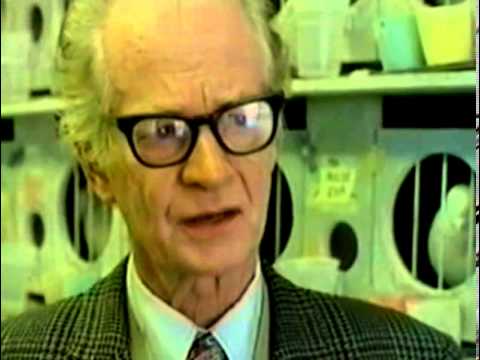
Dr. B.F. Skinner and Operant Conditioning
Can Pigeons Read?
This section discusses how pigeons can be taught to distinguish between words and behave accordingly through reward-based training.
Training Pigeons
- Pigeons can be trained to distinguish between two words and respond differently to each sign.
- The bird's behavior is shaped by controlling its environment and rewarding it with food.
- The first task is to isolate a specific behavior and observe how it can be changed.
Skinner's Experiment
- B.F. Skinner conducted an experiment using hungry pigeons as subjects.
- Food was used as an automatic reward, given when the pigeon exhibited the desired behavior.
- The pigeon was studied in a uniform box, where its pecking of a colored disc was measured on a graph.
Schedule of Reinforcement
- Skinner studied the relationship between pecking behavior and the frequency of rewards offered.
- Different schedules of reinforcement were used, such as reinforcing every tenth time or once every minute.
- Variable ratio schedule, effective with pigeons, is also found in gambling devices.
Implications for Humans
- Findings from pigeon experiments help interpret human behavior related to gambling.
- People gamble not because they punish themselves or feel excited but due to the schedule of reinforcement that follows their actions.
Free Will vs. External Causes
- Discovering external causes of behavior challenges the concept of free will.
- Internal states and feelings are not the initiators; external reasons play a significant role in our actions.
Science of Behavior
- Understanding the causes behind behavior allows us to dismiss free will as an imagined internal cause.
- The science of behavior aims to discover these causes and understand human actions better.
Timestamps have been associated with relevant bullet points based on their corresponding timestamps provided in the transcript.