How Voyager 2 Threaded The Needle Through Space
Voyager 2's Journey Through Our Solar System and Beyond
This video discusses the journey of the Voyager 2 space probe as it navigated through our solar system and beyond. It covers the physics behind its journey, including gravity assists and escaping the Sun's gravity.
The Challenge of Navigating Our Solar System
- The true scale of our solar system is impossible to comprehend, and navigating this huge expanse is anything but straightforward.
- In August 1977, the Voyager 2 space probe began an incredible lifelong journey that would take it all the way through our solar system and beyond.
Escaping the Sun's Gravity
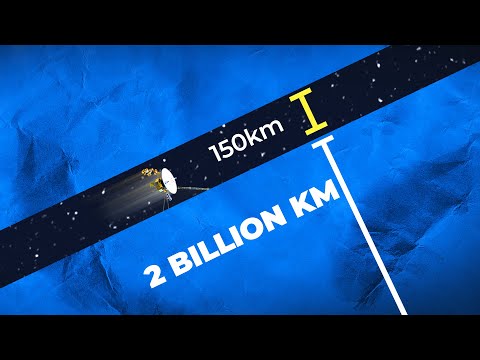
- To get to Neptune, Voyager 2 had to thread the needle through space, perform four gravity assists, and escape the Sun's gravity.
- Objects in space would be dragged straight into the Sun without velocity. If an object is traveling fast enough, it can outpace the sun's pull allowing it to completely break free and travel beyond our solar system.
- Since Earth is still relatively close to the Sun, Voyager needed a lot of energy to escape. None of the rockets around at that time were powerful enough to do this.
Gravity Assists
- Due to an incredible alignment of planets in our solar system in mid-60s, Voyager could use gravity assists to slingshot itself from planet to planet increasing its speed along the way.
- Under normal circumstances, Voyager would remain in orbit indefinitely but since it was trying to get a gravity assist from Jupiter, it aimed itself at Jupiter by threading itself through a small area around Jupiter.
Conclusion
Voyager 2's journey through our solar system and beyond was made possible by the clever use of gravity assists and escaping the Sun's gravity. Its journey has provided us with valuable insights into our solar system and beyond.
How Voyager Navigated Through Space
This section explains how NASA was able to navigate the Voyager spacecraft through space.
Thrusters and Orientation
- Five sets of thrusters were placed around the space probe, allowing Voyager to rotate around all three of its axes.
- The thrusters would fire tiny millisecond pulses rotating Voyager at around 0.3 degrees a second.
- Another set of identical thrusters could be fired for longer durations to alter Voyager's speed, allowing NASA to control its trajectory over time.
- To keep track of how much Voyager had rotated, it had an onboard gyroscope which could be used for several hours at a time.
Sun Sensor and Star Tracker
- Located on Voyager's antenna was a device called a sun sensor that detected the Sun as the brightest object in space and commanded Voyager to rotate until it locked onto it.
- In order to sort out the roll axis, a star tracker facing 90 degrees away from the sun sensor would look for a specific star which had a known level of brightness.
- Anytime Voyager passed by a planet its sun sensor would be temporarily blocked. Likewise, when Voyager rotated to take pictures of specific targets, both sensors would no longer be facing their reference points.
Trajectory Calculation
- In order to plot its trajectory, NASA needed to know how fast it was going. They did this by sending a signal out to Voyager and timing how quickly it would respond.
- With this incredible system, Voyager arrived at its Jupiter target point just 1.4 seconds late and only 60 km off course.
- If the space probe was a bit off, NASA could send a command to Voyager which would fire up its thrusters to fix it.
Gravity Assists
- As Voyager 2 approached Jupiter, its speed had slowed considerably to around 10 kilometers per second as it reached the top of its orbit. This was now well below the sun's escape velocity.
- Voyager went on to complete two more gravity assists around Saturn and Uranus before heading towards Neptune.
- The final gravity assist would be around Neptune, but this gravity assist would go a little bit differently.
Triton Flyby
- Scientists were very interested in flying as close as possible to Triton; one of Neptune's moons. But Triton orbits at a steep angle and so getting close would require a dramatic change of direction.
- From then on, Voyager began its lifelong journey into deep space.
Conclusion
This section concludes the transcript by summarizing the incredible journey that Voyager took through our solar system.
- The entire journey took 12 years in total and made incredible discoveries along the way.
- With all of these data points, NASA could continuously plot Voyager's trajectory and see how it compared to the desired trajectory.
- The spacecraft is now destined to escape our solar system and continue its journey into deep space.
Giveaway Announcement
In this section, the speaker announces a giveaway for an epic Saturn V framed print and provides instructions on how to enter.
Giveaway Details
- The speaker announces a giveaway for an epic Saturn V framed print.
- To enter the giveaway, viewers need to sign up at a provided link and leave a comment stating what they think will happen during Starship's first test flight.
Conclusion
- The speaker thanks viewers for watching and invites them to participate in the giveaway.