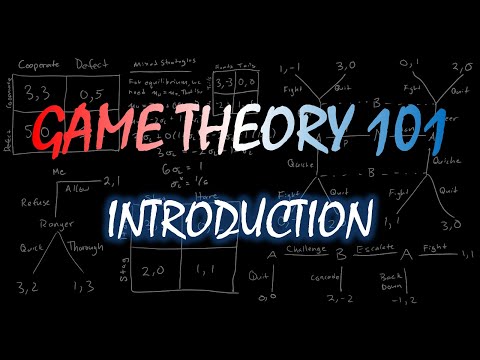
Game Theory 101 (#1): Introduction
Introduction to Game Theory
In this section, William Spaniel introduces the concept of game theory and its relevance in studying strategically interdependent behavior.
What is Game Theory?
- Game theory is the study of strategically interdependent behavior.
- It involves situations where one person's actions affect the outcomes of others and vice versa.
- Game theory extends beyond traditional games of winning and losing, encompassing situations where cooperation and competition coexist.
Why Study Game Theory?
- Developing logically sound theories for interactive behavior can be complex.
- Game theory provides accounting tools to ensure that conclusions follow from assumptions.
- Understanding game theory allows for drawing parallels between different situations, enhancing decision-making abilities.
The Importance of Studying Game Theory
In this section, William Spaniel explains why it is valuable to invest time in learning game theory.
Logical Soundness
- The logic of strategically interdependent situations can become extremely complicated.
- Studying game theory provides a framework with accounting standards to ensure logical coherence in theories.
Practical Applications
- Understanding game theory enables connecting seemingly unrelated situations.
- This ability enhances problem-solving skills and thinking on one's feet in various real-life scenarios.
Overview of the Lecture Series
In this section, William Spaniel outlines the three chapters covered in the lecture series on game theory.
Chapter 1: Simultaneous Move Games
- Simultaneous move games involve players independently deciding their strategies without observing others' choices.
- Examples include penalty kicks in soccer and decision-making at stoplights.
- Concepts covered include strict dominance, Nash equilibrium, best responses, mixed strategy Nash equilibrium, and weak dominance.
Chapter 2: Extensive Form Games
- Extensive form games involve players taking turns making moves.
- Examples include war and invasion plans, and police searches.
- Concepts covered include backward induction, perfect equilibrium, credible threats, tying hands, commitment problems, and forward induction.
Chapter 3: Advanced Strategic Form Games
- This chapter generalizes the concepts covered in Chapter 1.
- It allows for exploring questions like the impact of accuracy on penalty kick direction in soccer.
- Concepts covered include comparative statics, knife-edge equilibria, symmetric zero-sum games.
Prerequisites for the Course
In this section, William Spaniel discusses the prerequisites for studying game theory.
- While game theory can be logically demanding, it rarely requires more than high school algebra.
- Some familiarity with calculus is helpful but not essential.
Getting an A in the Course
The video congratulates the viewer on already achieving an A in the course and mentions that grades will not be discussed further. It also introduces the idea of a recommended textbook.
Recommended Textbook: "Game Theory 101: The Complete Textbook"
- The speaker recommends the textbook "Game Theory 101: The Complete Textbook" which they wrote to parallel the video series.
- The book contains more examples in every lesson compared to the video lectures.
- It is currently priced at $3.99 on Amazon, making it a cost-effective option.
- Unlike other textbooks, this book focuses on teaching game theory rather than assuming prior knowledge.
- It provides thorough explanations, step-by-step logic, and mathematical calculations.
Practical Reasons for Choosing the Recommended Textbook
- Most other textbooks act as reference manuals rather than teaching materials.
- This textbook is designed for learning game theory from scratch.
- It offers a user-friendly approach with detailed explanations and calculations.
- Chapters can be purchased individually or as a complete set.
Timestamps are provided for each section to help locate specific parts of the video.