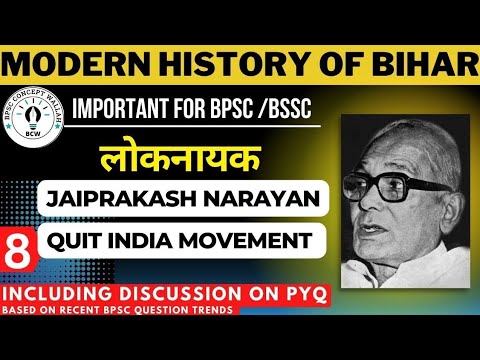
Jayaprakash Narayan & Quit India movement in Bihar l Lec#8
Lecture on Jayaprakash Narayan and the Quit India Movement
Introduction to Jayaprakash Narayan
- The lecture focuses on Jayaprakash Narayan (JP), highlighting his significance in Indian history, particularly in Bihar.
- JP is recognized as a national hero, often associated with the formation of the Azad Dasta and later becoming known as Lok Nayak.
Importance of the Quit India Movement
- The Quit India Movement is emphasized as a pivotal moment in India's struggle for independence, marking JP's rise to prominence.
- This movement is referred to as the "August Revolution," initiated by Mahatma Gandhi's call for immediate British withdrawal from India.
Key Events of the Quit India Movement
- The movement began on August 8, 1942, when Gandhi issued his famous slogan urging British authorities to "Quit India."
- Important leaders like Jawaharlal Nehru and Sarojini Naidu were arrested during this period, showcasing the government's crackdown on dissent.
Arrests and Reactions
- Notable figures such as Rajendra Prasad were detained under oppressive measures; their arrests sparked widespread unrest across Bihar.
- On August 9, Dr. Rajendra Prasad was arrested in Patna, leading to significant turmoil among local leaders.
Student Involvement and Protests
- Students played a crucial role during this time; they organized protests after their leaders were arrested.
- A notable incident involved students hoisting flags at government buildings, which led to violent confrontations known as the Secretariat Shooting Incident.
Legacy of Student Activism
- The actions taken by students during this period are remembered for their bravery and commitment to India's freedom struggle.
- Prominent student leaders emerged from these protests, leaving a lasting impact on Bihar's political landscape.
Key Figures and Events in the Quit India Movement
Overview of the Quit India Movement
- The movement saw significant actions, including raising the national flag at police stations in Siwan district, which led to violent confrontations.
- Important figures like Bhagwati Devi, who presided over women's activities during this period, are highlighted; she is noted for her connection to Rajendra Prasad.
Prominent Leaders
- Jayaprakash Narayan (JP), a central figure in the Quit India Movement, is recognized for his opposition to British rule and his advocacy for total revolution against Indira Gandhi's government.
- JP was imprisoned during the movement but escaped from Hazaribagh jail and fled to Nepal, where he organized guerrilla warfare against British forces.
Guerrilla Warfare Strategy
- In Nepal's Rajvillas jungle, JP formed a guerrilla army named "Azad Dasta" with associates like Surya Dev Narayan Singh and Lohia Ji.
- Training for guerrilla tactics was provided by notable revolutionary leaders such as Nityanand Singh.
Impact of Local Incidents
- A tragic incident involving a 13-year-old boy named Daru Pi highlights public outrage against British oppression; this event catalyzed further resistance efforts.
- The formation of a group named "Rudol" aimed at avenging the boy’s death reflects grassroots mobilization against colonial violence.
Regional Effects of the Movement
- Bihar emerged as one of the most affected regions during the Quit India Movement, alongside United Provinces (now Uttar Pradesh).
- Patna became a focal point where communication lines were disrupted significantly due to protests and resistance activities.
Legal Repercussions and Resignations
- Baldev Sahai, an advocate general in Bihar, resigned in protest against British atrocities during this tumultuous period.
- JP was released from Lahore jail on April 12, 1946; this date is commemorated as Jayaprakash Day.
Recognition and Awards
- JP received several accolades post-independence including the Ramon Magsaysay Award for public service in 1965 and was honored with Bharat Ratna in 1999.
Indira Gandhi and the Total Revolution
Historical Context of the Total Revolution
- The speaker references a significant event during Indira Gandhi's era, highlighting a massive gathering at Gram Leela Maidan with an audience of 100,000 to 150,000 people.
- A famous line by Ramdhari Singh Dinkar, "Sinhaasan khaali karo ki janta aati hai," is mentioned as being popularized by Jayaprakash Narayan (JP), linking it to the spirit of revolution.
Influence of Revolutionary Literature
- The speaker draws parallels between various revolutionary phrases and their origins, noting that while Harshad Mehta coined certain lines, they gained fame through figures like Bhagat Singh.
- The phrase "Sarfaroshi ki tamanna ab hamare dil mein hai" is attributed to Bismil Azimabadi but became well-known due to Ram Prasad Bismil's influence.
Contributions of Jayaprakash Narayan
- JP's literary contributions are discussed, particularly his book on socialism which faced destruction. His close association with prominent writers like Ramvriksh Benipuri is emphasized.
- The significance of Benipuri’s work titled "Jayprakash" is highlighted as an important piece in understanding JP's ideology and impact.
Labor Movements and Leadership
- The formation of a workers' association in Jamshedpur during the late 1920s is noted, led by trade union leaders Asian Halder and Vyomesh Chakraborty.
- JP played a crucial role in mediating during a major workers' strike at the steel plant in 1928, successfully advocating for worker demands against management.
Legacy and Recognition
- The discussion concludes with recognition of JP’s legacy; he is referred to as "Lok Nayak," similar to how Lokmanya Tilak was honored. This highlights his enduring influence on Indian politics and society.
Turn any video into a summary like this
YouTube links, meetings, lectures. With transcripts, search, and chat.