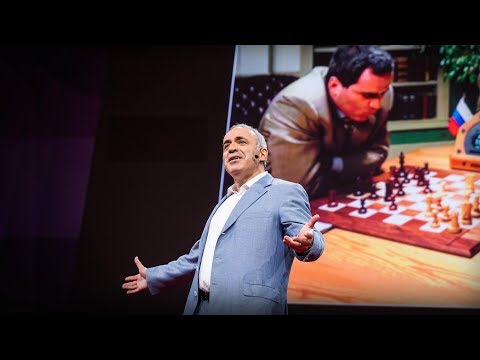
Don't fear intelligent machines. Work with them | Garry Kasparov
The Evolution of Human-Machine Competition
The Beginning of a New Era
- In 1985, at age 22, the speaker became the World Chess Champion by defeating Anatoly Karpov.
- Earlier that year, they played against 32 chess-playing machines simultaneously in Hamburg, Germany, winning all games.
- This period was described as the "golden age" for human players, with machines considered weak compared to human capabilities.
The Shift in Dynamics
- The narrative of humans versus machines is long-standing, exemplified by John Henry's legendary race against a steam-powered hammer.
- Current rhetoric suggests we are in a competitive struggle against machines that threaten jobs and livelihoods.
- The speaker reflects on their role as a prominent figure in this ongoing competition between humanity and technology.
Deep Blue: A Defining Moment
- The speaker faced IBM's Deep Blue in two matches; they won the first but lost the rematch in 1997.
- Deep Blue's victory marked a significant milestone where it was seen as reaching the summit of chess mastery.
- Despite its success, Deep Blue lacked true intelligence; it operated through brute force rather than understanding.
Understanding Machine Intelligence
- While Deep Blue could play grandmaster-level chess at incredible speeds (200 million positions per second), it did not provide insights into human intelligence.
- Questions arise about future roles for machines (e.g., taxi drivers or doctors); however, defining "intelligence" remains complex and philosophical.
Personal Reflections on Competition
- Upon meeting Deep Blue for the first time in February 1996, the speaker felt an unsettling sense of uncertainty regarding its capabilities.
- They experienced doubts about their own abilities and whether chess would remain relevant after facing such advanced technology.
Lessons Learned from Defeat
- Although ultimately losing to Deep Blue, the speaker noted that there remained a desire for human champions within chess culture.
- Contrary to doomsayers' predictions about technology diminishing interest in chess, participation has actually increased post-computer dominance.
Embracing Technology
- The speaker emphasizes confronting fears surrounding technology to harness its potential effectively while enhancing our humanity.
The Evolution of Human-Machine Collaboration
The Freestyle Chess Tournament Revelation
- In 2005, a freestyle chess tournament revealed that a team of amateur American players using three ordinary PCs outperformed grandmasters and supercomputers.
- This outcome highlighted the effectiveness of coaching machines, suggesting that human skill in guiding technology can surpass raw computational power.
- The formulation emerged: a weak human player plus a machine with an effective process is superior to a strong human player with an inferior process.
Current State of Human-Machine Interaction
- The concept of "human plus machine" is not just future speculation; it is already present in everyday applications like online translation.
- Machines assist in data processing and probability calculations, but humans still play a crucial role in interpreting results and making decisions.
- Despite advancements, reliance on machines for critical tasks (e.g., self-driving cars) remains cautious due to their current limitations.
Embracing Technological Progress
- Unlike past technological shifts that replaced manual labor, modern advancements are impacting educated professionals and those in influential positions.
- The speaker emphasizes the necessity for society to adapt to these changes rather than resist them; progress cannot be halted or slowed down.
Understanding vs. Calculation
- A distinction is made between what machines can do (calculations and instructions) versus what humans bring (understanding, purpose, passion).
- The focus should shift from worrying about machine intelligence today to recognizing areas where they still fall short.
Call to Action Against Complacency
Turn any video into a summary like this
YouTube links, meetings, lectures. With transcripts, search, and chat.