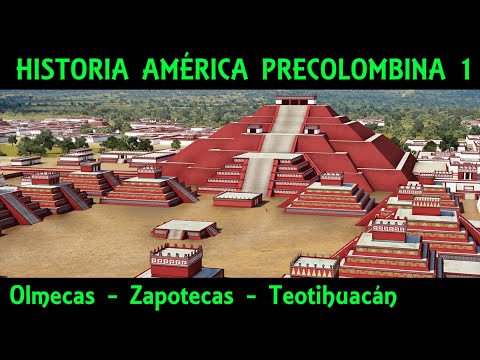
AMÉRICA PRECOLOMBINA 1: Olmecas, Zapotecas y Teotihuacán (Documental Historia México prehispánico)
The Origins of Pre-Columbian Cultures
Early Migration Theories
- The first Homo sapiens are believed to have crossed the Bering Strait into America around 30,000 years ago, but recent discoveries suggest earlier human activity, possibly by an unknown hominid.
- It is theorized that early migrations involved three or four major waves, starting with Siberian-Mongolian peoples who populated the Rocky Mountains and later migrated southward across the continent.
- Additional migrations may have occurred via sea routes from Melanesia and Australia, leading to a mix of cultures in the Americas.
Development of Agriculture
- By 8,000 BC, following the end of the Wurm glaciation, warmer climates led to a shift from hunting-gathering to sedentary agricultural lifestyles as megafauna populations declined.
- Key crops domesticated included corn, beans, avocados, squash, chili peppers, and tomatoes. Animals like turkeys and dogs were also domesticated for food and hunting purposes.
Cultural Flourishing in Mesoamerica
- Notable early cultures include Mokaya in Chiapas/Guatemala and Chupícuaro in western Mexico; Tlatilco culture emerged in central Mexico with significant pottery developments.
- After migration patterns established language families such as Eskimo-Aleutian and Na-Dene; Amerind languages became prominent among Native American populations.
The Olmec Civilization
- The Olmecs are recognized as one of the first great Mesoamerican cultures located in present-day Veracruz and Tabasco; their main city was La Venta around 1200 BC with an estimated population of 20,000.
- Known for colossal basalt heads representing rulers; some speculate these could depict African features—raising questions about ancient trans-oceanic contact.
Innovations and Decline
- The Olmecs contributed significantly to cultural advancements including a vigesimal numbering system (including zero), writing systems, calendars (lunar & solar), and ritualistic ball games involving sacrifices.
Cuicuilco and the Rise of Mesoamerican Civilizations
The Impact of Natural Disasters on Early Cultures
- Cuicuilco is noted for its large round temple; however, it was destroyed by the Xitle volcano around 100 AD, prompting a mass exodus to Teotihuacan, located about 70 kilometers from present-day Mexico City.
- The Tlatilcanos were also affected, leading to significant cultural shifts as people migrated and settled in new areas.
Development of Zapotec and Mixtec Cultures
- In Oaxaca, the emergence of the Zapotec culture is highlighted with San José Mogote as a major center. Glyphs found indicate an understanding of logophonetic writing.
- The Zapotecs were skilled weavers and goldsmiths, known for their funerary urns. Their origins are uncertain but linked to celestial beliefs and worship of rain gods like Cocijo.
Monte Albán: A Cultural Hub
- Monte Albán emerged around 500 BC as a capital for a confederation with approximately 20,000 inhabitants. Factors such as population growth and improved agricultural techniques contributed to this development during Mesoamerica's Classic period.
- This urban center featured significant structures like the Church of Dancers and astronomical observatories, showcasing advanced architectural skills.
Social Structure in Zapotec Society
- Zapotec society was hierarchical; elites resided in palatial homes adorned with murals while poorer citizens lived in modest huts.
- The decline of Epi-Olmec culture led to flourishing classical cultures in Veracruz, evidenced by clay figurines found at sites like Cerro de las Mesas.
Teotihuacan: A Cosmopolitan City
- Teotihuacan became known as "the place where men become gods," though its original name remains unknown. Its founders might have been Otomi tribes.
- By 300 AD, Teotihuacan expanded significantly with notable structures including the Sun Pyramid (64 meters high), indicating advanced engineering capabilities.
Trade Networks and Cultural Exchange
- Teotihuacan had a complex social hierarchy with rulers at the top followed by artisans and farmers. It housed around 200,000 people by 400 AD.
- Long-distance trade flourished between Teotihuacan and other Mesoamerican cultures including the Maya; obsidian tools were key exports exchanged for goods like cotton and jade.
Unique Architectural Traditions
- In western Mexico, the Teuchitlán tradition is characterized by circular plazas and conical pyramids found at Guachimontones in Jalisco.
The Decline of Great Cities in Mesoamerica
Life of Rulers and Nobility
- Rulers and the nobility resided in a palatial complex known as the Tajin group, characterized by elaborate wall paintings, separated from commoners by a wall.
- The resort of Columns served as another significant site for the upper classes, although its specific function remains unclear.
- The 17 tennis ball game courts at El Tajin were adorned with depictions of gods, warriors, and scenes of beheadings, indicating that violence was prevalent in their society.
Factors Leading to Urban Decline
- Between 700 and 900 AD, there was a notable decline in the splendor of major cities for reasons that are still not fully understood.
- The Zapotec capital Monte Albán experienced collapse; Teuchitlán may have fallen due to incursions by the Tarascos.
- Teotihuacán faced destruction through burning, leading to dismantling of many buildings. Speculation exists regarding Mixtec involvement in violent conflicts against neighboring states.
Emergence of Regional States
- Following the decline, Mixtecs repurposed abandoned Monte Albán as a necropolis during this period.
- Small regional states emerged that were militaristic and well-defended; examples include El Tajin and Cacaxtla located in Tlaxcala.