Michael Green: What the Social Progress Index can reveal about your country
The Impact of Simon Kuznets' Report
This section introduces the significance of Simon Kuznets' report, "National Income, 1929-1932," delivered to the United States Congress in 1934. It explains how this report shaped the lives of people and countries by establishing Gross Domestic Product (GDP) as a measure of economic success.
Simon Kuznets and his Report
- Simon Kuznets, an economist, delivered a report to the United States Congress in 1934.
- The report was titled "National Income, 1929-1932" and laid the foundation for measuring the success of countries through GDP.
- Despite being dry and dull, this report became crucial in shaping economic policies.
Dominance of GDP
- GDP has defined and shaped our lives for the past 80 years.
- However, it is important to note that GDP is a tool to measure economic performance and not a measure of overall well-being.
Warning from Kuznets
- In his report, Kuznets warned that national income (GDP) alone cannot determine the welfare of a nation.
- Unfortunately, this warning has been ignored as GDP became the benchmark for success in global economies.
The Role of GDP during Crisis
This section highlights how Kuznets' report provided reliable data during times of crisis such as the Great Depression. It also discusses how GDP statistics spread worldwide due to its usefulness.
Crisis and Data Availability
- During the Great Depression, policymakers lacked data and statistics to understand what was happening in the economy.
- Kuznets' report provided reliable data on U.S. economic production year by year.
- Armed with this information, policymakers were able to find solutions to overcome economic slumps.
Global Adoption of GDP
- Kuznets' invention of GDP statistics proved to be useful, leading to its adoption by countries worldwide.
- Today, every country produces GDP statistics.
Kuznets' Warning and Ignoring it
This section emphasizes how Kuznets warned that GDP should not be the sole measure of well-being. However, his warning has been disregarded as GDP became the primary measure of success in a global economy.
The Limitations of GDP
- Kuznets stated that national income (GDP) cannot fully reflect the welfare of a nation.
- Despite this warning, GDP has become the benchmark for success, with politicians boasting when it increases.
Flaws in GDP Measurement
- GDP ignores important factors such as environmental impact, happiness, community, fairness, and justice.
- Relying solely on GDP has led to environmental disasters and societal issues.
The Need for a Better Measure
This section highlights the need for an alternative measure that focuses on real aspects that matter to people's lives beyond economic growth.
Moving Beyond GDP Attempts
- Previous efforts have been made to move beyond relying solely on GDP.
- The financial crisis of 2008 and events like the Arab Spring have shown the limitations of focusing only on economic growth.
A Measurement Revolution
- The speaker believes that we are ready for a measurement revolution.
- Technological advancements now allow us to gather and analyze data in ways unimaginable during Kuznets' time.
Introducing the Social Progress Index (SPI)
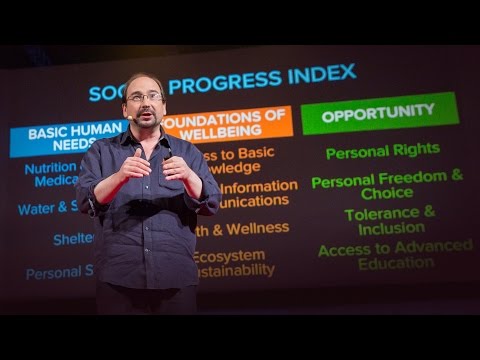
This section introduces the Social Progress Index (SPI) as an alternative measure separate from GDP. It explains how SPI defines a good society based on three dimensions: basic needs, building blocks for improvement, and access to pursue goals and dreams.
The Social Progress Index
- The SPI is a measure of societal well-being that goes beyond GDP.
- It defines a good society based on three dimensions: basic needs, building blocks for improvement, and access to pursue goals and dreams.
Components of the Social Progress Framework
- The first dimension focuses on ensuring everyone has basic needs like food, water, shelter, and safety.
- The second dimension emphasizes access to education, information, health, and a sustainable environment.
- The third dimension examines individual rights, freedom of choice, freedom from discrimination, and access to advanced knowledge.
Real Achievement Indicators
- For each component of the Social Progress Framework, there are indicators that measure real achievements rather than just effort or intention.
- Examples include measuring the length and quality of people's lives instead of healthcare spending or assessing whether people experience discrimination rather than relying on laws against discrimination.
Conclusion
This section concludes by acknowledging the audience's curiosity about which countries perform well according to the Social Progress Index (SPI).
Curiosity about Top Performers
- The speaker acknowledges the audience's curiosity about which countries rank highest in the SPI.
New Section
The speaker discusses the Social Progress Index and how it can be used to measure social progress in different countries, highlighting examples such as New Zealand, Chad, the United States, Senegal, Canada, the United Kingdom, Brazil, Russia, China, India, Kuwait, and Costa Rica. The speaker emphasizes that GDP is not the sole indicator of social progress and explains the relationship between GDP and social progress.
Understanding Social Progress Index
- The number one country on social progress is New Zealand.
- The country with the least social progress is Chad.
- GDP alone does not determine social progress.
- The United States has a lower level of social progress compared to New Zealand despite having a higher GDP.
- Senegal has a higher level of social progress than Chad but similar GDP.
Comparing Countries
- Canada is ranked highest among G7 countries in terms of social progress.
- The United Kingdom's level of social progress is average but beats France.
- Brazil tops the BRICS countries in terms of social progress.
- Kuwait has high GDP but low social progress.
- Costa Rica achieves high levels of social progress with a lower GDP.
Relationship Between GDP and Social Progress
- There is noise around the trend line when comparing GDP and social progress.
- Poor countries experience significant improvements in social progress with even small increases in GDP.
- As countries move up the curve, each additional dollar of GDP buys less and less social progress.
Importance of Social Progress
- Brazil's example demonstrates that increasing GDP alone is not enough for overall development.
- Brazil needs to prioritize both growth and social progress for sustainable development like New Zealand.
Social Progress Index Beyond Countries
- A subnational Social Progress Index was created for the Amazon region to assess quality of life across municipalities.
- This information helps construct a development plan while protecting the Amazon Rainforest.
- The Social Progress Index can be used for any state, region, city, or municipality.
New Section
The speaker highlights the importance of the Social Progress Index as a tool for inclusive and sustainable growth. They emphasize that GDP is not the ultimate measure of development and discuss how the index can be used at various levels to improve people's lives.
Rethinking GDP
- GDP is a measurement tool invented in the 20th century but may not fully address the challenges of the 21st century.
- The Social Progress Index reframes the debate about development by focusing on inclusive, sustainable growth rather than just GDP alone.
Subnational Social Progress Index
- A subnational Social Progress Index was created for the Amazon region, covering nearly 800 municipalities.
- Detailed information about quality of life helps stakeholders from government, business, and civil society work together to improve people's lives while protecting the Amazon Rainforest.
Accessibility of Social Progress Index
- The Social Progress Index is accessible to anyone as a tool for measuring progress beyond GDP.
- It can be used at different levels such as states, regions, cities, or municipalities.
This summary provides an overview of key points discussed in the transcript. For a more detailed understanding, please refer to the full transcript.
New Section
In this section, the speaker emphasizes the importance of evaluating individuals' contributions to social progress rather than just their economic impact. They envision a collaborative effort between government, business, civil society, and individuals to make this century a time of significant social progress.
Imagine a World with Accountability
- The speaker suggests that politicians should be held accountable for genuinely improving people's lives.
- They propose the idea of working together as a collective force comprising government, business, civil society, and individuals.
- The goal is to make the 21st century an era marked by substantial advancements in social progress.
Timestamps are not available for this section.
Turn any video into a summary like this
YouTube links, meetings, lectures. With transcripts, search, and chat.