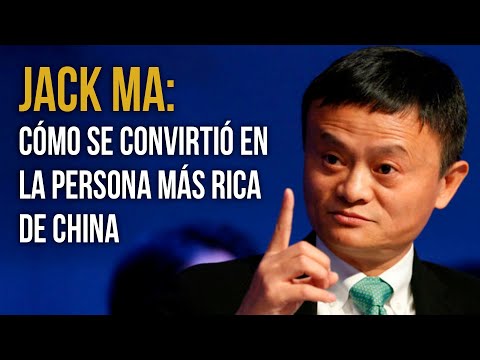
Cómo se convirtió Jack Ma en la persona más rica de China 💰
Jack Ma: From Teacher to Tech Titan
Early Life and Education
- At age 30, Jack Ma worked as an English teacher earning only $12 a month in his hometown university. Twenty years later, he became the richest person in China.
- Born on September 10, 1964, in Hangzhou, Ma grew up under strict Marxist rules of the Chinese Communist regime with limited opportunities for progress.
- The visit of U.S. President Richard Nixon in 1972 increased tourism in Hangzhou, providing economic improvement for locals.
- Despite struggling academically and having issues with mathematics, Ma's curiosity led him to learn English by volunteering as a tour guide for foreign tourists.
- After multiple failed attempts to enter university, he finally succeeded at Hangzhou Normal University where he met his future wife Zhang Ying.
Career Beginnings
- After graduating in 1988, Ma faced numerous job rejections despite applying thirty times; notably rejected by KFC when it opened in his city.
- Eventually secured a teaching position at Hangzhou Dianzi University but felt underpaid with a salary of just $12 per month.
- In 1994, he founded "Hangzhou Haibo Translation Agency," focusing on Mandarin-English translations which marked his first entrepreneurial venture.
Discovery of the Internet
- A business trip to the U.S. introduced him to the internet; fascinated by its potential after searching for "beer" online and finding no Chinese companies listed.
- Upon returning from the U.S., he borrowed $2,000 from friends to create "China Pages," an online directory aimed at promoting Chinese businesses internationally.
Challenges and Government Relations
- Faced skepticism from local businesses about internet advertising; sought government support but encountered bureaucratic resistance during meetings in Beijing.
Jack Ma's Journey to Alibaba
Early Challenges and Alliances
- Jack Ma concluded that survival required an alliance with Hangzhou Telecom, leading to a joint venture that ultimately failed due to his lack of influence in decision-making.
- In 1998, while working in the e-commerce division of the Chinese government, Ma decided it was time to pursue his entrepreneurial vision again.
The Birth of Alibaba
- In 1999, leveraging his experience from China Pages and government work, Ma gathered 17 friends in Hangzhou to invest in his new online marketplace concept called "Alibaba."
- His vision was to create a platform connecting small and medium-sized Chinese businesses with global markets, likening Alibaba to "open sesame" for these enterprises.
Initial Growth and Investments
- After seven months of development, Alibaba launched officially at a press conference in Hong Kong in October 1999, announcing a $5 million investment led by Goldman Sachs.
- By January 2000, Alibaba secured an additional $20 million from SoftBank, which helped attract both Chinese exporters and international buyers despite initial losses.
Navigating the Dot-Com Bubble
- Despite rapid growth and media attention, Alibaba struggled financially as the dot-com bubble burst affected investor confidence globally.
- To manage operations better during this crisis, Ma moved Alibaba's English operations to Silicon Valley but faced operational challenges leading to significant layoffs.
Crisis Management Strategies
- By 2001, as the internet crisis deepened and profitability remained elusive for Alibaba, drastic measures were taken including cutting international staff and advertising budgets.
- A focus on stabilizing operations allowed for strengthening company culture; they began exploring revenue sources like premium listings for exporters on their platform.
Path Towards Profitability
Jack Ma's Journey: Overcoming Challenges at Alibaba
Alibaba Achieves Profitability
- In late 2002, Jack Ma announced to his team that Alibaba had achieved profitability for the first time in its history, earning over $60,000.
- This milestone demonstrated that Alibaba was not only surviving the Internet bubble but also beginning to establish itself within the industry.
The SARS Outbreak and Its Impact
- At the beginning of 2003, news broke about a SARS outbreak in southern China, which quickly spread across the country.
- One employee contracted the virus, leading to a company-wide quarantine and forcing operations to shift online as 400 employees worked from home.
Preparing for Competition with eBay
- After quarantine, Jack Ma warned Porter Erisman of an impending challenge that would define Alibaba's future amidst a recovering digital industry in the U.S.
- eBay emerged as a significant competitor after acquiring Eachnet, raising concerns for Jack regarding their market presence in China.
Strategic Planning Against eBay
- To counter eBay's threat, Jack Ma gathered a small team to devise strategies for competing effectively against them.
- He famously compared their situation by stating: "eBay is a shark in the ocean; we are a crocodile in the Yangtze River," emphasizing their need to leverage local strengths.
Launching Taobao
- In May 2003, Alibaba launched Taobao ("treasure hunt"), a C2C platform aimed at gaining market share before eBay could fully enter China.
- Taobao was introduced as free for users for three years and included Alipay—a payment platform ensuring transaction security until delivery confirmation.
Understanding Local Market Dynamics
- Taobao focused on Chinese consumers' needs rather than replicating American models. This approach allowed it to grow rapidly compared to eBay’s more generic offerings.
- As Taobao gained popularity among young Chinese users, many began abandoning eBay due to its less tailored services.
Intensifying Competition by 2005
- By 2005, competition escalated with eBay announcing an additional $100 million investment while facing declining results in China.
- Meg Whitman (CEO of eBay at that time), sought partnership discussions with Jack Ma but was rejected due to differing visions regarding market development.
Yahoo! Investment and Strategic Shift
- In response to mounting pressure from eBay and seeking growth opportunities, Alibaba secured a $1 billion investment from Yahoo! for 40% equity stake.
Jack Ma's Journey: From Alibaba's Rise to Philanthropy
The Battle Against eBay
- In 2006, Alibaba, with Yahoo! as a major shareholder, began to outpace eBay in the Chinese market, marking a significant turning point.
- Taobao announced it would remain free for three more years, prompting eBay to drop its fees. This led to a 5% drop in eBay's stock and intensified competition.
- By late 2006, eBay closed its China site after failing to compete effectively against Taobao, solidifying Taobao’s dominance.
Transitioning Leadership and Growth
- With the exit of eBay from China, Jack Ma prepared for Alibaba's IPO. In late 2007, Alibaba debuted on the Hong Kong Stock Exchange with shares nearly tripling on the first day.
- In 2008, Alibaba launched TMall and AliExpress to expand its business model and reach international markets.
- Amidst growing tensions with Yahoo!, Ma announced his resignation as CEO in 2012 but remained as chairman focusing on strategic vision and talent development.
Dominance in E-commerce
- By 2013, Alibaba controlled about 80% of China's e-commerce market with transactions exceeding $248 billion annually.
- In September 2014, due to regulatory issues in Hong Kong, Alibaba went public on Wall Street with a record-breaking IPO valued at $25 billion.
Expansion into New Ventures
- Following its IPO success, Alibaba diversified into cloud computing (Alibaba Cloud), sports (Alisports), omnichannel retail (Hema Supermarket), and entrepreneurial support (Alibaba Entrepreneurs Fund).
- The company also acquired key players like Youku and Lazada while competing directly with global giants such as Amazon and Google.
Legacy and Philanthropy
- After stepping down from leadership roles in September 2019 at age 55, Jack Ma shifted focus towards philanthropy addressing environmental issues and education.