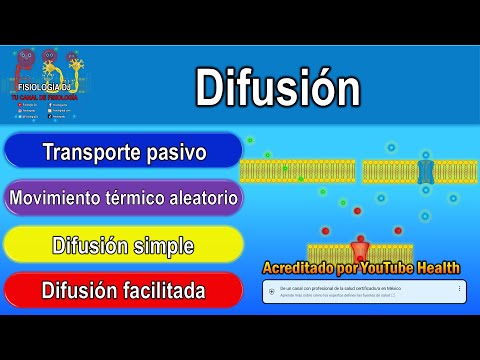
DIFUSIÓN | Difusión simple | Difusión facilitada | Transporte celular pasivo
Understanding Diffusion and Particle Movement
Introduction to Diffusion
- The video begins by emphasizing the importance of diffusion in cellular life, posing a question for viewers to consider after watching.
- A demonstration is introduced using blue water and green dye, illustrating how particles disperse in a liquid.
Brownian Motion
- The movement of dye particles is described as random and patternless, known as Brownian motion, which occurs due to thermal energy.
- This spontaneous movement does not require energy but can be influenced by temperature; higher temperatures increase particle movement.
Types of Diffusion
Simple Diffusion
- Simple diffusion is explained with examples like gases (oxygen, carbon dioxide), highlighting that different particles have varying sizes and charges affecting their movement.
- Lipid-soluble molecules can pass through cell membranes easily, while others may be restricted based on size or charge.
Facilitated Diffusion
- Facilitated diffusion allows certain molecules to cross membranes via specific channels or pores when they cannot pass through lipid layers directly.
Factors Affecting Diffusion
- The law of Fick is mentioned as a way to calculate diffusion magnitude based on particle characteristics and membrane properties.
- Selectively permeable channels allow some substances to pass while blocking others; this selectivity depends on molecular size and properties.
Characteristics of Membrane Channels
- Some channels are regulated by electrical signals, allowing them to open or close based on conditions.
Understanding Membrane Transport Mechanisms
Role of Proteins in Membrane Transport
- Lipids in the membrane and protein channels facilitate particle movement across membranes, with proteins acting as transporters.
- The direction of transport is determined by concentration gradients; specific proteins limit diffusion speed based on their availability and transport capacity.
Characteristics of Diffusion
- Diffusion serves numerous biological functions without requiring metabolic energy, relying instead on potential energy from concentration differences.