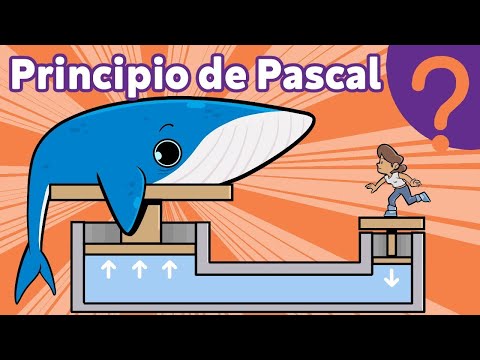
El principio de Pascal o ¿Cómo multiplicar tu fuerza?
How Does Hydraulic Technology Work?
Introduction to Hydraulic Technology
- The video opens with a thought-provoking question about the possibility of lifting heavy objects using only human strength, introducing hydraulic technology as the solution.
- It highlights Blaise Pascal's scientific contributions that enable such feats and mentions the potential applications, including moving buildings.
Understanding Pascal's Principle
- The narrator recounts an anecdote about Blaise Pascal's experiment involving a barrel and water, illustrating the principle of pressure in fluids.
- Although there is uncertainty regarding the actual experiment, it serves to explain Pascal's principle: a physical law in hydrostatics concerning fluid behavior under pressure.
Key Concepts of Pressure and Fluids
- Pressure is defined as force per unit area; decreasing surface area while maintaining force increases pressure.
- The concept of incompressibility in liquids is introduced, contrasting it with gases which can be compressed. Water behaves as an incompressible fluid for practical purposes.
Implications of Incompressibility
- When pressure is applied to a confined liquid, it transmits uniformly throughout the fluid due to its incompressible nature.
- This leads to Pascal’s principle: "A pressure change in a confined incompressible fluid is transmitted with equal intensity in all directions."
Practical Applications of Pascal's Principle
- The video explains how two pistons can demonstrate this principle; applying force on one piston results in greater force exerted by another piston due to differing areas.
- An example illustrates how 3 kilograms on a small piston can translate into 15 kilograms on a larger piston through calculated pressure distribution.
Mathematical Representation
- A mathematical equation representing this relationship between forces and areas is presented: Force 2 = Force 1 × (Area 2 / Area 1).
Understanding Pascal's Principle and Its Applications
Exploring Pascal's Principle
- Basic Concept: When the inlet plunger of a hydraulic system is moved 10 centimeters down, it results in only a 2-centimeter upward movement of the outlet. This illustrates how force and distance are exchanged in hydraulic systems.
- Real-world Applications: Various inventions utilize this principle, such as:
- Hydraulic brakes in buses that amplify small forces to stop heavy vehicles.
- Car jacks that lift vehicles using minimal effort.
- Elevators, cranes, hydraulic presses, and vehicle steering systems.
Historical Example of Pascal's Principle
- Engineering Feat: Jorge Matute Remus successfully moved an entire building in Guadalajara, Mexico during the 1950s to prevent its demolition.
- Methodology: The operation involved placing rails and rollers under the building along with 12 hydraulic jacks to move it incrementally without motors while maintaining normal operations inside.
Understanding Pressure Dynamics
- Hydrostatic Paradox: The pressure exerted by a liquid depends on the height and width of the tube rather than the volume. A concentrated column can lead to increased pressure that may cause containers (like barrels) to burst if not designed for such stress.
- Pressure Measurement Units: While "kilo per square centimeter" was used initially, "newton per square meter" or Pascal is more commonly accepted. Each kilo per square centimeter equals approximately 98,066.5 Pascals.
Professional Development Insights
- Skills for Success: Beyond technical knowledge, developing soft skills like teamwork, leadership, and time management is crucial for professional growth. Identifying habits that aid or hinder progress can help create effective development plans.
Call to Action