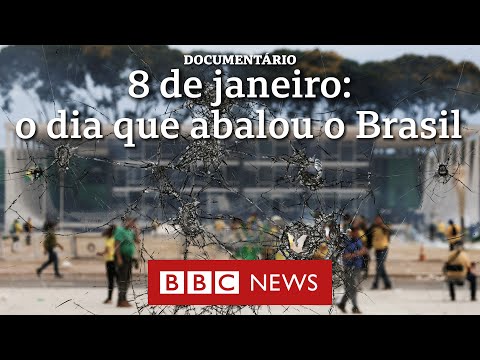
Documentário BBC | 8 de Janeiro: o dia que abalou o Brasil
Introduction
The speaker discusses the topic of moving and emphasizes the repetitive nature of moving.
Being a person who moves frequently
- The speaker describes themselves as someone who constantly moves.
- They emphasize the repetitive nature of moving.
News about President J. Bolsonaro
The speaker introduces news about President J. Bolsonaro and mentions that there are messages circulating regarding his presidency.
Spread of news about President J. Bolsonaro
- Thousands of supporters spread across the country in support of President J. Bolsonaro.
- Messages and rumors are being shared regarding his presidency.
- There is talk about invading the Congress to make their voices heard.
Impact on Brazil and worldwide attention
The speaker highlights the impact of recent events in Brazil, capturing global attention.
Brazil's situation captures global attention
- On January 8, 2023, people around the world try to understand what is happening in Brazil.
- Demonstrations have been organized by citizens who feel their voices were not heard during elections.
- The world watches as a group of protesters takes to the streets.
Timeline leading up to current events
The speaker provides important context by discussing events leading up to the current situation in Brazil.
October 30, 2022 - Election results and fake news
- On October 30, 2022, Jair Bolsonaro loses his bid for re-election.
- Fake news spreads across the country claiming election fraud without evidence.
- Rumors circulate that Bolsonaro could invoke Article 142 of the Constitution for military intervention.
Article 142 and the role of the military
The speaker discusses Article 142 of the Constitution and its implications for military intervention.
Misinterpretation of Article 142
- Bolsonaro mentioned Article 142 in 2020, suggesting it could be used for military intervention.
- Constitutional experts clarify that Article 142 does not authorize such intervention.
- The Supreme Court has declared that the military does not have the power to moderate conflicts between branches of government.
Fake news and Bolsonaro's silence
The speaker addresses fake news surrounding Article 142 and Bolsonaro's silence after election results.
Fake news and Bolsonaro's silence
- Fake news about Article 142 continues to circulate despite constitutional clarifications.
- Rumors suggest that Bolsonaro needs to remain silent for 72 hours before calling for military intervention.
- Bolsonaro finally speaks out more than 40 hours after the electoral court confirms the results.
Resistance movements and transition of government
The speaker discusses resistance movements and the transition of government.
Resistance movements and transition
- Supporters interpret Bolsonaro's ambiguous statements as a call for resistance.
- Movements arise from feelings of injustice during the electoral process.
- Minister Ciro Nogueira mentions a transition process initiated by Bolsonaro.
Youtubers' tent at protest camp
The speaker describes a tent set up by YouTubers at a protest camp.
Youtubers' tent at protest camp
- A tent is set up by YouTubers weeks after establishing the protest camp.
- The tent contains various equipment, surprising observers.
Long-term occupation of protest camp
The speaker discusses the long-term occupation of the protest camp and its growing infrastructure.
Long-term occupation and infrastructure
- People come prepared for a long stay at the protest camp.
- The camp grows with structures for shelter, food, sanitation, and power supply.
Journalist's experience at the protest camp
The speaker shares a journalist's experience at the protest camp.
Journalist's experience at the protest camp
- A journalist from TV Globo spent nearly 70 days undercover at the protest camp.
- She faced online attacks and requested anonymity.
- The scale of the camp's infrastructure was impressive.
Overview of the Camp Structure
The speaker describes the camp's infrastructure, including editing computers, cameras, internet routers, and power generators. They mention the technical support available for camera analysis, photography, internet connectivity, and lighting. The speaker also mentions a colleague from Ana Globo who worked on the camp coverage.
Camp Infrastructure
- The camp had editing computers, large cameras, power generators, and internet routers.
- Technical support was available for camera analysis, photography, internet connectivity, and lighting.
- A colleague from Ana Globo also worked on the camp coverage.
Food Supply at the Camp
The speaker discusses the quantity of food supplied at the camp. They mention that various agricultural organizations provided food supplies in large quantities. Over a ton of food was delivered to the camp. The speaker encourages viewers to share a video about this issue and raise awareness in Brasília.
Food Supply
- Various agricultural organizations provided a significant amount of food supplies.
- Over a ton of food was delivered to the camp.
- Viewers are encouraged to share a video about this issue and raise awareness in Brasília.
Charging Stations for Mobile Phones
The speaker talks about charging stations for mobile phones at the camp. Initially, there were limited charging options with multiple devices connected to one point. However, currently there are three generators and around 200 hanging sockets available at the camp.
Charging Stations
- Initially, there were limited charging options with multiple devices connected to one point.
- Currently, there are three generators and around 200 hanging sockets available at the camp.
Improvised Stage and Communication Center
The speaker describes the improvised stage at the camp, which served as a central news hub. People could request to speak and address various topics. The stage was also used for fundraising and providing updates on arrivals, bus schedules, and marching times.
Improvised Stage
- The stage served as a central news hub and communication center.
- People could request to speak and address various topics.
- Fundraising activities took place on the stage.
- Updates on arrivals, bus schedules, and marching times were provided.
Fundraising Success at the Camp
The speaker shares their observations of successful fundraising efforts at the camp. They mention that significant amounts of money were raised within short periods of time. The funds collected were used for food supplies and other necessities at the camp.
Fundraising Success
- Significant amounts of money were raised within short periods of time.
- On some occasions, up to five thousand reais were collected in just 30 minutes.
- The funds collected were used for food supplies and other necessities at the camp.
Diversity of Participants at the Camp
The speaker discusses the diversity of participants at the camp. They mention people from different regions, age groups, and backgrounds coming together. While there were many patriotic individuals present, families seemed to be less common among attendees.
Diversity of Participants
- Participants came from different regions across Brazil.
- People from various age groups attended the camp.
- Families seemed to be less common among attendees.
Daily Routine at the Camp
The speaker explains the daily routine followed at the camp. It involved morning gatherings with national anthem recitation, formation into squads for marches, meal times, gathering around parked trucks for noise-making demonstrations, and moments of silence in honor of the former president.
Daily Routine
- Morning gatherings included recitation of the national anthem.
- Participants formed squads for marches.
- Meal times were scheduled throughout the day.
- Noise-making demonstrations took place around parked trucks to attract media attention.
- Moments of silence were observed in honor of the former president.
Characteristics of Camp Participants
The speaker reflects on the characteristics of individuals present at the camp. They mention a mixture of people from different backgrounds, including patriots and individuals with a strong belief in their cause. Families seemed to be less common, and many attendees were solo participants.
Characteristics of Participants
- The camp had a diverse mix of individuals from different backgrounds.
- There were patriotic individuals and those strongly committed to their cause.
- Families seemed to be less common among attendees.
- Many participants attended the camp individually.
Motivations and Backgrounds of Camp Participants
The speaker discusses the motivations and backgrounds of camp participants. They mention that many attendees came alone, driven by their personal beliefs and expectations. The group consisted mainly of middle-class individuals who voted for Bolsonaro in the 2022 elections.
Motivations and Backgrounds
- Many participants came alone, driven by their personal beliefs and expectations.
- Attendees mainly belonged to the middle-class segment.
- A significant number had voted for Bolsonaro in the 2022 elections.
Emotional Attachment to Bolsonaro
The speaker explains that a minority group (around 15% to 20%) had an emotional attachment to Bolsonaro as their leader. This attachment was not purely rational but based on shared beliefs and values. It was not a result of brainwashing but rather a strong emotional connection.
Emotional Attachment
- A minority group (around 15% to 20%) had an emotional attachment to Bolsonaro as their leader.
Overview of Election Confidence and Fraud Claims
In this section, the speaker discusses the initial confidence in Jair Bolsonaro winning the elections and the belief that any loss would indicate electoral fraud. There were indications of videos requesting source code participation from the army for election audits.
Initial Confidence and Fraud Claims
- Initially, there was a strong belief that Jair Bolsonaro would win the elections and any loss would be seen as evidence of electoral fraud.
- Videos circulated requesting source code participation from the army for election audits.
Shift in Tone after Lula's Elections
The speaker explains how the tone shifted significantly after Lula's elections, with discussions about anti-democratic actions, road closures, and claims that the judiciary won instead of Lula.
Shift in Tone
- After Lula's elections on October 31st, there was a noticeable change in tone.
- Discussions about anti-democratic actions, road closures, and claims that the judiciary won instead of Lula became more prominent.
Varied Interpretations of Calls to Action
The speaker highlights how different groups interpreted calls to action differently. Some advocated for peaceful protests while others sought radical takeover of power.
Varied Interpretations
- Different groups had varying interpretations of calls to action.
- Some advocated for peaceful protests and standing in front of military barracks while others aimed for a radical takeover of power.
- Radical groups expressed a stronger sense of urgency to take matters into their own hands.
Rhetoric Turns into Political Violence
The speaker describes how political violence escalated on December 12th when Jair Bolsonaro was officially declared president. Acts of vandalism and attempts to invade police stations occurred.
Escalation of Violence
- On December 12th, political violence escalated after Jair Bolsonaro was officially declared president.
- Acts of vandalism and attempts to invade police stations were reported.
- These incidents were the beginning of a series of events that led to the invasion and destruction of government buildings.
Series of Incidents Leading to Destruction
The speaker explains how a series of incidents, including attempted invasions and acts of vandalism, culminated in the destruction of government buildings.
Series of Incidents
- In less than a month, a series of incidents unfolded, leading to the invasion and destruction of government buildings.
- Attempts to invade the police federal headquarters and attack a police station were reported.
- On December 24th, an explosive device was found near the airport.
- The police initially tried to dismantle the camp but faced hostility and eventually halted their operation under orders from the army.
Bolsonaro's Actions After Leaving Office
The speaker discusses Jair Bolsonaro's actions after leaving office, including refusing to pass on the presidential sash to Lula during the inauguration ceremony.
Bolsonaro's Actions
- Jair Bolsonaro left Brazil for the United States on December 30th using an aircraft from the Brazilian Air Force.
- He refused to pass on the presidential sash to Lula during his inauguration ceremony on January 1st.
- Despite no longer being in office, Bolsonaro maintained his description as President of Brazil on social media and continued posting content about his government's actions.
Arrival of Bolsonaro Supporters in Brasília
The speaker describes the arrival of Bolsonaro supporters in Brasília, with buses bringing hundreds of supporters to the city.
Arrival of Supporters
- On January 7th, at least 100 buses carrying Bolsonaro supporters arrived in Brasília.
- Despite efforts by the police, they were unable to prevent the influx of buses and people.
- Many supporters came from different parts of the country in response to a call circulated on social media.
Transformation of Camp into Commercial Area
The speaker observes how the camp transformed over time, with tents turning into businesses and various services being offered.
Transformation of Camp
- Initially, there were tents and a car with speakers rallying people.
- Over time, the area turned into a commercial space with barber shops, food stalls, and other services.
- A significant number of people gathered at the camp throughout the day, regardless of weather conditions.
Growing Number of Supporters Arriving in Brasília
The speaker discusses an increasing number of videos showing buses and caravans arriving in Brasília as more supporters joined the protests.
Increasing Supporter Numbers
- From January 3rd onwards, videos started circulating showing people gathering at KG Square in Brasília.
New Section
This section discusses the impact of fake news and months of fraud accusations on public sentiment in Brazil.
Inflamed by Fake News
- The public was inflamed by fake news and months of fraud accusations.
- This created a tense atmosphere leading up to the events at the Capitol.
New Section
This section explores how the events at the Capitol were seen as a precursor to potential unrest in Brazil.
Events at the Capitol as a Prenouncement
- Many saw the events at the Capitol as a prenouncement of what could happen in Brazil.
- The Minister of Justice, Flávio Díno, witnessed the attacks from his office window in Brasília.
- There was prior knowledge and anticipation of demonstrations taking place.
New Section
This section provides insights into the security preparations and coordination for demonstrations in Brasília.
Security Preparations for Demonstrations
- The Minister of Justice, Flávio Díno, was aware that there would be demonstrations.
- Extensive planning and coordination took place among various security agencies.
- The number of security personnel decreased significantly compared to previous events due to logistical challenges.
New Section
This section highlights different perspectives on the risk assessment for demonstrations and concerns about potential violence.
Varying Perceptions on Risk Assessment
- Commanders had differing opinions on the extent and nature of potential demonstrations.
- Some expressed concerns about isolated violent actions during protests.
- Protocols for integrated actions were established but may not have been fully implemented due to communication issues.
New Section
This section discusses the challenges of communication and implementation of security protocols.
Challenges in Communication and Implementation
- The effective execution of security protocols requires continuous monitoring and communication.
- The flow of information may have been disrupted, leading to a lack of implementation.
- Inadequate communication can hinder the effectiveness of security measures.
New Section
This section explores the transition of government and potential disruptions in communication.
Transition of Government and Communication Disruptions
- The transition of government may have interrupted or discontinued the flow of communication.
- Dialogue with authorities in Brasília was crucial for coordination but faced challenges.
- Intense communication efforts were made by the Minister of Justice, Flávio Díno, to ensure preparedness.
New Section
This section highlights changes in personnel within the security structure and their impact on planning.
Changes in Personnel within Security Structure
- Key positions within the security structure were replaced by individuals brought in by Anderson Torres, Secretary of Security.
- Exoneration and appointment decisions affected the continuity and effectiveness of planning processes.
New Section
This section emphasizes the importance of monitoring and effective communication for successful operations during demonstrations.
Importance of Monitoring and Effective Communication
- Planning for demonstrations typically occurs at a mid-level within security agencies.
- Predicting risks accurately and establishing dialogue with higher-ranking officials are essential for coordinated operations.
- The context of a government transition adds complexity to these processes.
New Section
This section raises questions about interruptions in communication during demonstrations at Brasília.
Interruptions in Communication
- The Minister of Justice, Flávio Dino, was questioned about potential disruptions in communication during the demonstrations.
- The chain of command and authority lies with the Governor of the Federal District, not the Ministry of Justice.
- Misconceptions exist regarding the authority and jurisdiction of different law enforcement agencies.
New Section
This section addresses misconceptions about the authority and limitations of law enforcement agencies.
Misconceptions about Law Enforcement Authority
- There are legal limitations on the authority and actions of law enforcement agencies.
- The Ministry of Justice does not have direct control over state police forces or federal agencies like the Federal Police or Highway Police.
- Dialogue and coordination with local authorities are necessary for effective security measures.
New Section
This section highlights efforts made to communicate and alert authorities about potential risks before the demonstrations.
Efforts to Communicate Potential Risks
- Intensive dialogue took place between the Ministry of Justice and local authorities in Brasília.
- A letter was sent to Governor Ibaneis Rocha, warning about increased movement of people organizing bus caravans to Brasília.
- The governor publicly acknowledged the planned demonstration but emphasized its peaceful nature.
New Section
This section mentions investigations into responsibilities for what occurred during the demonstrations.
Investigations into Responsibilities
- Governor Ibaneis Rocha is under investigation for his role in handling the events that unfolded during the demonstrations.
- Requests for interviews with relevant authorities, such as PMDF (Military Police) and Armed Forces, were unanswered.
New Section
This section discusses the intelligence gathered regarding potential risks and the deployment of security personnel.
Intelligence and Deployment of Security Personnel
- Intelligence reports indicated heightened tensions and the possibility of incidents during the demonstrations.
- A significant number of military police officers were deployed to ensure security on the following day.
New Section
This section introduces Adios Sompás, the director of the coordination of organic security at the Legislative Police Department. It mentions his involvement in a direct confrontation with the group that invaded the Chamber of Deputies.
Adios Sompás and Confrontation at the Chamber of Deputies
- Adios Sompás is introduced as the director of the coordination of organic security at the Legislative Police Department.
- A large group marches towards the Congress building, starting from an encampment.
- The Secretary of Public Security sends an audio message to the governor, assuring that everything is calm and peaceful.
- The initial reports indicate a smooth and peaceful demonstration without any signs of aggression.
- As the protesters descend towards the Ministries Esplanade, they are escorted by police officers.
- Fons, a journalist who had been at the encampment for two months, recalls hearing discussions about entering and invading certain areas.
- The protesters break through a barrier and start their destructive actions inside the Congress building.
New Section
This section focuses on how law enforcement attempted to contain and control the situation during the invasion.
Law Enforcement's Attempt to Contain
- The police containment line was not prepared for dealing with a peaceful crowd turning violent.
- The police officers were ill-equipped and vulnerable due to lack of riot gear.
- The first line of police officers tries to use pepper spray but fails to stop or deter the invaders.
- The Congress area is quickly overrun by the protesters, who break windows and enter the building.
New Section
This section describes the actions of law enforcement as the invasion progresses towards other areas.
Escalation of the Invasion
- The police continue to use non-lethal force, such as tear gas, but it has little effect on the large number of invaders.
- Some police officers are overwhelmed by the speed and sheer number of protesters descending towards them.
- Protesters forcibly remove police officers from a vehicle, leading to physical altercations.
- Destruction spreads to the Senate and Chamber buildings, while some protesters head towards the Presidential Palace.
New Section
This section highlights social media posts showing alleged misconduct by some police officers during the invasion.
Social Media Posts and Police Misconduct
- Images circulate on social media showing police officers allegedly taking selfies with protesters.
- Several investigations are launched into police conduct and command negligence following the attacks.
- Four police officers are arrested in early February in connection with their actions during the invasion.
New Section
This section focuses on reactions to the events from government officials and their impressions of what transpired.
Reactions from Government Officials
- The Minister of Justice expresses his astonishment at witnessing such an unprecedented situation unfold in Brazil.
- He reflects on how this event was unexpected given previous experiences with large protests in Brasília.
New Section
In this section, the speaker discusses their initial reactions and actions during the events that took place in the transcript.
Initial Reactions and Actions
- The speaker describes feeling perplexed and outraged by the situation.
- They mention being alone in a room and having to make decisions that were not legally their responsibility but were necessary for their position.
- The speaker notes the small number of police officers present compared to what was planned.
- They took immediate action by contacting relevant authorities, including the government of the Federal District.
New Section
This section focuses on the speaker's attempts to establish communication with the government and mobilize law enforcement personnel.
Communication Efforts
- The speaker mentions trying to contact Ivanés Rocha, but they were unable to reach him directly.
- They questioned the absence of planned police presence and attempted to mobilize law enforcement from the Federal District.
- Administrative processes and military police investigations would later reveal more information about what was happening at that time.
- The speaker assumed command of security in the Federal District due to a lack of effective response from higher authorities.
New Section
Here, the speaker discusses their observations of protesters' intentions and interactions during the events.
Protesters' Intentions
- The speaker recounts witnessing protesters breaking objects and attempting to invade different areas within the premises.
- Some protesters expressed a desire for attention from the armed forces, hoping for a military intervention.
- Despite these beliefs held by some protesters, it was clear that such support from the armed forces was unlikely.
New Section
This section highlights moments of intense confrontation between law enforcement officers and protesters inside Congress.
Confrontation Inside Congress
- Law enforcement officers faced intense resistance from protesters, who threw stones and other objects.
- The officers had to retreat behind reinforced doors due to the aggression.
- Despite the challenges, the police managed to prevent the invasion of the plenary chamber.
New Section
This section focuses on the intervention measures taken by authorities and their determination to hold those responsible accountable.
Intervention Measures
- The president declared a federal intervention in Brasília and appointed Ricardo Capel as an interventor.
- Authorities emphasized that those responsible for the events would be found and punished.
- Security forces gradually dispersed the protesters, leading to complete evacuation of the buildings by around 8 PM.
New Section
In this section, the speaker reflects on the planning and preparation of the protesters involved in the events.
Planning and Preparation
- The speaker believes that the group of protesters had planned their actions for a long time.
- Each participant seemed to have a specific mission or objective upon entering Congress.
- The speaker emphasizes that this was not an ordinary group of demonstrators but individuals with a well-thought-out plan.
Study Group Formation
The speaker mentions that they formed a study group to discuss the events of the invasion and the reactions of the police. They watched a documentary on the topic and analyzed the failures that occurred.
- The speaker expresses their desire to have conversations about the events.
- A documentary about the invasion was watched by the group.
- The study group focused on analyzing the failures and police reactions during the event.
Similarities with Events in the United States
The speaker highlights similarities between what happened in Brazil and in the United States during an invasion.
- Five people died during the US Capitol invasion, including one police officer who was beaten by protesters.
- Over 100 agents were injured during that event.
- The speaker mentions that they did not expect similar events to occur in Brazil.
Injuries and Arrests in Brazil
The speaker discusses injuries sustained by law enforcement officers and arrests made during the invasion in Brazil.
- Eight legislative police officers were injured, with four requiring hospitalization.
- Several PMs (Military Police) were also injured, some seriously.
- Many individuals were taken into custody by law enforcement.
Conclusion of Invasion
The speaker describes how, after several hours, the invasion and destruction of three main government buildings came to an end. Former President Lula arrived in Brasília shortly after.
- After approximately five hours since breaching barriers, the invasion finally concluded.
- Less than an hour later, former President Lula arrived in Brasília accompanied by Supreme Court ministers.
- Earlier, President Bolsonaro had accused Lula of encouraging acts of vandalism.
Responsibility for the Events
The speaker discusses President Bolsonaro's alleged encouragement of vandalism and the responsibility of political parties involved.
- President Bolsonaro was accused of encouraging acts of vandalism.
- The speaker mentions that there are speeches by former President Lula that also encouraged invasion.
- Both Bolsonaro and the parties associated with him will be held accountable for their actions.
Apologies and Legal Actions
The speaker apologizes for the events that occurred in their city and mentions legal actions taken against individuals involved.
- The speaker apologizes to the president of Lula da Silva's party for what happened in their city.
- Minister Alexandre de Morais issued a decision to remove the governor from office, leading to his arrest.
- Investigations revealed plans to change election results through a state of defense declaration at the TSE (Superior Electoral Court).
Statement from Bolsonaro
The speaker summarizes a brief statement made by President Bolsonaro on social media regarding peaceful demonstrations and depredation of public buildings.
- Bolsonaro acknowledges that peaceful demonstrations are part of democracy but condemns acts of depredation and invasion.
- He compares these recent events with similar actions carried out by left-wing groups in 2013 and 2017.
Investigation Findings
The speaker discusses findings related to decrees found in possession of government officials, indicating plans to change election results.
- A decree draft aimed at declaring a state of defense at the TSE was found at Anderson Torres' residence. Torres had been arrested earlier.
- Former Minister of Justice under Bolsonaro, whose name is not mentioned, claims the document was deemed unviable and denies responsibility for its placement.
- Another similar draft was found on the cell phone of Lieutenant Colonel Mauricio Sidi, a former aide to Bolsonaro.
Consequences and Accusations
The speaker mentions the consequences of the events and accusations made against government officials.
- The events led to a parliamentary inquiry committee (CPMI) and resulted in the dismissal of General Gonçalves Dias from his position in Lula's new government.
- Dias and members of GSE (Institutional Security Office) were accused of being friendly with invaders, but Dias denies these allegations.
- Some employees visited the damaged buildings during the night of January 8th.
Damage Assessment
The speaker describes the extent of destruction observed in the depredated buildings.
- Marcelo Sadi-Sosa, director of the Chamber of Deputies' museum, describes scenes of extensive destruction with broken glass and water bottles scattered around.
- Teams were assessing damages and providing updates to colleagues who watched everything unfold from home.
Restoration Efforts
The speaker discusses efforts made to restore normalcy after the invasion.
- Additional personnel were brought in early in the morning to expedite restoration work.
- Cleaning crews worked to remove traces of tear gas while other teams assessed damages to furniture and fixtures.
- Significant damage was caused by broken glass throughout the buildings.
Cleanup Process
The speaker provides further details about cleaning efforts following the invasion.
- Strong odors lingered due to residual tear gas, requiring frequent face washing.
Overview of Damages and Restoration Efforts
This section provides an overview of the damages caused by the vandalism and the restoration efforts undertaken to repair the damaged areas.
Damages to Glass and Windows
- The vandalized areas had broken glass, some of which were hanging dangerously.
- A large team, including specialists in various fields, was brought in for the restoration work.
- Daily production and distribution of glass were carried out to replace the damaged windows.
Damage to Artistic Panels
- The panel created by artist Ados Bucão showed visible marks of vandalism.
- Several sections of azulejos (tiles) were broken or cut, indicating attempts to climb or cause damage.
- Chemical reactions caused discoloration, stains, and changes in the sculpture's appearance.
Restoration Challenges
- The wooden sculpture required careful disassembly due to potential damage from moisture.
- Restoring the pieces requires precise reassembly like a puzzle.
- The angel sculpture suffered chemical reactions that resulted in stains and color changes.
Recovery of Stolen Piece
This section focuses on the recovery process of a stolen artwork piece.
- Initially, it was believed that a missing artwork piece might have been stolen or misplaced within the building.
- After thorough search efforts, the piece was found under a nearby armchair by a colleague from the museum staff.
- The recovered artwork underwent cleaning and polishing before being returned to its original location.
Restoration Process and Challenges
This section discusses the restoration process for damaged pieces and highlights some challenges faced during restoration.
Restoration Team and Collection Recovery
- The restoration work is carried out by Gil-Cirro Rodrigues Azévedo's team, which has expertise in preservation.
- Lanterns were used to search and collect fragments amidst the chaos of broken glass and debris.
Damages to Artworks
- Some pieces suffered minor damages, while others were severely affected.
- The painting "Candangos" by Cavalcante in the Green Hall remained almost intact, but the one at the Planalto Palace was torn in eight places.
- A 17th-century pendulum clock by Bautazar Martinou also sustained significant damage.
Restoration Authorities
- The restoration work at the Planalto Palace is carried out by Iphan (Institute of National Historic and Artistic Heritage).
- At the Chamber of Deputies, damaged pieces are temporarily stored on the restoration department's entrance table.
Restoration Techniques and Decision-making
This section discusses different restoration techniques and decision-making processes for damaged pieces.
- Various vases received as protocol gifts from different countries are being stored for future restoration.
- The restoration approach will be determined based on discussions with managers, considering whether to prioritize artistic or archaeological restoration methods.
- The preference is to preserve historical traces and leave visible signs of damage on restored pieces.
Salvage and Emergency Management
This section highlights the preparedness of the preservation team for handling damages and emergencies.
- The preservation team manages a collection spanning 23,000 linear meters.
- They have a salvage and emergency management plan that includes specific protocols for various types of incidents.
How did you feel when you arrived and saw what had happened?
The speaker reflects on their initial reaction to the events and the emotional impact it had on them.
Initial Reaction
- The question is difficult to answer as they consider themselves part of the house and spend many hours there.
- It was challenging and very difficult for them to see what had happened.
- They were initially able to focus on their work, but later started thinking about the significance of the events.
- They believe that despite the tarnished image, they have the ability to restore peace.
Coverage of the events by journalists and media outlets
The speaker discusses how journalists covered the events and their efforts to explain what had happened through live broadcasts.
Media Coverage
- Journalists from various outlets, including BBC News Brasil, provided live coverage to explain the events.
- Live briefings were conducted on platforms like the New York Times website.
- There was significant global interest in understanding what was happening in Brazil during this time.
Aftermath of January 8th
The speaker describes how the camp was dismantled on January 9th and hundreds of people were detained. The focus of international attention gradually shifted towards other news.
Aftermath
- The camp was dismantled on January 9th, leading to further arrests.
- The arrival of police cavalry was broadcasted worldwide.
- As days passed, international attention shifted away from these events towards other news stories.
Reflections on political violence in Brazil
The speaker reflects on Brazil's history of political violence and its current implications with a president who mobilizes in that direction.
Political Violence
- Brazil has a history of political violence, including coups and assassinations.
- The speaker highlights the role of the armed forces and their connection to President Bolsonaro.
- The involvement of the military and police in these events reveals anti-democratic sentiments within these institutions.
Challenges to democracy in Brazil
The speaker discusses challenges to democracy in Brazil, including the refusal of some military and police factions to accept civilian control.
Challenges to Democracy
- Some factions within the military and police do not accept civilian control, which is essential for a strong democracy.
- This resistance poses challenges for the process of democratization in Brazil.
- Similar patterns can be observed in other countries where military involvement weakens democratic institutions.
Implications for future governments
The speaker emphasizes that addressing these challenges will require significant effort from current and future governments.
Future Implications
- Overcoming these challenges will be a long-term task for not only the current government but also future administrations.
- The mixing of politics and social media presents new challenges for modern democracies.
- The spread of disinformation through social media contributes to the polarization and hatred seen in politics globally.
Brazil as a laboratory for radical movements
The speaker discusses how Brazil is seen as a testing ground for radical movements, particularly on the far-right, with significant impact from fake news dissemination.
Laboratory for Radical Movements
- Brazil is considered one of the most affected countries by fake news dissemination.
- Fake news had a profound impact on elections in Brazil.
- The country's experience with radical movements serves as an important case study for other democracies facing similar challenges.