Símbolos usados en conjuntos
Introduction to Symbols Used in Sets
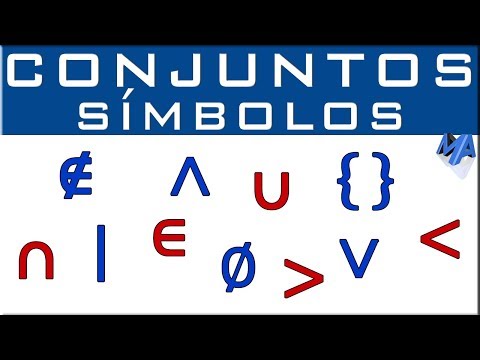
In this section, we will learn about the symbols used in sets and their meanings. We will explore the symbols for membership, such as "belongs to" and "does not belong to," as well as symbols for subsets, empty set, union, intersection, greater than, and less than.
Symbols for Membership
- The symbol "∈" is used to indicate membership or "belongs to" in a set.
- It can be read as "is in" or "is an element of." For example, if we have a set A with elements 1, 2, 3, 4, 5, 6, and 7, we can say that the element 1 belongs to set A.
- Conversely, if an element does not belong to a set (e.g., number 20), it is indicated by crossing out the symbol.
Symbol for Subset
- The symbol "⊆" or ":" is used to represent a subset. For example, if we have two sets A = 1, 2 ,3 ,4 ,5 and B = 3 ,4, we can say that B is a subset of A.
Symbol for Empty Set
- The symbol "∅" represents the empty set or a set with no elements.
Symbols for Union and Intersection
- The symbol "∪" represents the union of two sets. It includes all the elements that belong to either set. For example, if A = 1, 2, 3, 4 and B = 2, 4, 6, the union of A and B is 1, 2, 3, 4, 6.
- The symbol "∩" represents the intersection of two sets. It includes only the elements that are common to both sets. For example, if A = 1, 2 ,3 ,4 and B = 2 ,4, the intersection of A and B is 2 ,4.
Symbols for Greater Than and Less Than
- The symbol ">" represents "greater than," while "<" represents "less than." These symbols are used to compare values between sets or elements within a set.
Symbols for Union and Intersection (Continued)
- The symbols "&" (and) and "|" (or) are often used in conjunction with union and intersection operations. They indicate that the elements belong to both sets or at least one of the sets.
Conclusion
In this video lesson on symbols used in sets, we learned about various symbols such as membership ("belongs to"), subset ("⊆"), empty set ("∅"), union ("∪"), intersection ("∩"), greater than (">"), and less than ("<"). These symbols help us describe relationships between elements in different sets.