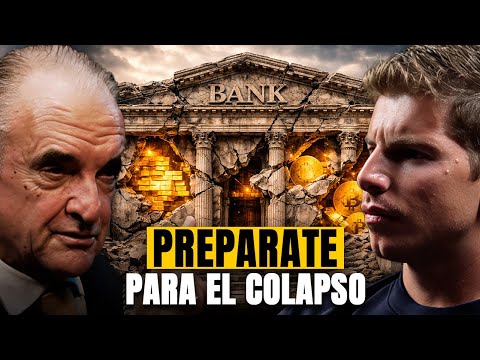
Ex-Banquero Predice La Siguiente Crisis y El Futuro del Sistema Financiero - Mario Conde
Understanding Wealth and Uncertainty
The Concept of Wealth
- The speaker reflects on the meaning of being rich, suggesting that the term is corrosive and complex, especially in uncertain times.
- There are two types of people during uncertainty: those who can navigate it and foresee the future (winners) and those who cannot (losers).
Life Reflections
- The speaker shares a personal perspective on life, expressing a lack of desire to prolong existence despite having lived an extraordinary life filled with challenges.
Financial Insights
- A discussion about N26, a digital bank that allows users to manage their finances without unnecessary fees or complications.
- Emphasizes the importance of not letting savings stagnate while inflation erodes value; many still cling to traditional banks that charge excessive fees.
Personal Journey and Growth
Moving Away for Clarity
- The speaker discusses relocating from their home country to Scotland after enduring 16 years of hardship, seeking peace and clarity.
Academic Pursuits
- In Scotland, they found solace in studying genetics and reflecting on human nature, feeling at ease in their new environment.
Solitude and Self-discovery
- Describes living alone in a hotel where they dedicated time to reading, studying, and finding happiness through solitude.
The Nature of Human Experience
Memories vs. Aspirations
- Reflecting on aging: one becomes old when memories outweigh aspirations. Curiosity remains vital for personal growth.
Personal Loss and Reflection
- After losing his first wife, the speaker discovered letters revealing insights about human growth through knowledge—an essential part of life.
Understanding Oneself
- Discusses self-awareness as crucial for personal development; confronting uncomfortable truths about oneself is necessary for growth.
Philosophical Insights on Imperfection
Human Imperfection
- Highlights that humans are inherently imperfect; our mission is to acknowledge these imperfections while striving for improvement.
Symbolism in Masonry
- The metaphor of humans as uncut stones represents the journey toward refinement—improvement requires effort rather than forceful actions.
Self-Improvement and the Role of Willpower
The Metaphor of Sculpting Oneself
- The speaker uses the metaphor of a hammer and chisel to illustrate self-improvement, where the hammer represents willpower and the chisel symbolizes intelligence.
- Emphasizes that without self-sculpting, individuals may struggle when faced with challenges in life, suggesting that personal development is crucial for success.
Understanding Consciousness and Self-Transcendence
- Discusses recent studies on consciousness, questioning what it means to be better or superior if we abandon transcendental values.
- Shares a poignant quote from a Galician priest about making space in one's heart for goodness, which can be interpreted as nurturing one's higher self.
Materialism vs. True Success
- Critiques modern society's materialistic approach to success, arguing that true achievement should not solely be measured by tangible outcomes.
- Reflects on personal experiences controlling significant economic sectors but highlights an internal struggle with identity and fulfillment.
Inaction and Opportunities for Growth
- Points out that many people fail to reach their potential not due to lack of talent but because of inaction; encourages reflection on personal dissatisfaction with life.
- Introduces artificial intelligence as a tool enabling individuals to pursue opportunities previously inaccessible, urging listeners to take action rather than remain stagnant.
The Impact of Social Media on Youth
- Observes how social media influences young people's lives, shifting focus from living experiences to curating them for sharing online.
- Argues that this shift creates a dependency on external validation rather than fostering genuine self-awareness or growth.
Sharing vs. Authenticity
- Explores the concept of sharing moments versus living them authentically; suggests current trends prioritize projecting curated images over real experiences.
- Raises concerns about individuals knowingly presenting false images of themselves online, warning against the dangers of such disconnection from reality.
Manipulations and the Impact of Social Media
The Nature of Manipulation
- Discussion on physical manipulations that create false images, leading to dissonance when individuals meet in person.
- The destructive nature of presenting a curated image online versus reality; raises questions about authenticity in social interactions.
Delegation of Opinion
- Observations on how people delegate their critical thinking to influencers or podcasters, adopting opinions without personal analysis.
- Historical context provided through a survey indicating reliance on traditional media for forming opinions, now largely replaced by social media.
Ease Over Thoughtfulness
- Acknowledgment that many prefer consuming information passively rather than engaging in critical thought, which is perceived as exhausting.
- Personal anecdote illustrating rapid growth in audience and responsibility after starting a podcast; highlights the unexpected impact of digital presence.
Responsibility and Coherence
- The weight of responsibility felt by content creators when they realize their influence over followers, especially younger audiences.
- Emphasis on good faith in communication; it’s acceptable to be wrong as long as intentions are sincere and not malicious.
Coherence Across Life Experiences
- Reflection on personal coherence throughout life experiences; maintaining moral principles despite challenges is crucial for integrity.
- Definition of coherence tied to having a consistent moral framework that withstands life's tests; emphasizes the importance of being true to one's values.
The Corruption of Power
The Impact of Power on Moral Integrity
- The speaker discusses the challenge of maintaining moral integrity in the face of power, emphasizing that power can corrupt one's moral framework.
- They highlight how wealth and success can lead to vanity, which is described as a significant corrupting influence.
- A personal anecdote illustrates the struggle against vanity, warning that it can subtly undermine one's character over time.
Ambition and Systemic Influences
- The speaker notes that human ambition is boundless, with few individuals genuinely content with their achievements.
- They reference a saying about wealth allowing one to reshape their past, indicating how money can obscure moral transgressions.
- The discussion shifts to the nature of power itself, suggesting that true power involves influencing others and carries inherent risks of corruption.
Testing Moral Structures Under Pressure
- An example from Galicia highlights how even incorruptible individuals may falter when faced with temptations related to power and money.
- The speaker emphasizes that human beings are inherently fragile; moral structures must be tested under pressure to reveal their strength.
Types of Power and Their Consequences
- Different forms of power (political, economic, physical) are discussed, illustrating how they can lead to abuse or corruption.
- Physical dominance is framed as a form of corruption when it leads to mistreatment or aggression towards those who are weaker.
Wealth's Role in Defining Freedom
- Transitioning from a stable profession to immense wealth prompts reflection on what it means to be "rich," particularly regarding freedom from financial constraints.
- The concept of "can we" versus "we can" is introduced as corrosive; wealth alters perceptions about possibilities and choices available in life.
Limitations of Material Wealth
- Despite its liquidity and ability to influence lives significantly, money cannot purchase eternal life or escape death's inevitability.
- Personal reflections on mortality prompt questions about legacy and the future role of technology in human existence.
Human Existence Beyond Materialism
- The speaker contemplates humanity's essence beyond mere biological components, hinting at philosophical discussions surrounding identity and consciousness.
Understanding Human Existence and Mortality
The Nature of Human Existence
- The speaker describes the human condition as having an internal void, where outward solidity is a result of pressure (9.8 m/s²). This metaphor illustrates how external pressures shape our existence.
Cellular Life and Mortality
- Cells are mandated by their DNA to grow and die; trillions die daily in the human body. Tumor cells defy this mandate, leading to uncontrolled growth that destroys surrounding tissues.
Organ Replacement vs. Immortality
- The speaker expresses skepticism about achieving immortality but sees potential in organic interchangeability—replacing organs rather than extending life indefinitely.
Blood Production Dilemma
- Questions arise about why humans cannot produce blood artificially despite advancements in technology. Blood is essential for life, yet its production remains a mystery.
Synthetic Solutions and Longevity
- Advances in synthetic food and organ replacement raise questions about blood renewal's potential impact on longevity, though the speaker expresses no desire for extended life beyond current limits.
The Concept of Time Travel
Time Travel Possibilities
- Discusses theoretical time travel based on speed and space, suggesting that moving at certain velocities could alter perceived time passage significantly.
Limitations of Physical State
- While time travel may be conceptually possible, the speaker emphasizes that one cannot revert to a younger physical state due to molecular deterioration over time.
Perceptions of Death
Acceptance of Mortality
- The speaker reflects on how perceptions of death change with age; while it seems trivial at 30, it becomes more significant at 70. However, he finds comfort in accepting mortality as part of life.
Coping Mechanisms Through Belief Systems
- Many cope with death through beliefs in an afterlife or reunion with deceased loved ones. The speaker admits he once held such beliefs but has since moved past them.
Life Experiences Shaping Perspective
Embracing Life's Journey
- Despite facing hardships—including imprisonment—the speaker views his life positively, emphasizing resilience through challenges as a source of personal strength and insight into human experience.
Value Beyond Wealth
- He contrasts his life's journey with those who inherit wealth without struggle, asserting that true attractiveness lies in overcoming life's seismic challenges rather than material success alone.
What is Legacy and How Does It Relate to Personal Experience?
Understanding Legacy
- The speaker discusses the concept of legacy, describing it as a form of permanence that one leaves behind.
- They reflect on their unique life experiences, particularly in the Spanish financial system, where they gained significant influence at a young age.
- The speaker emphasizes the importance of personal experience over mere ideas, citing Carl Jung's perspective on knowing versus believing in God.
The Role of Experience
- They argue that truth is rooted in personal experience, which encompasses various aspects such as finance, politics, and spirituality.
- The speaker aims to share their experiences rather than just ideas with younger generations facing moral challenges.
Navigating Uncertainty
- Acknowledging human vulnerability to uncertainty, the speaker highlights two types of people: those who can navigate through uncertainty and those who cannot.
- Historical transitions (e.g., from agricultural to industrial societies) are cited as periods marked by uncertainty where foresight is crucial for survival.
Lessons from History
- Personal anecdotes illustrate how failure to foresee changes (like the invention of automobiles) led to losses for previous generations.
- The speaker reflects on family history related to business failures due to an inability to adapt or predict future trends.
Future Challenges and Opportunities
- Current uncertainties include advancements like artificial intelligence and quantum computing that could reshape employment landscapes.
- Predictions indicate significant job losses but also new job categories emerging; however, there will be a lag in adaptation.
Economic Insights
- Discussion includes potential economic solutions like universal basic income due to anticipated job displacement caused by technological advancements.
- The speaker critiques current monetary practices and suggests a return to gold-backed currencies as a more stable economic model.
Understanding USDC and Digital Currency
Differences Between USDC and Traditional Currency
- The speaker explains that purchasing a USDC equates to acquiring one dollar, highlighting the distinction between USDC and virtual dollars.
- Concerns are raised about digital dollars being created at will by politicians, unlike USDC which is backed by actual reserves held by the issuing entity.
- The speaker mentions using USDT outside of Europe, indicating a shift in financial systems where traditional stock trading may become obsolete.
Future of Financial Transactions
- Discussion on how stock exchanges function as networks for transactions; suggests using blockchain technologies like Ethereum or Polygon for faster and cheaper transactions.
- Critique of traditional banking systems, emphasizing the inefficiency of bank transfers compared to instant cryptocurrency transactions.
- A warning that those who fail to adapt to these changes in finance will be left behind.
Value Comparison: Bitcoin vs. Gold
- The speaker compares tokens backed by gold with Bitcoin, noting both have limited supply but differ in their backing mechanisms.
- Reference to JP Morgan's changing stance on Bitcoin from skepticism to acceptance, illustrating evolving perceptions within traditional banking.
Integration of Cryptocurrencies into Banking
- JP Morgan's recent willingness to use cryptocurrencies as collateral for loans indicates a significant shift towards integrating crypto into conventional banking practices.
- Speculation on future scenarios where banks might offer loans directly in cryptocurrencies like USDC rather than fiat currency.
Innovative Banking Models
- Example of Banco Azteca illustrates how traditional retail can integrate banking services effectively through credit offerings tied to consumer goods purchases.
- Reflection on the potential transformation of banking operations as seen through innovative models emerging from different markets.
Understanding Human Behavior and Uncertainty
The Impact of Customer Volume on Business Strategy
- The speaker highlights a significant customer base of 120 million people, emphasizing the frequency of visits (4 to 10 times a year) as a critical factor in business strategy.
- Acknowledging the physical presence and time spent by customers, the speaker considered creating a retail space within a bank to sell tourism products, which was ultimately prohibited by regulatory authorities.
Navigating Fear and Uncertainty
- The discussion shifts to human nature's relationship with uncertainty, suggesting that fear can lead to failure. A metaphorical reference is made to a film illustrating that overcoming fear is essential for success.
- Emphasizing the inevitability of fear, the speaker argues that understanding future trends requires an open mind and continuous information gathering.
The Role of Conservatism in Human Behavior
- The tendency towards conservatism is discussed as humans often resist change due to fear of loss. Historical references are made about resistance to innovation in various industries.
- The conversation touches on how uncertainty shapes human experience and decision-making processes.
Power Dynamics in Society
- A question arises regarding the three pillars of power: banking, political influence, and media control. It notes how traditional media faces challenges from digital platforms.
- The speaker suggests that while new forms of media emerge, traditional power structures will attempt to maintain control over them.
Control Mechanisms in Modern Media
- There’s acknowledgment of existing censorship within social media platforms like Meta, indicating ongoing struggles for control over information dissemination.
- Historical context is provided about how conventional media has evolved with technology; each new medium faced attempts at regulation or control by those in power.
Future Implications for Power Structures
- Current financial regulations are seen as efforts by established powers to adapt and maintain dominance amidst changing societal dynamics.
- Despite societal changes and public debt implications affecting individual futures, there’s skepticism about whether these shifts will lead to substantial changes in power structures.