Tipos de sistemas de información - TPS, MIS, DSS - bases de datos
Introduction to Information Systems Classification
In this section, the video introduces the classification of information systems based on their functions within an organization.
Types of Organizations
- Organizations can be classified into three types: private, public, and individuals.
- Private organizations aim to generate economic benefits for their members. Examples include corporations like Facebook and Google.
- Public organizations focus on providing social benefits to citizens through services such as healthcare, education, security, and tax management.
- Individuals function as organizations themselves within society, managing various aspects of their lives using information systems.
Hierarchy in Organizations
This section discusses the hierarchical structure within organizations and how information systems support different levels.
Organizational Hierarchy
- Despite efforts by modern companies to flatten hierarchies, a functional hierarchy persists with varying levels of decision-making responsibilities.
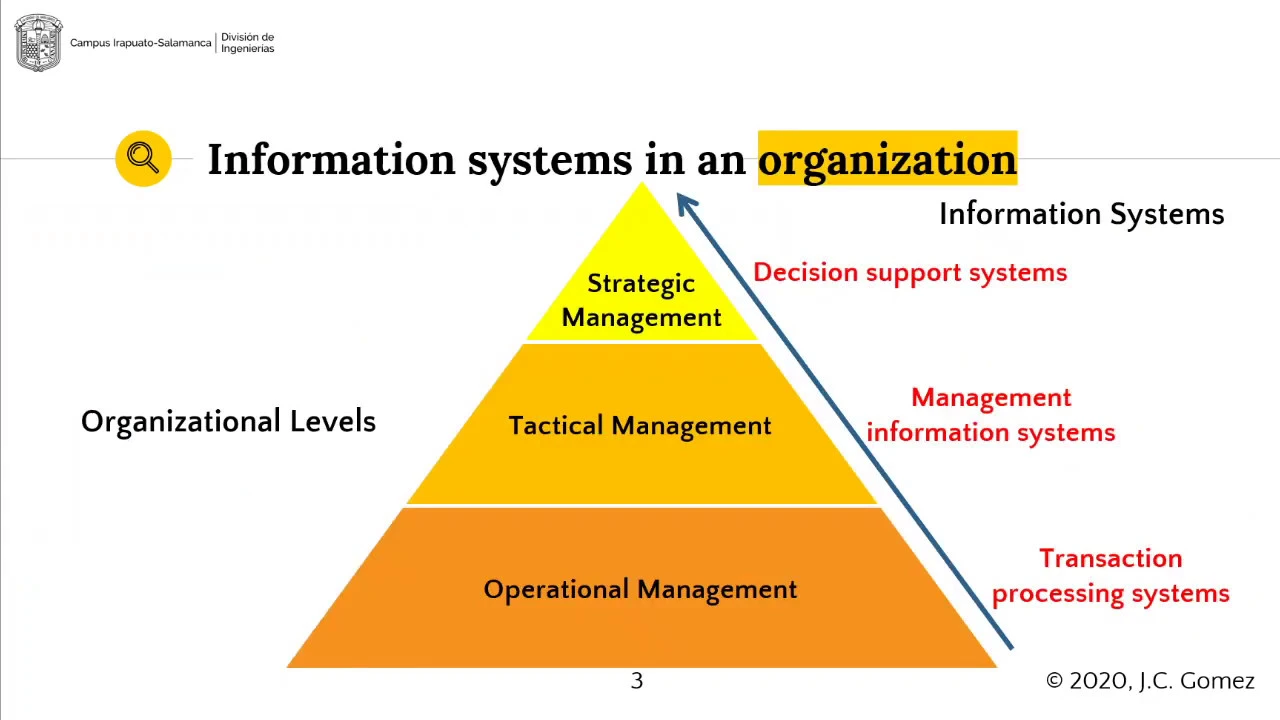
- Organizations are typically divided into operational, tactical, and strategic levels represented in a pyramid structure.
- Different levels correspond to different types of information systems: transaction processing at the operational level, managerial information systems at the tactical level, and decision support systems at the strategic level.
Users and Functions in Information Systems
This section explores users and functions across different levels of organizational hierarchy supported by information systems.
User Roles
- Operational level users perform day-to-day transactions systematically following defined rules set by managers or directors.
Loan Processing Systems and Transaction Processing
This section discusses the loan processing systems and transaction processing within organizations, highlighting the structured nature of operations at the operational level.
Loan Processing Systems
- Loan processing personnel must adhere to specific guidelines for processing loans within a designated timeframe.
Transaction Processing Systems (TPS)
- TPS, associated with the operational level, record day-to-day organizational operations performed by users at this level.
- Transactions consist of a series of steps or processes considered a complete unit, such as making a purchase involving product selection, payment, and receipt.
- TPS only allow structured and predefined operations authorized for users at the operational level like purchases, payments, loan requests, and catalog inquiries.
Types of Transactions in Modern Organizations
This section explores various types of transactions occurring in modern organizations and their significance in business interactions.
Types of Transactions
- Transactions occur continuously worldwide through different channels: business to business, business to consumer, customer to customer, companies to public sector, customers to public sector, and internal organization transactions.
- Examples include point-of-sale systems in supermarkets/pharmacies/departments stores; ticket sales systems in cinemas/airlines/buses; counter service systems like library loans or bank operations; online commerce replacing traditional sales points.
Role of Management Levels in Decision Making
This section delves into the roles played by different management levels—operational, tactical, and managerial—in decision-making processes within organizations.
Management Levels
- Tactical management focuses on determining optimal strategies to achieve specific objectives like increasing sales or production levels within set timeframes.
- Supervisors/managers at this level oversee daily operations ensuring efficiency and effectiveness while planning short-term operation structures for optimal performance towards set goals.
Decision-Making Processes Across Management Levels
Discusses how decision-making varies across management levels—practical users make structured decisions based on established procedures while tactical users blend rules with judgment.
Decision-Making Dynamics
- Practical users handle day-to-day situations following established procedures but may adapt based on circumstances using personal judgment.
- Tactical users make decisions aligning with strategic objectives by resolving non-standard situations or implementing changes for operational improvement.
Forma de Organización y Planificación Efectiva
This section discusses the role of Management Information Systems (MIS) in providing accurate information to the right individuals at the right time and format, aiding in effective decision-making.
Importance of MIS
- MIS plays a crucial role in enabling control, organization, and planning in a more effective manner.
- The primary function of MIS is to provide correct information to the appropriate person in the suitable format and at the right time.
- Managers at tactical levels receive information through reports generated by MIS to facilitate informed decision-making.
Sistemas de Información Gerencial General
The focus here is on how reports generated by Management Information Systems are utilized by tactical managers for monitoring, controlling, and predicting future organizational behavior.
Types of General Managerial Information Systems
- Production Management Systems: Provide reports on production levels within an organization.
- Sales Management Systems: Generate reports on sales activities.
- Budget Management Systems: Responsible for producing expenditure estimates for the organization.
Gestión Estratégica y su Importancia
This part delves into strategic management's significance at the top level of organizational hierarchy, emphasizing long-term planning and vision alignment.
Strategic Management Insights
- Strategic management involves setting long-term plans that form the foundation for company growth over 3 to 10 years.
- Executives and senior-level managers are responsible for designing and overseeing strategic plans' implementation.
Apoyo a la Toma de Decisiones Estratégicas
Discusses Decision Support Systems (DSS) used by executives for complex decision-making aligned with organizational strategies.
Decision Support System Functionality
- DSS aids executives in making non-routine decisions crucial for strategic plans.
- Utilizes data from internal transaction systems, managerial information systems, and external sources like financial reports or news sites.
Funcionalidades Avanzadas de los Sistemas de Soporte de Decisión
Explores how Decision Support Systems employ advanced techniques like mathematical methods and AI models to handle complex data analysis effectively.
Advanced DSS Capabilities
- DSS employs mathematical methods, statistical techniques, and AI models to process large datasets efficiently.
Distinguishing Information Systems
In this segment, the speaker discusses the distinction between general information systems and decision support systems based on their focus and purpose within an organization.
General Information Systems vs. Decision Support Systems
- General information systems (GIS) focus on ensuring the day-to-day operations of the organization run smoothly.
- The primary goal is to make sure that things are done correctly in daily activities.
- Decision support systems (DSS) concentrate on long-term decision-making processes.