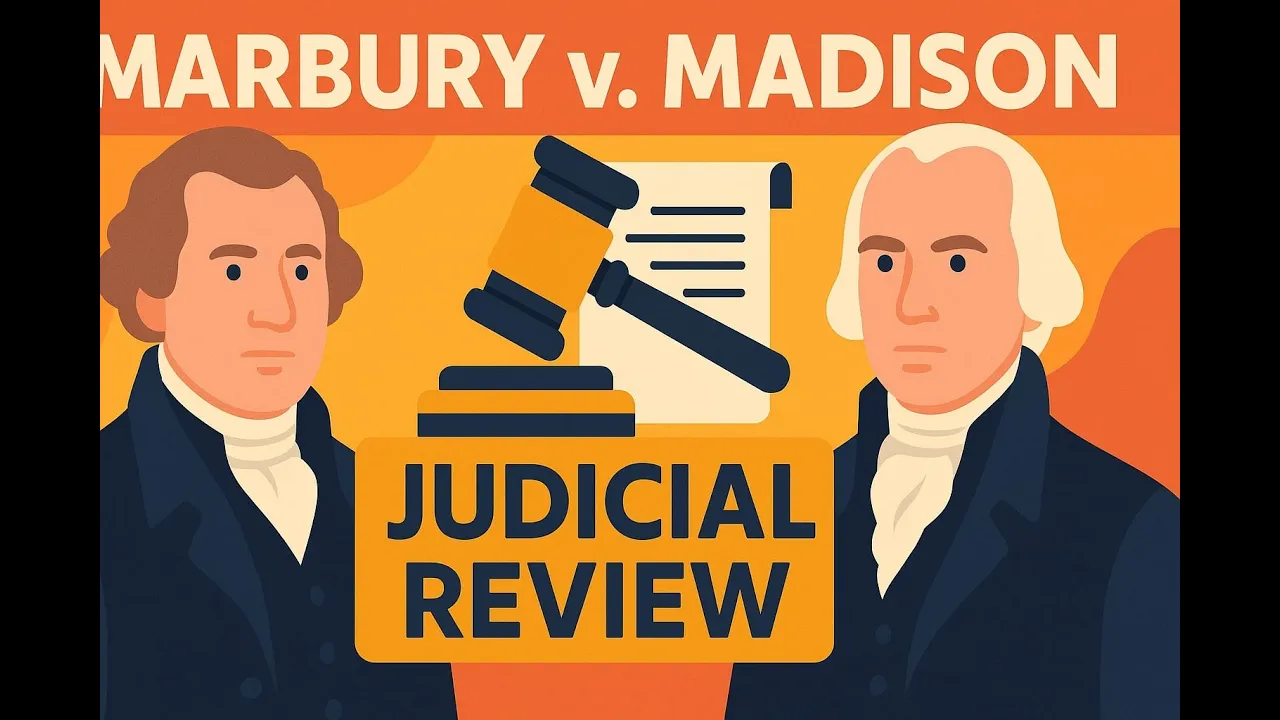
Te Enseño el caso 👨🎓 MARBURY vs MADISON en Español. - Código del Derecho 2#
New Section
The discussion delves into the importance of an unalterable content in the constitution that supersedes the legal system, using a significant U.S. Supreme Court case from 1801 as an example.
U.S. Supreme Court Case: Marbury v. Madison
- Adams made numerous last-minute appointments to undermine Jefferson's presidency, including attempting to appoint John Marshall as Chief Justice.
- Dispute arose when James Madison refused to deliver commissions to appointees; Marbury and others sought relief through legal channels.
- The case reached the Supreme Court based on Section 13 of the Judiciary Act of 1789, which granted original jurisdiction in certain cases.
- Three key elements in deciding a case: competence of the judge, legal framework, and the core conflict or justification for action.
- Chief Justice Marshall posed three critical questions regarding Marbury's rights and protections under the law.
Constitutional Interpretation
This segment explores how judges interpret and apply constitutional principles, focusing on the landmark decision in Marbury v. Madison.
Judicial Interpretation in Marbury v. Madison
- Emphasis on judicial competence, legal framework application, and resolving conflicts guided by constitutional principles.
- Marshall's strategic questioning approach reversed typical legal reasoning sequence for a profound outcome.
- Acknowledgment of Marbury's rights but denial of court jurisdiction led to a groundbreaking ruling by Chief Justice Marshall.
Role of Judges in Constitutional Interpretation
Examining how judges play a crucial role in interpreting and upholding constitutional integrity within legal systems.
Judges' Role in Constitutional Adjudication
- Conflict resolution between Marbury and Madison showcased judges as interpreters ensuring constitutional consistency over political influence.
- By declaring Section 13 unconstitutional, Chief Justice Marshall reinforced judicial authority over constitutional interpretation.
Conclusion
Resolving disputes like Marbury v. Madison highlights the pivotal role of judges in safeguarding constitutional integrity against political interference.
Upholding Constitutional Integrity
The Power of the Judiciary
The discussion revolves around the significant decision made by the judiciary in declaring state laws unconstitutional, highlighting the power vested in this branch of government.
The Role of the Judiciary
- Faculty and judges have previously declared state laws unconstitutional.
- This decision marked the first time such an action was taken on a national scale.
Judicial Power and Representation
- Who should possess the power to overturn laws created by legislative representatives?