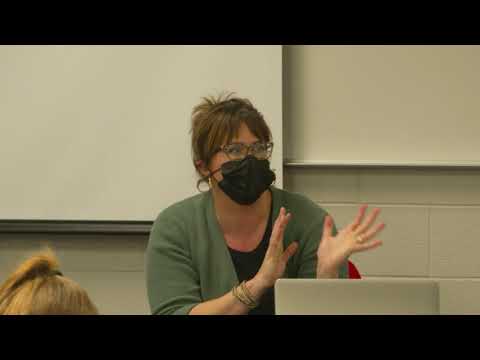
SW150 Presentation: Erin Fisk MSW, Owner, Fisk Solutions LLC
Introduction and Wrap-up Activity
The class is in its final session. Erin, a guest speaker from Fisk Solutions, will be sharing her career journey. There will also be a wrap-up activity, time for questions, and working on the final assessment.
Erin's Career Journey
- Erin introduces herself as someone who enjoys public speaking and encourages students to share what they hope to learn.
- Lindsay provided some questions about career challenges that Erin addresses.
- Erin shares an overview of her career progression, including moving to West Michigan 20 years ago and studying at Grand Valley and Western.
- She initially considered becoming a speech pathologist but switched to social work due to the appeal of helping people reconnect with their lives after brain injuries.
- Erin explains how social work allowed her flexibility in changing roles every few years without needing additional education.
- She discusses the differences between her parents' factory jobs and her desire for variety in her own career.
Internship Experience at Spectrum Health
Erin talks about her internship experience at Spectrum Health and how it shaped her understanding of society.
- Erin completed an internship at Spectrum Health during grad school, where she cross-trained in various departments except bariatrics.
- She started in pediatric intensive care and describes it as peeking behind the curtain of society when everything falls apart.
- After completing her internship, she was hired by Spectrum Health while simultaneously planning a wedding.
Working at Hope Network
Erin discusses her 11-year tenure at Hope Network and the different roles she held there.
- Erin mentions applying for a job at Hope Network through Monster.com without a cover letter but still getting hired as a case manager.
- Over 11 years, she had eight different jobs at Hope Network, including positions where she built and ran new departments.
- Erin highlights her involvement in macro social work, partnering with hospital executives and decision-makers to improve access to mental health services for low-income individuals.
Making Changes in the World
Erin reflects on her career at Hope Network and the impact she felt she made.
- Erin expresses satisfaction in making changes in the world through her work but acknowledges that it wasn't a long-term fit for her.
- She mentions standing up new programs to improve access to care for those already struggling.
- Despite feeling fulfilled by making a difference, Erin realized that Hope Network was not where she wanted to spend her entire career.
The transcript provided does not contain timestamps beyond this point.
The Importance of Communication with Management
The speaker discusses the importance of effective communication between employees and management, highlighting the need for leaders to understand the real issues impacting teams. They mention creating an assessment tool to provide information to leaders and express their secret mission to end ignorance in leadership.
Importance of Communication and Assessment Tool
- Effective communication between employees and management is crucial.
- Many employees feel they lack the ability to talk to management or that management doesn't grasp what's really going on.
- The speaker created an assessment tool to help give information to leaders about turnover and employee mental health.
- Their secret mission is to end ignorance in leadership by opening people's eyes to real issues impacting teams.
Overcoming Challenges in Sharing Mission Publicly
The speaker talks about their secret mission and the challenges they face in sharing it publicly due to potential career implications. They express a desire to educate leaders about important issues but acknowledge limitations in openly discussing their mission.
Secret Mission and Career Implications
- The speaker describes their secret mission as wanting to end ignorance in leadership.
- They compare it to a non-profit endeavor but also mention it sounds cooler like a James Bond mission.
- Due to career considerations, they haven't reached a status where they can openly share this mission on marketing tools.
- They believe openly expressing their mission may hinder job opportunities, especially in West Michigan.
Providing Information and Challenging Ignorance
The speaker discusses their drive to challenge ignorance among leaders by providing them with information. They emphasize that once leaders have been informed, they can no longer claim ignorance regarding biased views or unfair practices.
Challenging Ignorance Among Leaders
- The speaker aims to open people's eyes regarding real issues impacting teams.
- Leaders cannot claim ignorance once they have been informed about certain issues.
- This includes biased views, unfair hiring practices, and other relevant concerns.
Adapting During the Pandemic
The speaker talks about the challenges faced during the pandemic and how they adapted their work. They mention picking up clinical work as a therapist and partnering with a company that provides therapy assistance. They also share some interesting experiences during this time.
Adapting Work During the Pandemic
- The pandemic posed challenges for everyone, including the speaker.
- They picked up clinical work as a therapist and partnered with a company that offers therapy assistance.
- Through this partnership, they had opportunities to meet interesting people, such as the Koch brothers.
- They conducted sessions with employees from various companies, including wineries and Motorola Global Solutions.
Diverse Career Path
The speaker discusses their diverse career path, which includes working as a virtual therapist at BetterHelp and being hired by Pfizer as an on-site therapist. They also mention opening their private practice through Fisk Solutions.
Diverse Career Path
- The speaker worked as a virtual therapist at BetterHelp before being hired by Pfizer as an on-site therapist.
- At Pfizer's Kalamazoo manufacturing plant, they provide support to 5,000 employees involved in vaccine production.
- Additionally, they opened their private practice through Fisk Solutions to offer different types of therapy.
- They are starting a new part of their company to support essential workers through group therapy sessions.
Solution-Focused Therapy Approach
The speaker explains their approach to therapy, which focuses on solution-focused techniques rather than traditional long-term therapy. They also mention plans to develop group therapy sessions for essential workers.
Solution-Focused Therapy Approach
- The speaker's private practice follows a solution-focused therapy approach.
- They typically conduct three sessions to help individuals address their concerns and feel empowered.
- They are developing group therapy sessions for essential workers to provide support and connection.
Challenges in West Michigan
The speaker discusses the challenges they face in West Michigan due to their identity as a Jewish lesbian and their commitment to anti-racism. They mention the low prevalence of the LGBTQ+ population in the area and the need for open discussions about systemic racism.
Challenges Faced in West Michigan
- The speaker faces challenges related to their identity as a Jewish lesbian in West Michigan.
- There is a low prevalence of LGBTQ+ individuals in the area, which can affect acceptance and understanding.
- They actively engage in anti-racist work but acknowledge that openly discussing systemic racism is still relatively new in Grand Rapids.
These notes provide an overview of the main topics discussed in the transcript, highlighting key points and insights shared by the speaker.
Business Ownership and Consulting
The speaker discusses the challenges and rewards of business ownership and consulting in the field of social work. They highlight the importance of learning about systems, business ethics, and professionalism before venturing into entrepreneurship. The speaker also mentions the loneliness that comes with being an entrepreneur and the absence of benefits or vacation time. Additionally, they touch upon the misconceptions surrounding social workers and the need for support and comparison of experiences in dealing with clients' stories of pain.
Challenges of Business Ownership and Consulting
- Many people are hesitant to embrace a systems approach to consulting due to stigma.
- Loneliness is a common experience for entrepreneurs in private practice.
- Lack of benefits or vacation time adds to the mental game of determining when it's appropriate to take time off.
Misconceptions Surrounding Social Workers
- Social workers are often stereotyped as having specific political beliefs.
- Clients may feel compelled to share their family issues, shame, guilt, embarrassment, or childhood trauma with social workers.
Importance of Support and Comparison
- It is helpful for early-career social workers to have a network where they can compare notes and discuss their experiences.
- Many individuals in the field have their own traumatic experiences that inform their work.
- Some social workers find value in believing that their trauma has served a purpose and can benefit others.
Micro vs Macro Social Work Considerations
The speaker shares their perspective on micro and macro social work. They emphasize that macro-level work is composed of various micro-level actions. Understanding intentions, effective communication, empathy, compassion, targeting support towards those who need it most can lead to systemic change.
Micro vs Macro Social Work
- Macro social work consists of multiple micro-level actions within systems established by people.
- Understanding intentions and effective communication can lead to systemic change.
- Empathy, compassion, and targeting support towards those in need are essential for transforming the whole system.
Transitioning from Clinical to Macro-Level Social Work
The speaker discusses their transition from clinical social work to macro-level work. They mention that it was not an intentional decision but rather a result of the job opportunities available. They advise individuals interested in macro-level work to gain experience in micro-level work as well.
Transitioning to Macro-Level Work
- The transition from clinical to macro-level social work was not intentional but influenced by job opportunities.
- Individuals interested in macro-level work should consider gaining experience in micro-level work as well.
The transcript provided does not cover the entire video, so the summary is based on the available content.
Why Sticking with Your Why is Important
In this section, the speaker emphasizes the importance of sticking with your "why" and how it can create a strong connection. The speaker also mentions the Enneagram personality test.
Sticking with Your Why
- Sticking with your "why" creates a micro connection.
- It is important to have a clear purpose and motivation.
The Enneagram Personality Test
- The Enneagram is a personality testing tool.
- It is different from other tests like Myers Briggs or DISC.
- Taking the test can help identify one's dominant number out of nine.
- Understanding one's number can improve interactions with others.
Challenges Faced in the Field
This section discusses some challenges faced by the speaker in their field of work, including exposure to pain and misconceptions about the profession.
Exposure to Pain
- Regular exposure to pain can be addicting.
- It can feel difficult to turn off and may lead to feeling complacent if not engaged in addressing it.
- Making a difference for someone in need can provide a sense of fulfillment.
Compassion for Unexpected Groups
- The field opens one's eyes to compassion for unexpected groups, such as individuals involved in problematic sexual behaviors or crimes.
- Personal experiences, such as surviving sexual abuse, influenced the speaker's career path and compassion towards these groups.
Loneliness and Protecting Others
- Hearing stories of pain can be isolating, leading to loneliness.
- There are certain stories that should not be shared without consent due to their sensitive nature.
- Creating spaces where essential workers are protected from knowing the full extent of suffering can be both necessary but lonely.
Personal Challenges and Growth
This section highlights personal challenges faced by the speaker and their journey towards personal growth, including sobriety and self-discovery.
Losing Oneself
- The speaker experienced challenges in maintaining their own identity while working in the field.
- Misconceptions about the profession and being viewed solely through a political lens can contribute to losing oneself.
Sobriety Journey
- The speaker became sober in support of their spouse's journey.
- This led to personal realization that sobriety was the right path for them as well.
- Quitting smoking was also part of this journey.
Therapy and Personal Growth
- Engaging in therapy has been challenging but ultimately purposeful and transformative.
- Learning from experts like Brené Brown has shown how therapy can lead to positive outcomes.
Timestamps have been associated with relevant bullet points.
The Rewards of Helping Others
In this section, the speaker discusses the rewards they have experienced by helping others and being authentic.
Rewards of Authenticity
- Being told that you are authentic or genuine is considered a compliment in today's society.
- The speaker takes pride in being vulnerable with people who are in pain and offering genuine support.
- Celebrating the success of individuals who have overcome challenges brings immense joy.
Personal Satisfaction
- The speaker finds satisfaction in being able to relate to different experiences and provide personal references to help others.
- They enjoy feeling like they have a deeper understanding of mental health issues and can make a positive impact on their community.
Making an Impact as a Mental Health Advocate
In this section, the speaker talks about their role as a mental health advocate and how they contribute to their community.
Voice for Mental Health
- The speaker takes pride in being the voice of mental health and making a difference in their community.
- They actively participate in organizations such as the Chamber of Commerce and Athena Council to promote mental health awareness.
- Their involvement includes speaking engagements at events like Leadership Grand Rapids.
Imposter Syndrome
- Despite their accomplishments, the speaker sometimes feels like an imposter among other successful individuals.
- They acknowledge that their work involves encouraging people to embrace their emotions and challenge societal norms.
Self-Care Practices
In this section, the speaker shares insights into their self-care practices.
Taking Care of Oneself
- The speaker emphasizes the importance of taking care of oneself through sobriety, therapy, and medication for mental health conditions.
- They mention having obsessive-compulsive disorder (OCD) and anxiety, which they manage with medication.
- The speaker prefers staying at home and using their front room as an office to create a comfortable space for themselves.
Self-Care Misconceptions
- The speaker challenges the misconception that self-care is solely about indulging in leisure activities like bubble baths.
- They believe that taking care of necessary tasks, such as paying bills or calling loved ones, can also be considered self-care.
- Having a structured system to prioritize and accomplish tasks contributes to their overall well-being.
Embracing Individuality
In this section, the speaker discusses embracing their unique qualities and finding comfort in being different.
Embracing Uniqueness
- The speaker acknowledges being different from societal norms in terms of how they openly discuss vulnerability and emotions.
- They have faced criticism and fixed perceptions regarding their approach but have learned to embrace their individuality.
Being True to Oneself
- The speaker finds solace in being true to themselves, even if it means deviating from societal expectations.
- They encourage others not to make assumptions about the saturation of mental health advocacy efforts and join them in making a difference.
Timestamps are provided for each section based on the given transcript.
New Section
In this section, the speaker discusses feeling comfortable discussing topics that others may find difficult to talk about.
Feeling Special and Comfortable
- The speaker feels special because they are comfortable discussing things that others feel they can't say.
- They express a desire to take off their mask and show their true self.
- The speaker mentions the usefulness of LinkedIn for job opportunities and offers their contact information for further communication.
New Section
In this section, the speaker talks about their excitement for helping others and shares some personal experiences with LinkedIn.
Excitement for Helping Others
- The speaker expresses excitement for helping others.
- They mention that LinkedIn is not just for older people but is also a valuable tool for finding jobs.
- The speaker offers to answer questions through email or phone calls and provides their contact information.
New Section
In this section, the speaker discusses assessment tools used in their work.
Performing Assessment Tools
- The speaker explains that they conducted research through Gallup and Harvard Business Review to create valid assessment tools.
- These tools assess various aspects such as mental health, physical health, access to healthcare, perception of leadership teams, support levels, and future plans within the company.
- There is room for qualitative data collection through storytelling and custom-designed questions.
New Section
In this section, the speaker addresses a question about performing assessment tools.
Description of Assessment Tools
- The speaker emphasizes creating assessments that are equally valid for CFOs and HR directors.
- Assessments focus on experiences impacting mental and physical health over the past year, access to healthcare, perception of leadership teams, support levels, and future plans within the company.
- The speaker also mentions offering a confidential space for employees to share their stories and conducting webinars to address employee concerns without calling anyone out.
New Section
In this section, the speaker talks about working with different companies and sharing client experiences.
Working with Different Companies
- The speaker mentions partnering with companies like Mitten Brewing Company and Blue Cross Blue Shield of Michigan.
- These companies have hired the speaker to help improve communication and address issues within their organizations.
- The speaker highlights the importance of maintaining confidentiality when sharing client experiences.
New Section
In this section, the speaker discusses their internship experience at Spectrum.
Internship Experience at Spectrum
- The speaker was the first intern from their school in pediatrics at Spectrum.
- They had the opportunity to cross-train in 14 out of 15 departments at Spectrum.
- The experience allowed them to work as a resource social worker on weekends after their internship.
New Section
In this section, the speaker shares more about their internship experience at Spectrum.
Closure and Variety in Internship
- The speaker found closure by facing pediatric intensive care due to personal experiences involving a family member's death.
- They enjoyed being part of establishing social work internships in pediatrics at Spectrum.
- Working as a resource social worker on weekends provided variety as they worked in different departments each weekend.
New Section
In this section, the speaker talks about root therapy and BetterHelp.
Root Therapy and BetterHelp
- The speaker mentions that they haven't started root therapy yet.
- They discuss BetterHelp, an app similar to Talkspace, and its current controversy.
- The speaker expresses the need to look up the details of the controversy.
New Section
In this section, the speaker shares their experience with Spectrum and cross-training in different departments.
Positive Experience at Spectrum
- The speaker enjoyed their time at Spectrum and appreciated the opportunity to cross-train in various departments.
- They worked as a resource social worker on weekends after their internship, providing support in different departments each weekend.
New Section
In this section, the speaker reflects on their internship experience at Spectrum and personal motivations.
Closure and Motivations
- The speaker found closure by facing pediatric intensive care due to personal experiences involving a family member's death.
- Their motivation for interning in pediatrics was driven by a desire to confront those experiences directly.
New Section
In this section, the speaker discusses group therapy and their involvement with BetterHelp.
Group Therapy and BetterHelp
- The speaker mentions being chosen as a therapist for BetterHelp based on ratings.
- They express willingness to conduct group therapy sessions through BetterHelp.
New Section
In this section, the speaker talks about researching BetterHelp due to recent controversies.
Researching BetterHelp
- The speaker acknowledges that there is controversy surrounding BetterHelp but expresses curiosity about it.
- They mention avoiding any negative situations related to controversies but plan to look up more information about it.
New Section
In this section, the speaker discusses their experience of constantly learning new things and meeting people from different places. They also mention the reluctance of some workers to be called heroes due to low pay. The speaker aims to create a space where people can be themselves and receive support.
Constant Learning and Meeting People
- The speaker mentions that every time they meet with others, there is always something new they learn.
- They highlight the diversity of their interactions, mentioning meetings with people from Glasgow, Scotland; Toronto; and Arkansas.
- Despite being in different locations, they are all part of the same group.
Reluctance to Be Called Heroes
- The community has a mindset of calling certain workers heroes.
- However, these workers do not want to be labeled as such because their pay has not increased despite their efforts.
- The ongoing challenges faced by these workers make them hesitant to accept such titles.
Creating a Safe Space
- The speaker expresses their desire to provide a place where people can remove their masks both literally and figuratively.
- Virtual groups will be established for individuals who prefer anonymity.
- Confidentiality is crucial, and any violation will result in strict consequences.
New Section
In this section, the speaker discusses the pressure faced by anesthesiologists in maintaining perfect mental health due to working with drugs. They also emphasize the importance of virtual therapy in providing access to care for those who may face barriers due to their chosen profession.
Pressure on Anesthesiologists
- Anesthesiologists have significant pressure to maintain exemplary mental health due to their role in sedating patients during surgery.
- This pressure arises from concerns raised by employers regarding mental health issues among anesthesiologists.
Accessing Therapy
- Anesthesiologists cannot openly discuss or seek help for their own struggles due to the nature of their work.
- Seeking therapy locally may lead to concerns about privacy, as someone might recognize them entering a therapist's office.
- Virtual therapy has expanded access to mental health support for professionals in certain fields.
Breaking Barriers to Care
- The speaker aims to address the lack of access to care faced by individuals in specific professions.
- They want to ensure that people who have chosen certain careers do not face barriers when seeking mental health support.
New Section
In this section, the speaker discusses the impact of seasonal factors on stress and mental health. They mention how anesthesiologists experience pressure throughout the year and highlight the importance of addressing seasonal affective disorder. Additionally, they share insights into substance use patterns during different seasons.
Seasonal Factors and Stress
- The speaker acknowledges that stress can be influenced by seasonal changes.
- Anesthesiologists experience pressure consistently throughout the year, regardless of seasons.
Seasonal Affective Disorder (SAD)
- The speaker mentions that in Michigan, many people connect with seasonal affective disorder (SAD).
- They recommend checking with a doctor and taking vitamin D supplements or using a vitamin D lamp as a starting point for managing SAD.
Substance Use Patterns
- Substance use is prevalent during both summer and winter seasons.
- In summer, it is often associated with social activities like barbecuing and boating.
- In winter, loneliness can contribute to substance use, especially in areas with heavy snowfall or among homeless populations.
New Section
In this section, the speaker shares personal experiences related to seasonal affective disorder (SAD) and preferences for different seasons. They also discuss how COVID-19 has impacted mental health on a national level.
Personal Experience with SAD
- The speaker reveals that they personally experience seasonal affective disorder (SAD) during the summer.
- They explain how the intensity of sunlight can affect their mood and create feelings of obligation and pressure.
Seasonal Preferences
- The speaker expresses a preference for the winter season, where people tend to stay indoors, play board games, watch Netflix, and enjoy comfort food.
- They mention experiencing more depression in winter but correct others who complain about the weather, as they personally enjoy it.
Impact of COVID-19 on Mental Health
- The speaker believes that the mental health impact of COVID-19 will require a longer recovery period than anticipated.
- They have observed more individuals reaching their breaking point due to various factors such as technology learning curve, job cuts, underemployment, and limited access to support services.
New Section
In this section, the speaker discusses the challenges faced by individuals during COVID-19. They highlight job losses, underemployment, and the divisive nature of public opinion regarding support for those affected by pandemic-related restrictions.
Challenges Faced During COVID-19
- Many individuals have experienced job cuts or losses during the pandemic.
- Older generations or those less familiar with technology faced challenges adapting to new technological requirements.
- Childcare and transportation limitations added additional stressors for those trying to make ends meet.
Divisiveness in Public Opinion
- There is a divide between those who are underemployed but managing to make ends meet and those who judge them for seeking support.
- Some people mistakenly believe that unemployment benefits provide substantial income when in reality they are often limited.
Due to time constraints mentioned earlier in this transcript, further sections could not be summarized.
New Section
In this section, the speaker discusses the tendency to compare and validate one's suffering during tragic times. They also touch upon the challenges of coming together as a community during difficult situations.
The Suffering Olympics
- During tragic events, there is a tendency for individuals to feel the need to prove their suffering.
- People may downplay their own pain because they didn't experience certain specific hardships.
- On the other hand, some individuals may question why others seem to be coping better despite going through significant suffering.
Difficulty in Coming Together
- Instead of uniting, people find it challenging to come together during times of tragedy.
- The speaker invites questions from the audience.
New Section
In this section, an audience member shares their perspective on how comparing and validating suffering has become normalized. They also inquire about why recovery from difficult times seems to take so long.
Normalization of Comparing Suffering
- The audience member expresses that they have always considered comparing suffering as normal.
- They believe that others are waiting for the speaker's insights on this matter.
Recovery Time
- The audience member agrees with the idea that recovery takes an extensive amount of time.
- They ask why it seems to be taking so long and acknowledge that it might be a deep question.
- The speaker assures them that there are no limitations on discussing such topics.
New Section
In this section, the speaker reflects on the resistance towards healing and getting better. They provide a metaphorical response to address why recovery might be taking longer than expected.
Refusal to Get Better
- The speaker acknowledges the resistance towards healing and getting better.
- They compare it to a situation where one refuses to touch something unpleasant.
Lesson on Brain Functioning
- The speaker uses a lesson on brain functioning to address the question raised by the audience member.
- They explain the three-part system of the hind brain, mid-brain, and frontal lobe.
- The ideal scenario is for all three parts to work together effectively.
New Section
In this section, the speaker further explains the functioning of different parts of the brain and how they relate to meeting basic needs and building relationships.
Three Parts of Brain Functioning
- The speaker elaborates on the three parts of brain functioning: hind brain, mid-brain, and frontal lobe.
- Each part needs to be satisfied before moving onto the next for optimal functioning.
Basic Needs and Survival
- The hind brain is responsible for accessing basic needs such as shelter, healthcare, transportation, and financial stability.
- It compares these needs to being in a cave with active lions outside. Survival becomes the primary focus until those needs are met.
Relationships and Connection
- The mid-brain is associated with relationships and connections within a community or family.
- It involves having someone next to you in the cave who supports your basic needs.
New Section
In this section, the speaker discusses how distress can affect physical reactions related to eating, sleeping, and going to the bathroom. They emphasize that unconditional support is crucial for vulnerability during difficult times.
Physical Reactions in Distress
- Distress can lead to physical reactions such as eating too much or too little, sleeping too much or too little, and changes in bathroom habits.
- These reactions reflect the need for a sense of safety and support during challenging times.
Unconditional Support
- The speaker highlights the importance of having someone who unconditionally supports you during distress.
- This support allows for vulnerability and the assurance that someone will have your back when facing difficulties.
New Section
In this section, the speaker addresses the common struggle of individuals shaming themselves for not being able to cope effectively. They explain that humans were not designed to handle everything on their own and that self-care is essential.
Deficits in Coping
- Many individuals enter therapy because they struggle with deficits in coping with challenges.
- They often blame themselves for not being able to handle situations better.
Humans Were Not Designed to Handle Everything Alone
- Humans were not meant to handle everything alone but rather rely on others for support.
- The speaker emphasizes that now is not the time to worry about future planning but instead focus on meeting basic needs and seeking support.
New Section
In this section, the speaker suggests that recovery might be taking longer due to the lack of basic needs being met. They compare it to fighting lions outside a cave and emphasize the importance of addressing these challenges collectively.
Lack of Basic Needs Met
- Recovery might be taking longer because many people do not have their basic needs met.
- The speaker compares it to fighting lions outside a cave before focusing on other aspects of life.
Collective Effort Needed
- To overcome challenges, it is crucial for communities to come together and address the obstacles collectively.
- The speaker highlights the importance of fighting the lions as a united front.
[t=0:53:23s] Appreciating the Knowledge
The speaker expresses gratitude for receiving an answer and emphasizes the importance of knowledge.
The Value of Learning from Gabrielle
- The speaker acknowledges that everyone is eagerly waiting for Gabrielle, who is described as a knowledgeable and respectful professor.
- The speaker identifies themselves as a "Gabrielle" and appreciates the opportunity to learn from Gabrielle throughout the semester.
- A personal comment is made about how the speaker has learned a lot in just one hour from what they are currently doing.
Impactful Clinical Work
- The speaker commends Erin's clinical expertise and recalls a specific memory of Erin supervising others. Erin's ability to offer support on both individual and systemic levels is highlighted.
- A powerful lesson learned from Erin is shared, involving a case where Erin provided hope to a client struggling with an eating disorder while in the hospital.
- The impact of holding onto hope in personal life and working with systems is discussed, emphasizing its relevance in various social work contexts.
Holding onto Hope
- The speaker expresses gratitude for Erin's sharing and reflects on their belief in holding onto hope. They mention John Mayer's song "The Heart of Life" as something that resonates with this concept.
- It is emphasized that one does not have to wait until entering the field to hold onto hope for someone else. Vulnerability plays a role in seeking help or supporting others.
[t=0:57:45s] Advocacy and Personal Experience
The speaker transitions to discussing advocacy work and shares a personal story related to their spinal condition.
Advocacy Work
- The speaker acknowledges the importance of advocacy work and expresses admiration for the person who brought up this topic.
- A brief personal story is shared, highlighting the speaker's experience with genetic testing, spinal issues, and the need for fusion surgery.
Challenging Health Journey
- Details about the speaker's spinal condition, spondylolisthesis, are provided. They describe the extensive surgical procedure they underwent at 33 years old.
- The speaker recounts a difficult period leading up to the surgery, including using a walker and experiencing temporary paralysis due to stress. Mental health challenges during this time are also mentioned.
[t=1:00:10s] Holding onto Hope in Difficult Times
The speaker reflects on maintaining hope during challenging experiences and emphasizes the importance of vulnerability and support.
Finding Hope Amidst Challenges
- The speaker discusses how their personal experiences have shaped their understanding of hope. They mention that even in difficult times, it is possible to find hope.
- Vulnerability is highlighted as an essential factor in seeking support from others during challenging moments.
- The importance of creating spaces where individuals can hold onto hope for themselves or others is emphasized.
[t=1:02:05s] Conclusion
The video concludes with final thoughts on holding onto hope and expressing gratitude for sharing personal stories.
Final Thoughts on Hope
- The speaker reiterates the significance of hope and expresses gratitude for the opportunity to share personal stories.
- The importance of vulnerability, support, and creating spaces for hope is emphasized once again.
Timestamps are approximate and may vary slightly.
A Difficult Moment on the Bathroom Floor
The speaker describes a distressing moment when they were on the bathroom floor feeling sick, and their four-year-old daughter walked in and asked what was wrong.
A Scene of Distress
- The speaker found themselves on the bathroom floor, feeling unwell.
- Although not a scene typically associated with drug use, it was still unpleasant.
- Their four-year-old daughter entered the room and asked about their condition.
Seeking Help for Mental Health Issues
The speaker shares their experience of seeking help for mental health issues after reaching a breaking point. They discuss being diagnosed with OCD at 15 and trying various medications before finding a solution.
Reaching Out for Assistance
- Overwhelmed by pain and mental anguish, the speaker sought help from their primary care doctor.
- Despite having knowledge of mental health due to working in the field, they didn't know how to help themselves.
- Their doctor took a different approach by suggesting genetic testing to determine suitable medication.
Genetic Testing as a Solution
The speaker explains how genetic testing, specifically through GeneSight, helped them find appropriate medication. They highlight the process of obtaining the test and receiving personalized recommendations based on the results.
GeneSight Genetic Testing
- GeneSight is a genetic testing service that provides data-driven medication recommendations.
- Doctors can request this test for patients who may benefit from personalized medication guidance.
- By taking ten swabs inside your cheek, you provide DNA samples for analysis.
- Within three weeks, you receive a seven-page packet with personalized recommendations categorized into traffic light colors (red - avoid, yellow - cautionary, green - likely to be effective).
- The test covers pain medication, mental health medication, ADHD treatment, and folic acid supplementation.
Overcoming Trial and Error with Medication
The speaker emphasizes the challenges of finding the right medication for invisible illnesses like mental health conditions. They express their admiration for GeneSight's approach and even considered working for the company.
Turning Trial and Error into Triumph
- Mental illness is often invisible, making it difficult for others to understand the struggle.
- It can take weeks or months to determine if a medication is effective.
- GeneSight's personalized recommendations aim to reduce trial and error by providing targeted options.
- The speaker was so impressed with GeneSight that they wanted to work for the company.
Insight into Working with GeneSight
The speaker shares their personal experience with GeneSight and expresses gratitude towards the company. They mention attempting to secure a job opportunity but ultimately not being able to pursue it.
Personal Connection with GeneSight
- The speaker reached out to a GeneSight representative after their positive experience.
- They expressed how GeneSight had saved their life and inquired about potential job opportunities.
- Unfortunately, due to circumstances beyond their control, they were unable to secure a position at GeneSight.
Transforming Genetic Testing into an Impactful Story
The speaker reflects on how storytelling can make information more memorable. They use the example of sharing their own story about GeneSight as a way of creating awareness and understanding.
Making Genetic Testing Memorable
- Sharing personal stories can help people remember important information.
- By telling their own story about using GeneSight, the speaker hopes to make the concept more memorable for others.
Exploring Different Fields of Social Work
The speaker asks about the various types of social work and populations that have been encountered or learned about through their studies. They express interest in working with Child Protective Services (CPS) and the police.
Exploring Social Work Specializations
- The speaker is considering a career in CPS, particularly working with the police.
- They recently interviewed a police officer who highlighted the stigma surrounding mental health as a significant issue.
- Many calls received by the police involve individuals experiencing mental health crises.
Discovering NICU Social Work and Hospital Settings
The speaker expresses excitement about exploring different areas of social work, including NICU social work, hospital settings, and pediatrics. They share their surprise at learning about these specializations during their studies.
Interest in Hospital-Based Social Work
- The speaker's interest has expanded to include NICU social work, which involves supporting families dealing with substance use and birth defects.
- They were surprised to discover the role of social workers in hospitals, where they assist doctors and handle sensitive situations such as substance use cases.
- Hospital social work can also involve emergency rooms, pediatric units, and PICUs (Pediatric Intensive Care Units).
Challenging Aspects of Hospital Social Work
The speaker discusses some challenging aspects of hospital social work, including confronting people who may be dishonest or dealing with difficult situations involving child protection services.
Demanding Aspects of Hospital Social Work
- Hospital social work often involves confrontation with individuals who may not be truthful.
- In cases involving child protection services (CPS), social workers play a crucial role in assessing and intervening when necessary.
- Social workers may be responsible for informing doctors about a family's intoxication while they are present in the room.
These notes provide a comprehensive summary of the transcript, highlighting key points and insights discussed by the speaker.
The Importance of Choosing a Career Path
In this section, the importance of choosing a career path is discussed.
Considering Different Career Paths
- It is important to consider different career paths and explore various options.
- Interacting with others who have chosen different career paths can provide valuable insights.
Exploring Fresh Start Opportunities
- Embracing the idea of a fresh start in a new career can be exciting.
- Don't feel pressured to choose one specific career path for the rest of your life.
- It's okay to change careers and view past experiences as valuable lessons.
Potential Career Choices
- Consider working with children, CPS (Child Protective Services), or substance abuse issues.
- Clinical social work with adolescents or trauma victims is also an option.
- Working with sex trafficking victims or as a medical social worker are other possibilities.
Understanding Measurement and Reimbursement in Social Work
- It's important to understand how your job performance will be measured and what metrics are used for reimbursement purposes.
- Consider whether the measurement criteria align with your values and goals in social work.
Importance of Working with Vulnerable Populations
- Working with youth requires compassion, empathy, and understanding their vulnerability.
- Recognize that working with parents and systems may present challenges beyond just working directly with children.
Personal Growth and Adaptability
- Personal growth, self-reflection, and life experiences can shape career choices.
- Don't be discouraged by initial doubts or negative opinions from others.
Balancing Lifestyle and Passion
- Social work may not always provide the desired lifestyle, but passion for the field can make it fulfilling.
Understanding the Role of Social Work in Different Systems
This section explores the role of social work within various systems and highlights the importance of understanding how social work is viewed and valued.
The Business Aspect of Social Work
- Social work involves more than just emotions; it also has a business aspect to consider.
- Reimbursement, financial considerations, and system priorities play a role in social work practice.
Aligning Values with Measurement Criteria
- It's crucial to align personal values with measurement criteria used in social work settings.
- Consider whether your goals align with those of the organization or corporation you are working for.
Importance of Various Roles in Social Work
- All roles within social work are important, including CPS workers, police officers, emergency room staff, etc.
- Each role requires compassionate individuals who listen and hold hope for others' well-being.
Personal Growth and Career Development
This section focuses on personal growth, self-discovery, and career development.
Embracing Change and Self-Awareness
- Personal growth often comes through embracing change and being open to new perspectives.
- Age and life experiences can contribute to increased self-awareness when making career choices.
Supportive Family and Changing Perspectives
- Initially, family members may have doubts about chosen career paths but can become supportive over time.
- Changing perspectives and personal growth can lead to unexpected career choices.
Balancing Lifestyle and Passion
- Social work may not always provide the desired lifestyle, but passion for the field can make it fulfilling.
Reflection on Social Work and Salary
The speaker reflects on their experience of making a six-figure salary for the first time and discusses the societal perception of social work.
- The speaker acknowledges that social work is often considered thankless and requires self-motivation.
- They emphasize that pursuing a degree in social work has no limits in terms of career opportunities.
- The speaker shares an anecdote about their father asking about potential earnings in the field, but they prioritize their passion for helping others over monetary gain.
- They encourage individuals to have clarity about their life goals, as many people struggle with finding their purpose.
- It is mentioned that there are ways to make a good income in social work while still prioritizing values and advocating for oneself.
Advocating for Financial Well-being in Social Work
The importance of recognizing one's value and advocating for financial well-being in the field of social work is discussed.
- Many social workers struggle with asking for raises or acknowledging their worth due to the belief that money should not be the primary focus.
- It is highlighted that it can be challenging to ask for more money at any job, but it is essential to recognize one's value and advocate accordingly.
- The speaker suggests considering sustainability for oneself and family when choosing jobs or staying with companies long-term.
- Balancing financial stability with caring and giving is emphasized as a valid approach.
Personalizing Your Career Path in Social Work
The importance of personalizing one's career path in social work based on individual needs and preferences is discussed.
- It is encouraged to find what works best for oneself, such as purchasing health insurance independently or working multiple roles to supplement income.
- Recognizing that different systems have varying payment structures, individuals are advised to be aware of what they are getting into and open-minded about alternative options.
- The speaker emphasizes the importance of serving others while also having a lifestyle that aligns with one's financial needs.
Solution-Focused Therapy Approach
The concept of solution-focused therapy is introduced, highlighting its focus on present and future goals rather than dwelling on past experiences.
- Solution-focused therapy differs from other approaches by minimizing the time spent on discussing the past and instead focusing on current challenges and desired outcomes.
- Strategies such as identifying cognitive distortions, practicing mindfulness, and utilizing relaxation techniques are mentioned as part of solution-focused therapy.
- Other therapeutic approaches like dialectical behavior therapy and trauma-informed care are briefly mentioned but not elaborated upon.
Gene Testing for Medication Effectiveness
The benefits of genetic testing in determining medication effectiveness are discussed.
- A company called Gene Site is mentioned, which offers genetic testing to minimize trial-and-error in finding suitable medications.
- The goal is to provide individuals with a more efficient path towards overcoming their challenges by identifying medications that will work effectively for them.
Decision-Making Process
The speaker mentions having multiple decisions to make and reflects on the complexity of decision-making.
- The speaker acknowledges having various choices to consider but does not provide specific details or context regarding these decisions.
Turn any video into a summary like this
YouTube links, meetings, lectures. With transcripts, search, and chat.