Tautología, contradicción y contingencia
Understanding Tautologies, Contradictions, and Contingencies
Introduction to Key Concepts
- The video introduces the concepts of tautology, contradiction, and contingency in propositional logic.
- Definitions will be provided along with examples to clarify these concepts.
What are Tautologies?
- A tautology is a proposition that is true for all possible truth values of its variables.
- When constructing a truth table for a tautology, the final result will always yield true.
Understanding Contradictions
- Contradictions are propositions that are false for all possible truth values of their variables.
- In a truth table, if the final result is always false, it indicates that the proposition is a contradiction.
Exploring Contingencies
- Contingencies lie between tautologies and contradictions; they can be either true or false depending on the truth values assigned.
- A truth table for contingencies will show some true and some false results.
Practical Examples
Example 1: Truth Table Construction
- The first example involves creating a truth table for a simple proposition (p).
- The number of rows in the truth table corresponds to 2^n, where n is the number of simple propositions. Here, n = 1 leads to 2 rows.
Example 2: Negation in Propositions
- The negation of p must be included in the truth table; if p is true, then not p is false and vice versa.
Example 3: Evaluating Logical Operations
- For the operation "p or not p," since at least one value will always be true regardless of p's value, this confirms it as a tautology.
Example 4: Further Proposition Analysis
- Another proposition involving logical conjunction (and/or operations with negations) requires similar steps to evaluate its nature through its truth table.
Contradictions and Tautologies in Propositional Logic
Understanding Contradictions
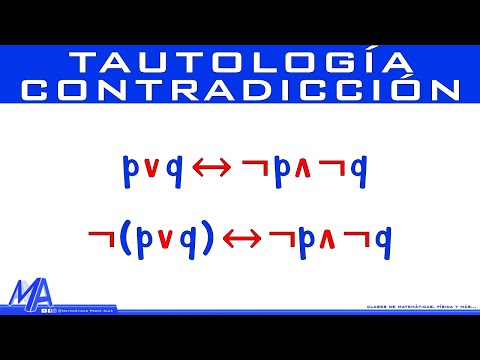
- The speaker introduces the concept of a contradiction, stating that a certain proposition is entirely false, which defines it as a contradiction.
Practice Exercises
- The speaker suggests pausing the video to complete an exercise related to the discussed propositions, indicating that viewers can practice on their own.
Conditional Propositions and Tautologies
- A key point is made about compound propositions involving the "if and only if" symbol (↔), emphasizing that tautology occurs only under specific conditions.
- The discussion highlights the importance of verifying equivalence between two propositions using this conditional symbol, which is crucial in propositional logic.
Evaluating Truth Values
- The speaker explains how to determine if a proposition is equivalent by checking if it results in a tautology. If so, it indicates equivalence between the original proposition and its negation.
Constructing Truth Tables
- To construct truth tables for two simple propositions (p and q), four combinations are created since there are two variables (2² = 4).
- The process begins with writing down both simple propositions clearly before proceeding to create their truth values.
Steps for Truth Table Construction
- Operations within parentheses should be addressed first; however, since there are none here, negations are performed next—specifically negating p and q.
- After determining the negations of p and q based on their initial truth values, these new values will guide further operations.
Logical Operations: Conjunction and Disjunction
- Following negation, conjunction (AND operation) or disjunction (OR operation) is performed. For instance, evaluating p OR q reveals when at least one value is true.
- The speaker notes that conjunction yields true only when both operands are true; thus they analyze each combination for validity.
Finalizing with Conditional Relationships
- After completing previous steps, the final operation involves establishing conditional relationships between left-hand side expressions and right-hand side expressions.
- This step includes applying "if and only if" logic to assess whether both sides yield equivalent truth values based on their relationship.
Identifying Contradictions vs. Tautologies
- A critical observation is made regarding whether the resulting expression represents a tautology or contradiction; in this case, it turns out to be a contradiction due to opposing truth values across comparisons.
- The speaker emphasizes understanding contradictions as they represent completely opposite truths within logical frameworks.
Conclusion: Practical Application
- Viewers are encouraged to apply what they've learned by constructing their own truth tables for given propositions as practice exercises.
Understanding Logical Operations in Propositional Logic
Introduction to Logical Operations
- The speaker discusses the order of operations in logical expressions, emphasizing that operations within parentheses are prioritized.
- It is noted that a conjunction (AND operation) is only false if both propositions are false; otherwise, it is true.
Negations and Their Impact
- After performing operations inside parentheses, negations are applied. There are three negations: one for the entire expression and two for individual propositions p and q .
- The results of these negations lead to a new set of truth values, where the original true values become false after negation.
Conjunction and Disjunction
- The speaker explains how to determine the truth value of conjunctions (AND) and disjunctions (OR), noting that they have already established some distinctions previously.
- A conditional statement's truth value depends on whether its left and right propositions are equivalent; if they match, it is true.
Tautologies in Propositional Logic
- The discussion highlights that when both sides of a conditional statement yield the same truth value, the overall proposition becomes a tautology.
- The speaker emphasizes that this tautology indicates equivalence between two propositions based on their truth values.
Conclusion and Further Learning
- The session concludes with an invitation for further practice exercises related to logical operations discussed during the class.