Getting to Mars: The Hohmann Transfer
Mission Planning to Mars
Introduction to the Mission
- The video explores concepts from "Orbital Mechanics 101" to plan a mission to Mars.
- Focus is on determining the time required to reach Mars from Earth.
- Discussion includes necessary Delta V (change in velocity) for the trip, with some mathematical calculations involved.
- Consideration of optimal launch windows and whether a one-way or return mission is preferable.
Understanding Orbital Dynamics
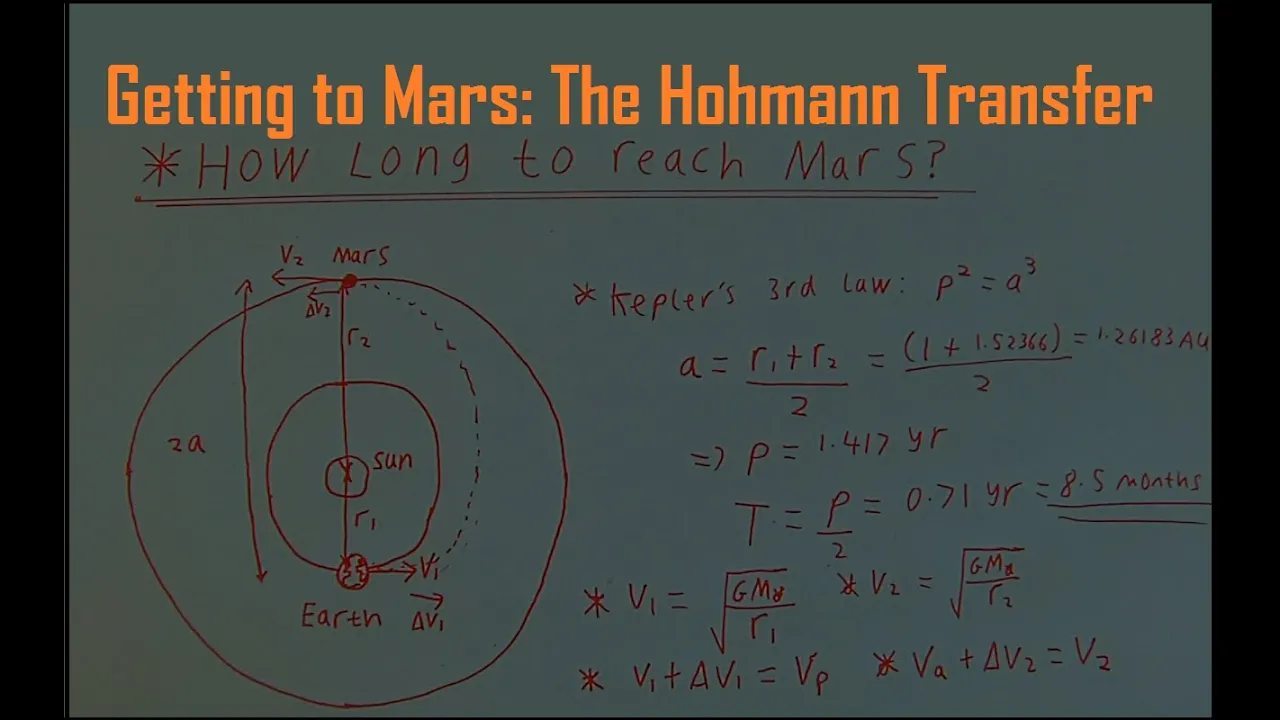
- A diagram illustrates the inner solar system, showing the positions of the Sun, Earth, and Mars.
- Earth orbits at a distance of one astronomical unit (R1), while Mars orbits further out (R2).
- To reach Mars, an increase in velocity (Delta V1) is needed to transition from Earth's orbit into an elliptical transfer orbit towards Mars.
Calculating Transfer Time
- The elliptical orbit will drift outward until it aligns with Mars' orbital distance; additional velocity (Delta V2) is required to match Mars' speed upon arrival.
- Kepler's third law is introduced as a method for calculating orbital periods based on semi-major axes.
Applying Kepler's Third Law
- The semi-major axis of the transfer orbit can be calculated using distances between the Sun, Earth, and Mars: (R1 + R2)/2.
- Using known values for R1 and R2 leads to a semi-major axis measurement of approximately 1.26183 astronomical units.
Determining Travel Duration
- Substituting this value into Kepler's third law yields an orbital period of about 1.417 years if no additional Delta V were applied during transit.
- Since only half of this elliptical path is traveled towards Mars, the actual travel time becomes approximately 0.71 years or about 8 months and 5 days.
Factors Affecting Travel Time
- Acknowledgment that real-world factors such as Jupiter's gravity and non-circularity of Martian orbit could affect calculations but are minor in impact compared to approximations made here.
Preparing for Delta V Calculations
- Equations are set up for calculating velocities V1 (Earth’s orbital speed) and V2 (Mars’ orbital speed), which depend on gravitational constants and distances measured in meters rather than astronomical units.
Understanding Orbital Mechanics: Velocity and Energy Conservation
The Concept of Apogee and Velocity Changes
- The discussion begins with the concept of apogee, where a spacecraft is at its highest point in an elliptical orbit. A small increase in velocity (delta V2) is necessary to transition into a circular orbit.
- To determine the velocities VP (velocity at perihelion) and VAR (velocity at aphelion), two key equations are introduced: conservation of energy and conservation of angular momentum.
Conservation Equations
- Angular momentum is conserved; it can be expressed as the product of mass, velocity at perihelion (V1), and radius (R1). This must equal the angular momentum at aphelion, represented by mass times velocity at aphelion (VA) times radius (R2).
- The conservation of energy equation involves kinetic energy at perihelion minus gravitational potential energy, equating it to similar terms for aphelion. This sets up the framework for calculating delta V values.
Deriving Velocity Expressions
- By manipulating the angular momentum equation, VA can be expressed in terms of VP using R1 and R2. This relationship simplifies further calculations.
- After substituting VA into the energy conservation equation, a simplified expression for VP squared emerges: VP^2 = frac2GM_SunR_2R_1(R_1 + R_2).
Calculating Delta V Values
- To find delta V1, subtract V1 from VP. The formula derived indicates that delta V1 depends on gravitational parameters and distances involved.
- For delta V2, substitute VP back into the earlier equations to derive its value based on known variables.
Final Results for Delta V Calculations
- The final expressions for both delta V values are presented clearly:
- Delta V1: sqrtfracG M_SunR_1 left( sqrt2 R_2/R_1 + R_2 - 1right)
- Delta V2: sqrtfracG M_SunR_2 left( 1 - sqrt2 R_1/R_1 + R_2right)
Rocket Launch Timing and Delta V Calculations
Understanding Mars Launch Timing
- The timing of the rocket launch is crucial to ensure it reaches Mars, as launching at the wrong time could result in missing the planet due to its orbital movement.
- The key question is determining where Mars should be positioned in its orbit when preparing for launch.
- To calculate this, a ratio involving the time spent traveling and Mars's orbital period is established.
Calculating Orbital Angles
- The angle that Mars moves during the travel time can be calculated using a formula based on its total orbital angle (360 degrees).
- The travel time to Mars is approximately 8.5 months, which converts to about 0.71 years.
- This leads to a calculation showing that Mars must be 44 degrees ahead of Earth at launch for successful arrival.
Return Mission Considerations
- A quick analysis compares fuel requirements between one-way missions and return missions from Mars.
- The discussion introduces the rocket equation, which relates delta V (change in velocity) to fuel consumption.
Rocket Equation Insights
- The rocket equation involves calculating mass ratios based on initial and final masses concerning delta V and exhaust velocity.
- If returning from Mars requires doubling the delta V used for departure, this significantly impacts fuel needs—specifically reducing mass by a factor of 7.
Discussion Points
- Viewers are encouraged to consider advantages and disadvantages of one-way versus return missions to Mars, prompting engagement through comments.