How Robots Could Help Retailers Save Billions
Inventory Robots: The Future of Retail?
This video discusses how autonomous robots are being used to verify price signs, look for out-of-stock items, and capture images of shelves. These images are then uploaded to a cloud environment to determine what products are out-of-stock, mispriced or in the wrong position. The use of inventory robots is becoming increasingly popular as retailers face challenges with missed sales from empty shelves and out-of-stock items.
The Challenge of Inventory Management
- Inventory management is one of the biggest challenges retailers face.
- Missed sales from empty shelves and out-of-stock items cost US retailers $82 billion in 2021.
- Almost half of retailers said out-of-stock items were their biggest challenge in fulfilling customer orders.
- Retailers are using robots and automation to fill physically intensive tasks while having people do skills that require brainpower.
Impact on Retailers and Workers
- Almost 900,000 retail jobs were unfilled at the end of November 2022 due to a tight labor market.
- The inventory robot market is a $34 billion industry with other companies like Simbe Robotics and Bossa Nova Robotics also competing.
- Keeping shelves fully stocked has been a full-time job for retailers in recent years due to supply chain issues caused by fewer truck drivers, higher fuel prices, supplier issues, severe weather, changing consumer preferences, etc.
- An out-of-stock item is when a shopper leaves a store without purchasing what they intended to buy.
Evolution of Brick-and-Mortar Stores
- Correct inventory management is key for retail operations as it ensures the correct amount of inventory is on hand and available to shoppers.
- In the past, physical counts were used to reconcile data with reality, but this could take weeks.
- Not having a product available for purchase can be disastrous for a retailer.
Overall, inventory robots are helping retailers evolve and capture new markets where customers can order online and pick up in-store. The use of robots is also allowing workers to focus on tasks that require brainpower while filling physically intensive tasks with automation.
Surplus Inventory and Robotics in Retail
This section discusses the problem of surplus inventory in retail, how it can lead to losses for retailers, and how robotics and automation are being used to manage inventories more efficiently.
Surplus Inventory
- Surplus inventory is when a retailer has too many products on hand that need to be heavily discounted.
- Retailers who invest all their money in purchasing products that don't sell end up selling them off below purchase cost, losing money and opportunities.
- To manage their inventories better, retailers are turning to robotics and automation.
Robotics in Retail
- Historically, inspecting store aisles has been a laborious, costly, and not always entirely accurate job done by retail workers.
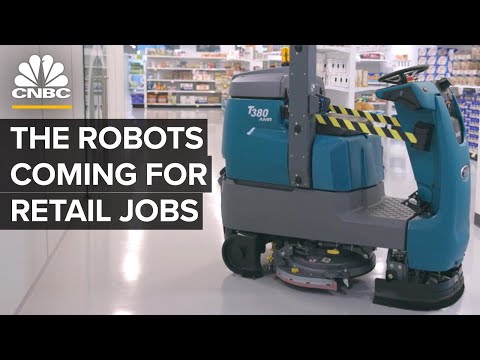
- Brain Corp. got its start developing self-driving technology for floor cleaners before moving into inventory scanning.
- Robots manufactured by Tenet use technology by Brain Corp. to move autonomously through stores, cleaning floors and acquiring data along the way.
- The robots have as many as five cameras used to scan store shelves as well as 3D cameras to assist with navigation.
Benefits of Inventory Robots
- Retailers benefit from inventory robots collecting more data about what customers do and don't want by monitoring inventory.
- They're also freeing workers to perform other tasks potentially lowering labor costs.
- More than a third of US retailers say staff shortages are their biggest challenge.
- The scrubber allows mundane routine work off associates such as scanning items into location or counting stock levels.
The Rise of Robots in Retail
This section discusses how robots are being used to improve efficiency and accuracy in retail stores.
Benefits of Using Robots in Retail
- Robots can work consistently on a daily basis, without getting tired or calling out sick.
- They can perform tasks that are time-consuming and frustrating for humans, such as physically counting inventory.
- Robots provide consistency and accuracy, ensuring that nothing is missed by accident.
Examples of Robot Use in Retail
- Simbe Robotics' Tally robot scans between 15 to 30,000 products per hour, taking roughly two hours to scan a supermarket. BJ's Wholesale added Tally across its 237 locations in 2023.
- Amazon has more than half a million warehouse robots worldwide.
- Brain Corp rolled out its autonomous delivery tug in 2020 to move inventory from the warehouse to the store shelf.
Future of Robot Use in Retail
- The market for inventory moving robots is expected to reach $23 billion by 2027.
- There may be an expansion of robots used for moving products within commercial spaces within the next 5 to 10 years.
- As retailers become more sophisticated about tasks they use people for, they may turn to robots that can do these jobs more efficiently at a lower cost.