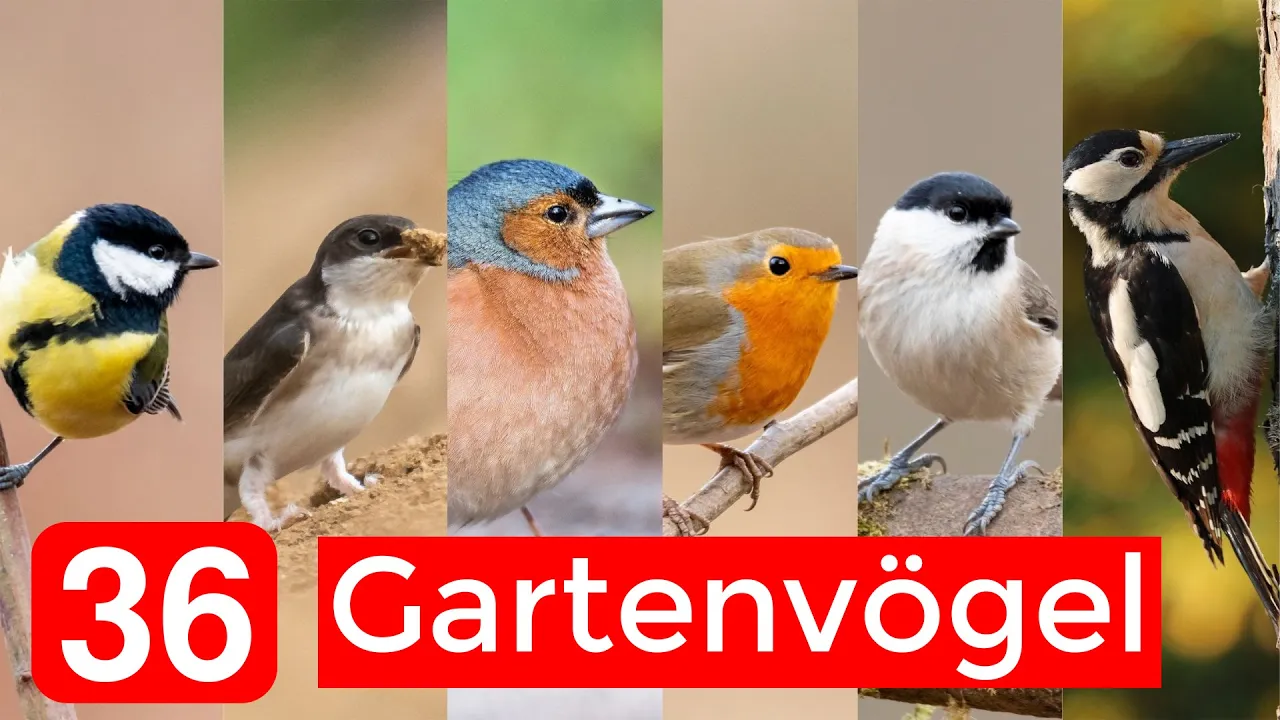
36 häufige Gartenvögel bestimmen | Aussehen, Gesänge, Besonderheiten
Introduction and Overview
The video introduces 35 common garden birds for identification, encouraging viewers to subscribe to the channel for similar content in the future.
Common Garden Birds Introduction
- The first bird discussed is the blackbird, categorized alphabetically. Blackbirds are medium-sized birds with distinct male and female colorations.
- The blue tit, smaller than the great tit, is recognizable by its yellow-blue coloring and active behavior around feeders.
- Buchfink (chaffinch) is a year-round garden visitor known for its colorful appearance and nesting habits in trees.
- The great spotted woodpecker, with a red crown on males, frequents gardens year-round and is easily identifiable by its striking colors.
- The eichelhäher (jay), larger in size, has a vibrant plumage of black, white, and blue hues. It warns other animals of danger with its loud calls.
Continuation of Bird Descriptions
Further exploration of garden birds including the elster (magpie), erlenzeisig (redpoll), feldsperling (field sparrow), and gartenbaumläufer (garden treecreeper).
More Garden Birds Description
- Elsters are easily observed throughout the year due to their distinctive black-white-blue coloring and vocal warnings.
- Erlenzeisigs migrate from Scandinavia to milder climates in winter; they have yellow-black coloring and visit gardens in groups.
- Feldsparrows resemble house sparrows but have unique features like chocolate-brown caps. They are social birds found in natural cavities.
Exploring Additional Garden Birds
Delving into more garden bird species such as gartenbaumläufer (garden treecreeper), gartenrotschwanz (black redstart), gartengrasmücke (garden warbler), and girlitz (goldfinch).
Diverse Garden Bird Species
- Gartenbaumläufer climb tree trunks spirally seeking insects; distinguishing their calls from similar species like wald baumläufer is crucial.
- Gartenrotschwanz migrates seasonally but nests locally; it's elusive yet emits distinctive calls early mornings.
Bird Watching: Identifying Common Garden Birds
In this section, the speaker discusses various bird species commonly found in gardens, highlighting their distinctive features and behaviors for identification purposes.
Goldfinch and Gray Flycatcher
- The goldfinch is often seen in agricultural landscapes with individual hedges or larger gardens, easily recognizable by its gray and white coloration.
- The gray flycatcher, as the name suggests, is a gray and white bird that breeds in gardens, parks, and open forests. It arrives in May as a migratory bird.
Greenfinch Characteristics
- The greenfinch stands out with its vibrant green and yellow plumage, primarily found in gardens throughout the year.
- Recognizable by its robust beak designed for cracking hard seeds, the greenfinch frequents feeders in winter and trees in summer.
Great Spotted Woodpecker and House Sparrow
- The great spotted woodpecker is known for foraging on the ground for insects and ants. Its distinct features include a green coloration, red crown, black mask, and loud calls.
- The sociable house sparrow is distinguishable by its size (14-16 cm), large head, robust beak, gray-brown back, black throat. Differentiated from field sparrows by cap color.
Continuation of Bird Species Identification
This section delves into additional garden birds like the house redstart, short-toed treecreeper, hawfinch, coal tit, swifts (common swift & alpine swift), sand martin (bank swallow), barn swallow (European swallow).
House Redstart Behavior
- House redstarts are more urban than other redstarts. They spend winters around the Mediterranean but breed near buildings or old mills. Their diet consists mainly of insects.
Short-Toed Treecreeper Features
- Short-toed treecreepers are adept at camouflage similar to robins' size. They feed on insects but can also be seen near houses.
Hawfinch Characteristics
- Hawfinches have a bulky body with an exceptionally massive bill suited for cracking seeds. They inhabit deciduous forests but visit gardens too.
Coal Tit Description
- Coal tits exhibit acrobatic skills while descending tree trunks headfirst. Identified by their blue-gray upperparts and rust-colored underparts along with unique feeding behavior.
Swift Species Traits
- Swift species include common swift & alpine swift known for their aerial prowess during long migrations to Africa. Distinguished by their calls which differ from swallows'.
Exploring Swallow Species
This segment focuses on mauerseglers (house martins), meadow pipits (titlarks), Eurasian crag martins (rock martins), common house martins (northern house martins).
Mauerseglers' Habitat Preferences
- Mauerseglers prefer nesting under eaves or roofs using mud pellets to construct rounded nests; however they are less favored compared to swallows due to messiness concerns.
Meadow Pipits' Characteristics
New Section
The section discusses various garden birds that can be observed during different seasons, highlighting their distinctive features and behaviors.
Mönchsgrasmücke (Blackcap)
- The Mönchsgrasmücke is a summer garden bird distinguishable by its brown or black cap.
- Its melodious song sets it apart from other birds like the Garten Grasmücke.
- The bird is typically found in dense shrubs and is more ground-level compared to other garden birds.
Rabenkrähe (Rook)
- The clever and shy Rabenkrähe is commonly seen in gardens, especially in larger and wilder settings.
- It can be differentiated from the Saatkrähe by the absence of a white bill.
- Rabenkrähen are year-round visitors known for their intelligence.
Rauchschwalbe (Barn Swallow)
- This bird frequents open farmlands near farms or larger animals due to ample food sources.
- Recognizable by its long tail streamers, it is a common sight from April to October.
- Their distinct call and acrobatic flight patterns make them stand out in gardens.
New Section
This segment introduces the Ringeltaube, Tauben, Rotkehlchen, Schwanzmeise, and Star as notable garden birds with unique characteristics.
Ringeltaube (Wood Pigeon)
- Identified by its white neck patch, grey coloration, blue-grey head, and wine-red breast.
- Known for its round appearance when puffed up and distinctive wing-clapping behavior while landing.
Tauben
- Tauben are plump with fluffed feathers; they have a 50-song repertoire often heard on rooftops.
- They are distinguishable from Ringeltauben by their slimmer build and smaller size.
Rotkehlchen (European Robin)
- Recognizable by its orange throat; this bird is a common sight in most gardens.
- Despite appearing round in winter due to fluffing up for warmth, they are actually slender creatures.
New Section
This part covers the Sperber, Schwanzmeise, Starling (Star), Stieglitz (Goldfinch), Distelfink (Linnet), Zaunkönig (Wren), Tannenmeise (Coal Tit).
Sperber
- Regularly spotted at feeding stations where they consume soft foods like raisins or apples.
- Their presence indicates potential danger from humans, Sparrowhawks, or cats around.
Schwanzmeise
- Easily recognizable with no confusion due to their unique appearance resembling frying pans.
Star
- Originally migratory but now partially resident in southern Germany; known for mimicking sounds including human noises.
New Section
This section delves into the Tannenmeise's habitat preferences along with insights on the Dompfaff (Chaffinch) and Teichrohrsänger (Reed Warbler).
Tannenmeise
- Prefers sunflower seeds at feeders during winter; nests intricately woven spherical structures during summer.
Dompfaff
- Often seen consuming sunflowers seeds at feeders; breeds in cultivated landscapes with sparse woods.
Teichrohrsänger