English Working Class
The Evolution of the Working Class in Britain
Early Organizations and Political Reform
- The London Corresponding Society emerged in the 18th century, aiming to unite members advocating for universal manhood suffrage amidst revolutionary sentiments in France.
- Friendly societies, which were mutual aid associations for workers, eventually evolved into trade unions during Britain's industrialization period.
- Scholars note a connection between political reform advocates and those demanding better wages and working conditions, highlighting a shared history among the common people.
Government Response to Labor Movements
- Prime Minister William Pitt promoted combination laws in 1800 to ban friendly societies, fearing radicalization similar to events in France.
- Although mutual aid organizations were tolerated, strikes and demonstrations faced strict prohibitions; trade unionists resorted to clandestine meetings and riots as forms of protest.
Ludism: A Form of Protest
- Ludism involved destroying machines as a protest against industrialization, with notable riots occurring from 1799 to 1831 across various regions like Nottingham and Lancashire.
- Textile workers targeted new machinery such as steam-powered looms using tools like the Enoch hammer; Parliament responded with increasingly harsh laws against machine breaking.
The Peterloo Massacre and Its Aftermath
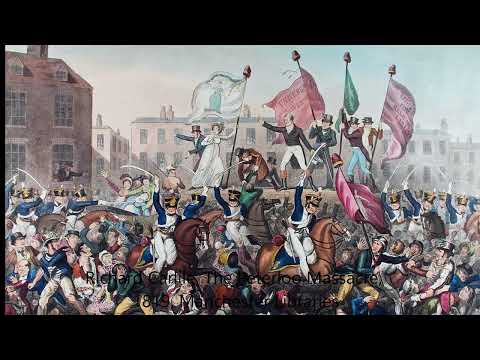
- The Peterloo Massacre occurred on August 16, 1819, when an estimated 60,000 gathered at St. Peter's Field demanding parliamentary reform amid economic hardships from the Napoleonic Wars.
- Local magistrates ordered arrests during the rally led by radical orator Henry Hunt; military intervention resulted in numerous casualties including deaths among civilians.
Legislative Changes Post-Peterloo
- In response to public sympathy for victims of repression at Peterloo, Parliament passed legislation allowing mutual aid organizations but continued to restrict labor movements through conspiracy laws.
- By 1825, strikes were labeled conspiratorial actions against order; however, efforts began towards unifying trade unions leading up to the formation of the Grand National Consolidated Trades Union (GNCTU).
Key Figures and Ideologies
- Robert Owen emerged as a significant figure promoting utopian socialism through cooperative models like New Lanark; he later attempted establishing a community called New Harmony in the U.S., though it failed.
- Owen played a crucial role in advocating for GNCTU but its collapse within a year was attributed to local strikes depleting resources.
Chartism and Its Impact on British Labor Movements
The Origins of Chartism
- The Charter was a document presented to the British Parliament in 1838 by the Working Men's Association of London, representing the interests of the working and lower middle classes who felt excluded from electoral reforms.
- Chartists engaged in peaceful initiatives alongside demonstrations advocating for parliamentary and electoral reform, marking their peak activity in 1838.
Reactions and Consequences
- Despite efforts from radical liberal politicians, all petitions from Chartists were rejected by Parliament, leading to increased unrest characterized by strikes, sabotage, and violent riots.
- The last significant protest occurred in 1848; following this period, the movement gradually diminished as some liberal policies began addressing labor issues.
Transition to Peaceful Negotiation
- In response to Chartism's failure, the British trade union movement shifted towards peaceful methods and negotiation during the 1850s.
- New unions emerged across Britain that represented themselves as an "aristocracy of labor," emphasizing pride in their trade skills rather than violence.
Union Dynamics
- These unions charged membership fees and provided benefits to members while attempting to reach compromises through non-aggressive means.
- This approach contrasted sharply with negative portrayals of the working class propagated by conservative newspapers and factory owners.