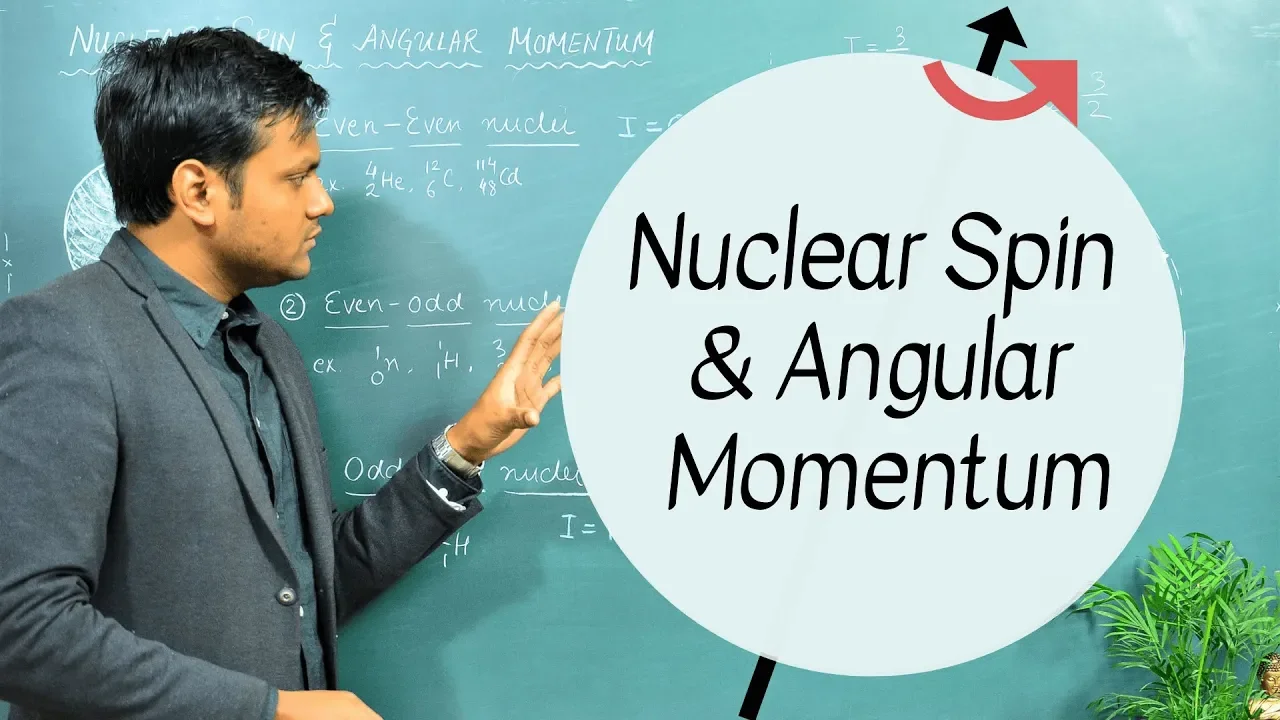
Nuclear Spin and Angular Momentum
Introduction to the Nucleus
In this section, we learn about the nucleus and its composition, including protons and neutrons. We also explore the concept of angular momentum in the nucleus.
The Nucleus as a Collection of Particles
- The nucleus is made up of protons and neutrons, which are particles with spin 1/2.
- These particles contribute to the overall angular momentum of the nucleus.
Angular Momentum in the Nucleus
- The total angular momentum of a nucleus is a vector sum of orbital angular momentum (L) and spin angular momentum (S).
- L represents the orbital angular momenta of all constituent particles inside the nucleus.
- S refers to the spin angular momenta of all individual particles.
- Angular momentum in quantum systems experiences quantization in magnitude and direction.
Central Potential Field in Nuclei
This section discusses certain nuclear models that assume a central potential field within nuclei, leading to orbital angular momentum for constituent particles.
Central Potential Field
- Some nuclear models assume that there is a central potential field within nuclei.
- This assumption leads to orbital angular momentum for constituent particles.
Total Angular Momentum of Nuclei
Here, we delve into how the total angular momenta of nuclei are determined by combining orbital and spin angular momenta.
Total Angular Momenta
- The total angular momenta of any given nucleus is a vector sum of orbital (L) and spin (S) angular momenta.
- L represents the summation of individual orbital angular momenta.
- S refers to the summation of individual spin angular momenta.
Quantization of Nuclear Angular Momentum
This section explores the quantization of nuclear angular momentum, both in terms of magnitude and direction.
Quantization of Magnitude
- The magnitude of the total spin angular momentum of a nucleus is given by √(I(I+1)ħ).
- I is a quantum number that can take values such as 0, 1/2, 1/3, and so on.
- This expression provides the quantization of nuclear angular momentum magnitude.
Quantization of Direction
- The direction in which nuclear angular momentum is oriented in space is also quantized.
- The Z component of the angular momentum with respect to a z-axis is equal to Mħ.
- M can take 2I+1 values from -I to +I with a difference of ±1.
Relationship to Electron Angular Momentum
In this section, we draw parallels between the quantization of nuclear angular momentum and electron angular momentum.
Similarities with Electron Angular Momentum
- Just like electron motion around the nucleus, nuclear angular momenta also experience quantization in magnitude and direction.
- For more details on quantization of electron angular momentum, refer to another video.
Nuclear Spin Values
Here, we explore the possible values for nuclear spin and their representation in three-dimensional space.
Nuclear Spin Values
- Nuclear spin can have values such as 0, 1/2, 1, and 3/2.
- Each value corresponds to different possible orientations or precession paths in three-dimensional space.
Visualization of Space Quantization
This section visualizes how space quantization manifests for different values of nuclear spin.
Visualization Example: I = 3/2
- For I = 3/2, there are four possible values of M: -3/2, -1/2, 1/2, and 3/2.
- Each value corresponds to a different Z component of the angular momentum along the z-axis.
Precession of Nuclear Spin
Here, we explore how the precession of nuclear spin leads to different orientations in three-dimensional space.
Precession and Orientation
- The precession of nuclear spin around a particular conical section determines its orientation.
- Different orientations result in different Z components of the angular momentum.
Conclusion
In this transcript, we learned about the composition of the nucleus and its constituent particles. We explored how angular momentum is determined by combining orbital and spin angular momenta. Additionally, we discussed the quantization of nuclear angular momentum in terms of magnitude and direction. Finally, we examined how different values of nuclear spin lead to distinct orientations in three-dimensional space.
Quantum Numbers and Nuclear Spin
This section discusses the concept of nuclear spin and how it is determined by the quantum number I. It explains the behavior of even-even, even-odd, and odd-odd nuclei in terms of pairing effects.
Determining Nuclear Spin for Even-Even Nuclei
- Even-even nuclei have an even number of neutrons and an even number of protons.
- Pairing effect: Even numbers of protons pair up with each other, as do even numbers of neutrons, canceling out their spin and orbital angular momentum.
- The final nuclear spin for even-even nuclei is 0.
- Examples include helium, carbon, and cadmium.
Determining Nuclear Spin for Even-Odd Nuclei
- Even-odd nuclei have an even number of neutrons and an odd number of protons or vice versa.
- Pairing effect: Large numbers of protons and neutrons try to pair up with each other to cancel out their spin and orbital angular momentum.
- One unpaired neutron or proton contributes towards the overall spin of the nucleus.
- The nuclear spin for even-odd nuclei is 1/2.
Determining Nuclear Spin for Odd-Odd Nuclei
- Odd-odd nuclei have an odd number of neutrons and an odd number of protons.
- Pairing effect: Protons and neutrons pair up to cancel out their spin and orbital angular momentum, but there is one unpaired neutron and one unpaired proton remaining.
- The nuclear spin for odd-odd nuclei is 1.
This section highlights the importance of pairing effects in determining the nuclear spin and angular momentum. Most protons and neutrons pair up to cancel out their individual spins, while any unpaired particles contribute towards the overall spin.
Turn any video into a summary like this
YouTube links, meetings, lectures. With transcripts, search, and chat.