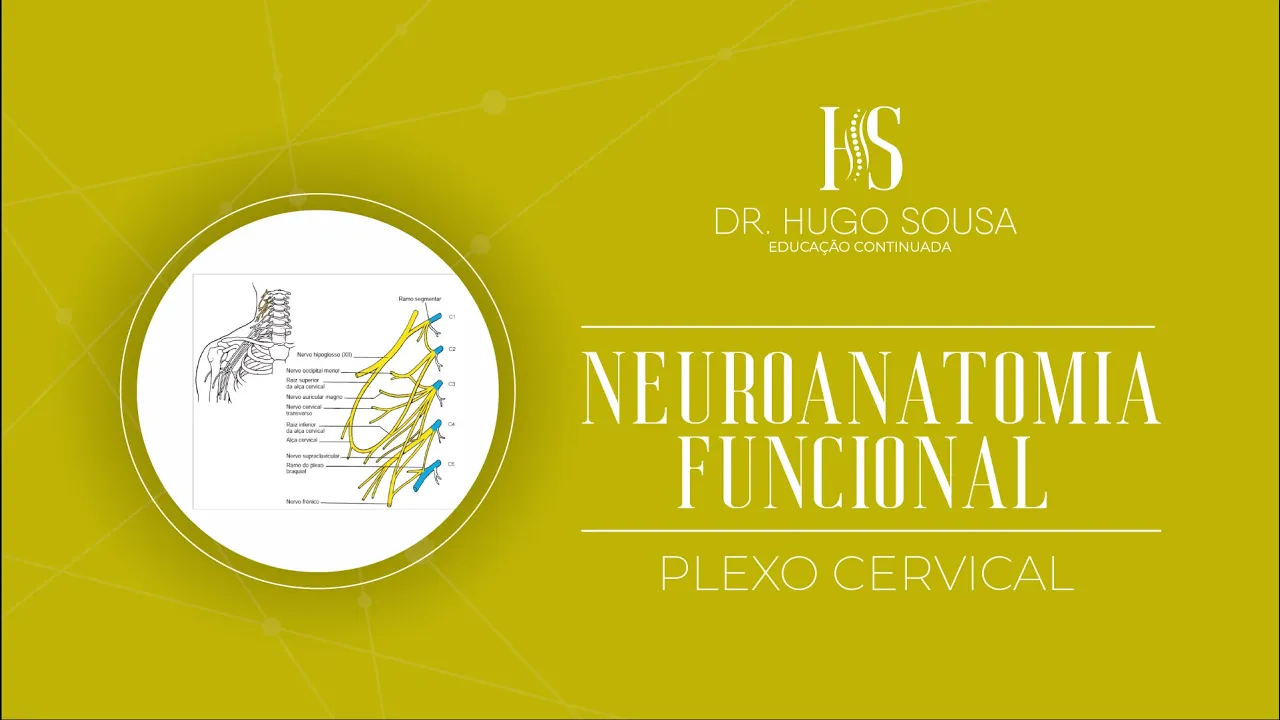
PLEXO CERVICAL - PARTE 1
Understanding the Nervous System
Overview of the Nervous System
- The nervous system is anatomically divided into two main parts: the central nervous system (CNS) and the peripheral nervous system (PNS).
- The CNS includes the brain and spinal cord, protected by bony structures such as the skull and vertebral column.
- The PNS consists of spinal nerves (31 pairs from the spinal cord) and cranial nerves (12 pairs originating from the brainstem).
Components of Peripheral Nervous System
- Sensory ganglia are part of PNS, specifically dorsal root ganglia, which precede sensory nerve roots.
- The autonomic nervous system is also a component of PNS, comprising sympathetic and parasympathetic divisions with distinct ganglia locations.
Receptors in the Nervous System
- Receptors can be sensory or effector-related; they connect the nervous system to various organs like muscles and glands.
- Sensory receptors detect external stimuli while effector receptors facilitate responses through neuromuscular junctions.
Types of Sensory Receptors
- Sensory receptors are categorized into general somatic sensitivity, detecting temperature, pain, touch, and pressure.
- Interoceptors provide information about internal body conditions; they include mechanoreceptors that respond to organ wall tension.
Pain Perception and Visceral Pain
- Visceral pain may not correspond directly to its anatomical location; for example, heart pain can radiate to other areas like neck or jaw.
- Understanding visceral pain is crucial as it often presents diffusely rather than at a specific site.
Proprioception and Body Awareness
- Proprioceptors in joints and muscles inform the CNS about body position and movement.
Muscle Work and Sensory Receptors
Understanding Muscle Functionality
- Increasing muscular work requires enhanced blood flow and nutrient supply to the muscle region.
- Intrafusal fibers, innervated by gamma motoneurons, play a crucial role in muscle tone and contractility.
- Neuromuscular spindles contain mechanoreceptors that detect stretch and contraction speed, essential for movement coordination.
Peripheral Nervous System Components
- The enteric plexus is part of the autonomic nervous system, regulating gastrointestinal functions including mechanical and chemical digestion.
- It facilitates food breakdown into absorbable nutrients for circulation and metabolism in target organs like the liver.
Neuronal Support Cells
Types of Glial Cells
- Adipose tissue comprises two cell types: neurons and glial cells; glial cells outnumber neurons significantly.
- Six main types of glial cells exist, including astrocytes, oligodendrocytes, Schwann cells, microglia, ependymal cells, and satellite cells.
Functions of Glial Cells
- Schwann cells form myelin sheaths around peripheral nerves; astrocytes create the blood-brain barrier to regulate communication between blood and the nervous system.
- Microglia act as immune defenders within the nervous system while ependymal cells line brain ventricles contributing to cerebrospinal fluid production.
Peripheral Nervous System Overview
Structure and Function
- The peripheral nervous system (PNS) encompasses all nerve tissues outside the central nervous system (CNS), which is protected by skull bones and vertebrae.
Nerve Complexes
- PNS includes sensory receptors, nerves, associated ganglia, and nerve plexuses that facilitate communication between CNS and body parts.
Plexus Formation
- Nerves can intertwine to form plexuses such as cervical or brachial plexuses; thoracic regions lack such complex interconnections due to segmented roots.
Nerve Functions
Information Transmission
- Nerves serve as conduits for sensory and motor information throughout the body; spinal nerves primarily transmit both somatic and visceral signals.
- Cranial nerves have unique characteristics that will be explored further when discussing brainstem anatomy.
Understanding Spinal Nerves and Their Functions
Formation of Spinal Segments
- The spinal segment is characterized by the union of a ventral motor root and a dorsal sensory root, forming a spinal nerve.
- Each spinal nerve consists of two roots: the anterior (ventral) root, which carries motor information, and the posterior (dorsal) root, which carries sensory information.
Functionality of Roots
- The anterior root transmits motor signals from the anterior column of the spinal cord, while the posterior root receives sensory input from peripheral sources.
- Sensory information travels through the dorsal ganglion before reaching the posterior column for processing; this can lead to further transmission to higher brain centers like the cerebellum.
Anatomy of Spinal Nerves
- Spinal nerves exit through intervertebral foramina and are functionally mixed due to their composition of both motor and sensory fibers.
- The formation involves anatomical structures such as vertebrae processes and intervertebral discs that create foramina for nerve passage.
Branching of Spinal Nerves
- Each spinal nerve branches into two rami:
- Dorsal Ramus: Supplies muscles and skin in the back region.
- Ventral Ramus: Innervates muscles and skin in limbs and anterolateral trunk areas.
Clinical Relevance
- Understanding these branches is crucial for diagnosing conditions related to muscle innervation or pain in specific body regions.
- Clinicians often encounter confusion between nerves, tendons, ligaments, and muscles during examinations; clear differentiation is essential for accurate diagnosis.
Structure of Nerves
- Nerves consist of white cords made up of nervous fibers encased in connective tissue that integrates various body tissues.
- Key components include:
- Endoneurium: Surrounding individual nerve fibers,
Understanding Nervous Tissue and Its Components
Structure of Nerves
- The transcript discusses the structure of nerves, highlighting the perineuro, which is a sheath surrounding a bundle of nerve fibers.
- It introduces epineuro, the outer layer that encases multiple fascicles, emphasizing its superficial nature.
- The presence of myelin sheaths in nerve fibers is explained, noting that larger diameter fibers with myelin conduct signals faster than those without.
Types of Nerve Fibers
- Different types of nerve fibers are mentioned, particularly Type C fibers, which are associated with chronic pain and have slower conduction speeds due to being unmyelinated.
- The slow conduction speed of Type C fibers is contrasted with faster conducting fibers, indicating a physiological strategy for managing pain through competitive signaling.
Pain Transmission Theory
- A theory called the Gate Control Theory of pain is introduced, explaining how different fiber diameters affect pain perception and transmission.
Vascularization and Functionality
- The importance of blood supply to nerves is emphasized; nerves require significant vascularization due to their high metabolic demands.
- Compression on nerves can lead to dysfunction, underscoring the need for careful management in clinical settings.
Spinal Nerves and Plexuses
- Discussion shifts to spinal nerves, which can be either uni-segmental or multi-segmental, derived from one or several segments of the spinal cord respectively.
- The formation of plexuses from multiple spinal segments is explained, including examples like cervical and brachial plexuses.
Turn any video into a summary like this
YouTube links, meetings, lectures. With transcripts, search, and chat.