Why p-orbital, d-orbital, f-orbital have TWO Peaks- Doublet in XPS Spectra
Understanding XPS Spectra and Quantum Numbers
Overview of Orbital Peaks in XPS Spectra
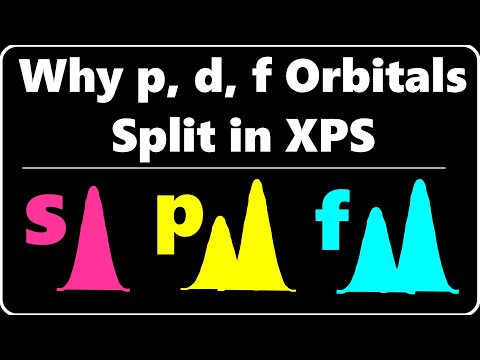
- The XP Spectrum shows that s orbitals have a single peak, while p, d, and f orbitals exhibit two peaks each. This phenomenon is referred to as doublet or multiplet splitting.
- The notation used includes 'X' for the element (e.g., zinc), 'n' for the principal quantum number, 'l' for the orbital quantum number, and 'J' for total angular momentum which combines both orbital angular momentum and spin quantum number.
Application of Nomenclature to Orbitals
- For p orbitals where L equals one, there are two possible values: 3/2 and 1/2. This nomenclature also applies similarly to d orbitals.
- In the case of d orbitals with an angular momentum of two, we again observe two peaks at 5/2 and 3/2 in the XP spectrum.
Explanation of Doublets in XPS Spectra
- The presence of doublets arises from unfilled shells and unpaired electrons within these orbitals.
- Unlike s orbitals which only show a single peak due to zero orbital momentum (L = 0), all other types (p, d, f) display doublets when L > 0.
Characteristics of Different Orbitals
- Each type of orbital has distinct characteristics: s has one peak; p has two peaks; d has two peaks; f also exhibits two peaks.
- The term "douet" refers to this concept in quantum mechanics related to multiplet splitting or spin-orbit splitting.
Understanding Quantum Numbers
- If L equals zero (for s orbitals), there is a single peak in the XP spectrum. As L increases (to one for p, two for d, three for f), doublets appear.
- The common notation used is spectroscopic notation where 'X' represents any element like zinc or cobalt along with its respective principal quantum number.
Detailed Breakdown of Principal Quantum Number Notation
- Principal quantum numbers can be represented as integers indicating energy levels. For example: n = 1 corresponds to K shell; n = 2 corresponds to L shell.
- Total angular momentum J combines both orbital angular momentum (L) and spin number (S).
Specific Examples from D Orbitals
- When applying nomenclature specifically to D orbitals with L equal to two, we see specific ratios such as intensity ratios between peaks being noted but not elaborated on here.
- In summary discussions about elements like cobalt or magnesium are made regarding their representation in XPS spectra using similar principles outlined above.
Understanding Spin-Orbit Splitting in D Orbitals
Key Concepts of D Orbital Peaks
- The discussion begins with the calculation of peaks for d orbitals, where it is noted that J equals L minus S. Here, L is 2 and S is half, leading to a result of 5/2 and subsequently introducing π (Pi).
- The term "douet" or spin-orbit split is introduced, emphasizing that this phenomenon occurs in XP spectra specifically for p, d, and f orbitals when there are unfilled shells. An example illustrates how filled s shells contrast with an unfilled d shell.
- Unpaired electrons are defined as those not paired within an orbital. For instance, in the case of the 1s² configuration, one electron spins up while another spins down; however, unpaired electrons exist when only one electron occupies an orbital.
- The concept of parallel spins among unpaired electrons is highlighted using the example of a 3d⁵ configuration where all five electrons exhibit parallel spin. This results in specific magnetic properties due to their arrangement.
- The discussion concludes by reiterating that phenomena such as spin-orbit coupling lead to observable effects like doubling in energy levels when certain conditions regarding electron pairing are met.