Nisbett and deCamp Wilson's Anti-Introspectionism: Telling More Than We Can Know
Introduction
In this section, Matt McCormick introduces himself and the topic of discussion, transitioning from Descartes to modern research on introspection.
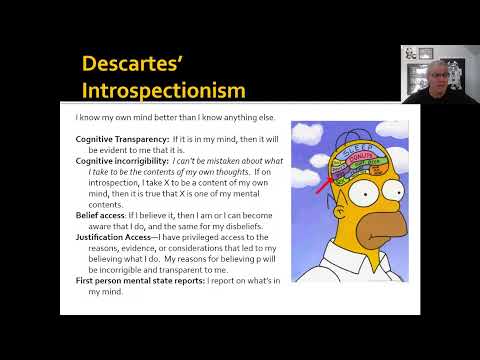
Descartes' Assumptions
- Descartes believed in having direct access to one's mind and its contents.
- Descartes assumed individuals know why they believe what they do and have authority over their beliefs.
- He considered his conclusions as certain and incorrigible through reason.
Modern Research Insights
- Nisbett and Wilson challenge Descartes' claims through empirical psychology studies.
- Empirical evidence suggests we know less about our minds than assumed.
- Individuals are authoritative about their beliefs, memories, and mental states.
Descartes' Views on Cognitive Transparency
Delving into Descartes' views on cognitive transparency and incorrigibility regarding mental contents.
Cognitive Transparency Principles
- Descartes presumed cognitive transparency where mental content is evident upon introspection.
- Believed in cognitive incorrigibility; what one takes as a mental content is true for them.
- Privileged access to reasons for beliefs was another key aspect of Descartes' philosophy.
Descartes' Foundationalism and Critique
In this section, the discussion revolves around Descartes' foundationalism, the concept of mental state reports, and a critique presented by Nesbitt and Camp Wilson regarding introspective access and subjective reports.
Mental State Reports in Descartes' Philosophy
- Mental state reports in Descartes refer to first-person accounts of one's thoughts.
- Descartes questions the accuracy of perceptions due to concerns about dreaming, hallucinations, insanity, or deception by an evil demon.
Undermining Foundationalism
- Nesbitt and Camp Wilson challenge Descartes' foundationalism by questioning introspective access.
- They argue that individuals cannot accurately report on stimuli effects or higher-order inference-based responses.
- People often employ implicit theories about causal connections between stimuli and responses based on cultural experiences rather than direct access.
Anti-Cartesian Perspective
- The critique presented is fundamentally anti-Cartesian as it rejects immediate, incorrigible introspective access.
- Individuals theorize about their own thoughts and behaviors similar to how they analyze others', based on empirical observations rather than privileged access.
- A priori theories are formed through experiences of observing behaviors in others, challenging Descartes' notion of innate knowledge.
Scientific Abstract Importance
This part emphasizes the significance of scientific abstracts in conveying essential information concisely from research papers.
Understanding Scientific Abstracts
- Scientific abstracts serve as crucial summaries at the beginning of research papers.
- Authors use abstracts to communicate key aspects clearly within limited word counts akin to Twitter's brevity requirement.
Key Points from Abstract
- The importance lies in grasping subjects' lack of directive introspective access according to Nesbitt and Camp Wilson's anti-Cartesian stance.
Read a Scientific Abstract
The speaker emphasizes the importance of reading scientific abstracts thoroughly to understand the essence of research papers.
Understanding Research Studies
- Nisbet and Camp Wilson conducted numerous studies with anti-Cartesian and anti-introspection implications.
- An old study involved polling students on integrated busing, revealing how group discussions influenced participants' views.
- Subjects changed their beliefs after persuasive arguments, even altering their memories to align with the new viewpoint.
Changing Minds and Memories
People often revise their beliefs without acknowledging the change, leading to shifts in both opinions and memories.
Shifting Perspectives
- Society's changing views on gay marriage exemplify how individuals adapt their beliefs over time.
- Individuals may hide changes in their beliefs from themselves, challenging the notion of being an authority on one's own mind.
Confabulation and Problem-Solving
Subjects tend to confabulate explanations for problem-solving processes, overlooking external cues that prompt solutions.
Problem-Solving Behavior
- Participants struggled with a task until prompted by a researcher's action, then falsely attributed their solution to internal insights.
The Bystander Effect and Unconscious Influences
The discussion delves into the bystander effect, where individuals are less likely to help in distress situations as the number of bystanders increases. Additionally, it explores how unconscious influences impact behavior without individuals being aware of these effects.
The Bystander Effect
- The bystander effect illustrates that people are less inclined to assist those in need when surrounded by more bystanders.
Unconscious Influences on Behavior
- People may deny the influence of others on their behavior, leading them to change their minds or behaviors unconsciously.
Priming Effects
- Priming individuals with different labels like "parmesan cheese" or "vomit" can significantly alter their perception of a smell, showcasing the power of priming on preferences.
Biases in Decision-Making and Perception
This segment discusses biases affecting decision-making processes and perceptions, such as the tendency to prefer items placed on the right side and biases in job interviews based on interview order.
Right-Side Bias
- Individuals exhibit a bias towards items placed on the right-hand side, even when controlling for item quality, indicating an unconscious preference for objects positioned on that side.
Interview Order Bias
- Job interviewers tend to favor candidates interviewed first or last due to increased memorability, highlighting how interview order can influence decision-making processes.
Unconscious Influences on Attractiveness Perception
This part explores how personality traits affect perceptions of attractiveness and how individuals may be unaware of these influences.
Personality Impact on Attractiveness Perception
- Individuals rate attractiveness based on personality traits like pleasantness or distrustfulness without realizing the impact of these traits on their evaluations.
Placebo Effects and Unconscious Responses
The discussion focuses on placebo effects and how individuals' beliefs can lead to significant changes in responses without conscious awareness.
Placebo Response
Behavior and Beliefs
The discussion delves into how behavior can be influenced by factors individuals are unaware of, such as dilated eyes affecting attractiveness perception and calm heartbeats reducing fear without conscious recognition.
Influence of Dilated Eyes on Attractiveness
- Men showed a strong preference for women with dilated eyes when rating attractiveness.
- Participants were unaware of the impact of dilated eyes but still rated those women as more attractive.
- When asked about their preferences, men provided reasons unrelated to eye dilation, indicating confabulation.
Impact of External Factors on Fear Perception
This segment explores how external stimuli like fake calm heartbeats can reduce fear responses without individuals realizing the influence, leading to behavioral changes despite no conscious awareness.
Calm Heartbeat and Fear Reduction
- Snake-phobic subjects exposed to a fake calm heartbeat showed reduced fear towards snakes.
- Despite the decreased fear response, participants did not attribute it to the calm heartbeat or report feeling less afraid.
Influence on Moral Views
The conversation shifts towards how manipulating moral views through speech rehearsals opposing personal beliefs can lead to a shift in perspectives, highlighting the malleability of beliefs even when individuals remain convinced otherwise.
Rehearsing Opposing Views
- Subjects writing speeches against their own moral views experienced a shift towards the contrary position.
- Engaging with opposing perspectives helps moderate extreme influences in one's thoughts and fosters better understanding of differing viewpoints.
Marriage and Moral Justification
The discussion delves into how individuals may attribute their beliefs to God, leading to chilling effects when using God to justify moral views.
Marriage and Misattribution
- Misattributing positions to God can lead to hiding changes, causing chilling effects.
- Using God as a justification for moral views raises concerns about consistency and change in beliefs.
Subject Responses to Electric Shocks
Subjects who receive electric shocks without explanation tend to downplay the pain compared to those with a reason for the shocks.
Response to Electric Shocks
- Subjects downplay painful electric shocks if given no explanation for them during a task.
- Providing a reason for the shocks leads subjects to acknowledge the pain more significantly.
Empirical Evidence on Self-Judgment
Nisbet and Camp Wilson's research highlights that people are poor judges of their beliefs, feelings, motivations, and reasons behind their thoughts.
Self-Judgment Insights
- People struggle to accurately assess what they believe, feel, or why they changed their minds.
- Nisbet and Camp Wilson challenge the idea of privileged access to one's own mind, emphasizing empirical observation over introspection.
Anti-Cartesian Position on Self-Knowledge
Nisbet and Camp Wilson argue against Cartesian introspectionism by suggesting others might have better insight into an individual's thoughts than themselves.
Anti-Cartesian Perspective
- Individuals may not have perfect cognitive transparency or incorrigible access to their beliefs.