ICT Mentorship Core Content - Month 09 - Trading Market Reversals
Lesson 5: Trading Market Reversals
In this lesson, the instructor covers eight market reversals that can be effectively traded with consistency. The first reversal discussed is trading previous day's highs.
Trading Previous Day's Highs
- Look for opportunities where the market will blow out the previous high or previous day's high specifically raid the buy stops and then reverse and trade lower.
- Not every previous day's high or low is the same in terms of an opportunity but there are certain criteria to look for such as buy stops above that previous day's high, banking levels, intraday algorithms, and secret liquidity resting below or above it respectively.
- There has to be other things that blend well with all the teachings given thus far. One scenario to look for is intra-week highs where traders are looking to have their buy stops above that initial intra-week high.
- Ops is obviously seen in the form of an intra-week low where we see the lowest low on the week be violated on the downside and the cell stops be rated and the market reverses.
Conclusion
- These are really high odds trades for day trading purposes and scalping even if it doesn't continuously move higher as a reversal.
Trading Strategies
In this section, the speaker discusses various trading strategies that traders can use to capture profits in the market.
Reversal Entry Week Intermediate Term Highs
- A run above an old high is a good opportunity to look for a reversal entry week intermediate term high.
- Buy stocks resting above that old high would be rated if the market reverses.
- Not every old high is one to be selling short at. You have to look at the context of the marketplace at your current time of analysis and weigh out whether or not we are in a mood that's going to most likely continuously go through that high or are we due to reverse because above that old intermittent term High fulfills a higher time frame PD array or does it go above that high after a long prolonged uptrend where logical profit taking would be met.
Intermediate Term Low
- A scenario where price trades down below last week's low or a couple of weeks ago previous month is seen as an intermediate-term low.
- We don't simply just buy the sell stops and anticipate a reversal in every old low. There has to be context used.
- What's the storyline again? What is the purpose for the market makers to permit price to trade down below that old low? Is it scooping up sell stops to use as an exit for their short positions they've been in, or are they looking to knock off those individuals who were already going long and take their long positions over?
New York Session Reversals
- Generally, New York session is a continuation of what was already established in London.
- If London created the low of the day, then I'm going first looking for signs that there's a continuation on that move going higher from New York's open going into London's close.
- New York session reversals occur when price eventually trades into a higher time frame discount or premium array.
London Close Reversal and Previous Day's Highs and Lows
In this section, the speaker discusses the London close reversal and how to trade previous day's highs and lows.
London Close Reversal
- The London close can be a reversal of sorts.
- It has the potential to create an intraday scalp.
- Trade it when the average daily range of the last five days has been exceeded at least one and a quarter to one and a third percent.
- Look for some measure of weakness or if it fulfills the numbers as taught in the previous lesson.
- Anticipate retracement back into the daily range.
Previous Day's Highs and Lows
- Always refer to how price traded today after the close in relationship to the previous day's range.
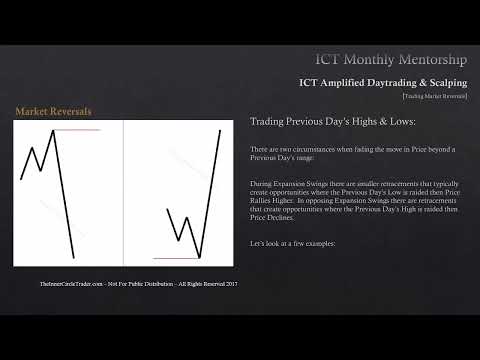
- There are two circumstances when looking to fade price beyond the previous day's range: expansion swings and opposing expansion swings.
- During normal retracements lower into a fair value gap, price finds buyers under the previous day's low using it as support.
- Anticipate market reversal after previous day's low is rated.
Trading Under Previous Day's Low
In this section, the speaker discusses how to trade under the previous day's low and what context is needed for such trades.
Buying Under Previous Day's Low
- Look for a move down below the previous day's low and into a discount array.
- Context is important when buying under the previous day's low.
- Look for confluences of PD arrays to support the idea of buying under a previous day's low.
Trading Above Previous Day's High
In this section, the speaker discusses how to trade above the previous day's high and what context is needed for such trades.
Selling Above Previous Day's High
- Price finds sellers above a previous day's high.
- Look for institutional order flow on weekly, daily or four-hour charts suggesting prices are going lower.
- If price trades up into a premium array during retracement, couple it with trading above the previous day’s candle high to be a seller right above that high.
Trading Equal Week Highs
In this section, the speaker discusses how to trade equal week highs and what context is needed for such trades.
Selling After Buy Stops Are Rated
- When price rates buy stop liquidity pool as a premium array after trading equal highs in an intra-week period, step into the marketplace as a seller intraday.
- Equal highs are like Candyland where retail has their buy stops resting just above that level. Banks will sell right into that level giving you your short-day trade.
- Look for confluences of PD arrays to support selling above an intra-week high.
Trading Equal Week Lows
In this section, the speaker discusses how to trade equal week lows and what context is needed for such trades.
Selling After Sell Stops Are Rated
- When price rates sell stop liquidity pool as a discount array after trading equal lows in an intra-week period, step into the marketplace as a seller intraday.
- Look for confluences of PD arrays to support selling below an intra-week low.
Buying Below Old Lows
In this section, the speaker discusses how to identify buying opportunities below old lows and the importance of context and reference points.
Context is Key
- When looking to buy below an old low or equal lows, there has to be a context.
- The move that drops down onto Tuesday below those equal lows that's formed on Monday and Friday of this example in the chart that's trading down into a higher time frame discount array when you're staring at intraday charts.
- If you don't have any reference point on the higher time frame, you're going to miss these beautiful scenarios where you can clearly see where the manipulation is going to take place and where they're going to run the cell stops.
Intermediate Term Highs and Lows
- Price trading in a large consolidation offers ideal conditions for shorting above an old high and buying below an old well from a previous week or longer in time.
- Old lows and old highs are gold mines because large fund traders will have their stop losses placed around these higher time frame highs and lows so if the market trades back to them they're gunning those stops.
- Studying old highs and old lows and incorporating The pdra Matrix assists in finding higher odds day trades.
Day Trading Conditions
In this section, the speaker discusses how day traders can identify ripe conditions for day trading.
Range-Bound Conditions
- When the market lacks directional trend and one-sidedness, it offers more opportunities to trade like this than not.
- Traders who identify range-bound conditions see that in their charts once they do this several times in practice once you see it in examples in the past when you find yourself.
- You wake up before anybody else gets up in the house sit down with a bunch of charts like I used to do this for years before I had children.
- It takes a level of experience doing it for a while seeing it and developing a feel for it, and that experience factor can't be communicated in teaching.
Dynamic Reactions
- When you incorporate setups with the PD array matrix and higher time frame institutional order flow, you're going to find dynamic reactions.
- It's always a bonus for you as a day trader because we need movement we need to have displacement we need to see a rapid movement to get paid before the end of the day.
- While most statistics state that day traders don't make money consistently over time because they don't look for the conditions that are ripe for day trading.
Reversal Trading Strategy
In this section, the speaker discusses reversal trading strategy and how it can be used to identify intraday reversals during London, New York, and Asia sessions.
Reversal Concepts
- The speaker's London open strategy involves looking for reversal patterns every single London session.
- Reversal concepts are large in scale with intermediate-based ideas.
- The speaker reduces these concepts to the London open for Judas, CME open for the New York Judas, and Asia's Judas at 8 o'clock.
- Lung and close reversals occur on days that create lung and close reversals.
New York Session Reversals
- Weekly templates provide a basis for studying current market structure and anticipating what the New York session is going to do in terms of continuation or reversal.
- Certain weekly templates are more likely to unfold than others based on higher time frame PD arrays and data ranges that the market is presently respecting.
- If there is a higher time frame discount array below the market price but has not been met yet, when it trades down into it during London's move and crosses over into New York open, this is the classic New York session reversal condition.
- As long as New York has not traded down into a hard timeframe discounted rate or up into a higher time frame premium array, New York session will always be slated as a continuation of what was seen in London session.
Market Reversal Profile
- When we see price trade down into a discount array on a higher time frame chart and it does it at the time New York opens, that is when the most likely chance of a market reversal occurring in New York session is going to be seen.
- If London session creates the low today, it's been rallying up crosses over into New York open into a premium array once the New York session trades up into that premium array expect the market reversal in New York session trade higher into that premium array just to go lower on the day you expect that New York session reversal.
- The characteristics are simple but what many people are not getting is that they have to see it, study it, look at it repeatedly, make notations and draw up some notes on their charts. By having higher time frame PD arrays outlined on daily transfers over to lower time frames, one won't be blindsided by these reversals.
Reversals and Market Behavior
In this section, the speaker discusses how to anticipate market reversals and the role of London close in determining market direction.
Anticipating Market Reversals
- The London close can signal a market reversal that leads to one-sided direction for several days.
- Similar to New York session reversals, London close can also reverse the market.
- Even if you're expecting a New York reversal, London can come back and act like it did in the previous example.
Buying/Selling Reversals
- If you see a reversal occur during London close, step right in there again and buy it below the New York low if you're looking for a bullish New York session reversal.
- Many times, buying/selling reversals at wicked low pricing quickly moves away the other way and everything's reversed on the sell side.
Studying Reversals
- Scour through your price charts for examples of all eight types of reversals discussed by the speaker.
- By doing this until you go through your charts, you're not going to understand that the best teacher you have is your charts and personal note-taking.
- People who enjoy studying price action will build a collection of each reversal concept discussed here.
Turn any video into a summary like this
YouTube links, meetings, lectures. With transcripts, search, and chat.