2020 10 26 17 44 29- Städtebau- Teil 1
Introduction to Urban Planning
The lecturer introduces the course on urban planning, outlining the topics to be covered and resources available for students.
Course Overview
- The course is an introduction to urban planning within the context of a broader module that includes private and public law.
- Lecture materials are available on the campus platform with a specific password for access.
- A forum will be set up on the campus for student interaction and questions related to the course content.
Key Concepts in Urban Development
The lecture delves into essential concepts in urban development, highlighting key functions and elements of cities.
Functions of Cities
- Urban development involves various functions such as housing, recreation, work, economic activities, and mobility.
- Cities serve as structural elements encompassing residential areas, green spaces, workspaces, services, retail sectors, and transportation networks.
Planning Instruments
- The course will cover city planning focusing on developing concepts derived from theories and ideas leading to concrete plans.
- Two types of planning instruments will be discussed: informal plans without legal binding but practical significance and legally binding plans like building development plans crucial for urban development.
Recommended Literature in Urban Planning
The lecturer suggests essential readings in urban planning literature for further exploration and understanding.
Recommended Books
- "Stadtplanung - Eine illustrierte Einführung" by Stell et al. provides an overview of city planning practices.
- "Städte für Menschen" by Gehl offers a visionary perspective on creating livable cities focusing less on tools but more on goals.
- "Städtebau - Technische Grundlagen" by Corder covers technical standards essential for urban design elements like housing, workspaces, green areas, and infrastructure.
- "Stadtbau und Stadtplanungsgeschichte" by Schröder delves into historical developments in urban construction and city planning principles.
Legal Foundations in Urban Planning
Emphasis is placed on understanding legal aspects crucial for effective city governance through proper regulations.
Legal Considerations
- City governance heavily relies on legal frameworks guiding urban development processes ensuring compliance with regulations.
New Section
The role of the population in urban society has evolved over time, impacting planning processes and understanding the competencies of various actors involved.
Understanding Urban Development
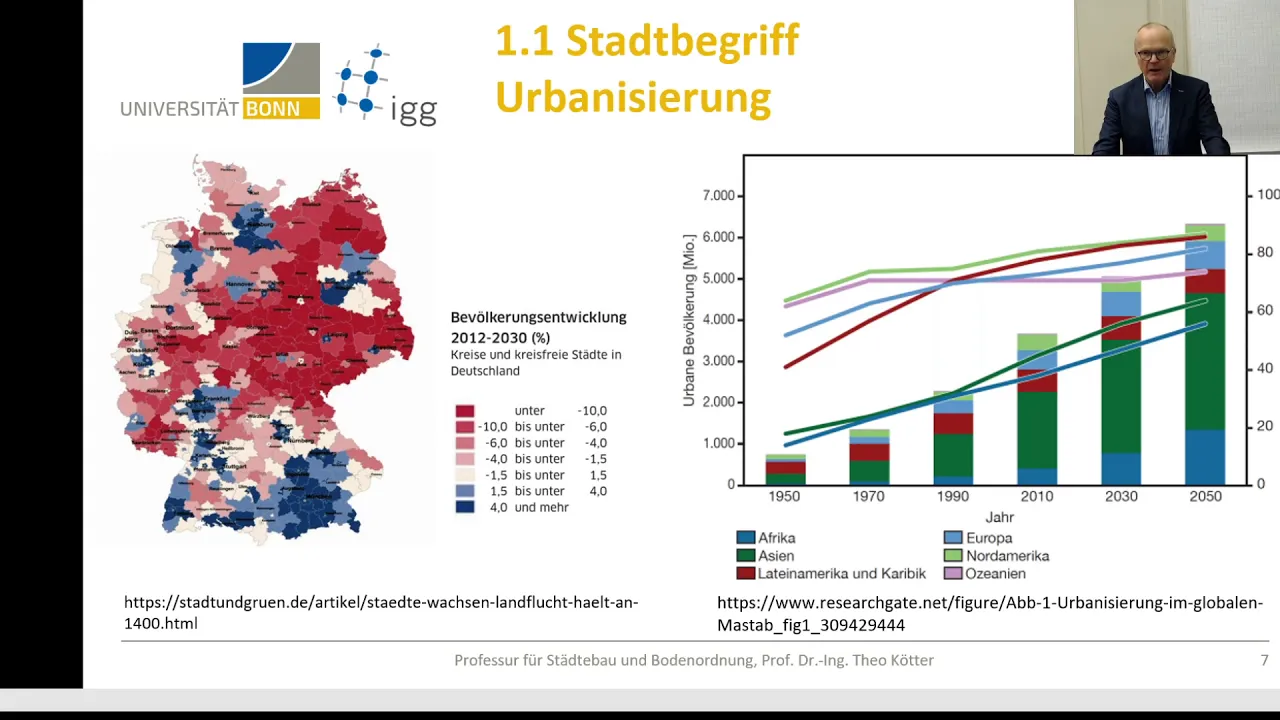
- Urbanization and population development in Germany from 2012 to 2030 show spatial variations, emphasizing how migration within Germany significantly influences city growth or decline.
- Migration patterns lead to contrasting scenarios: blue areas experience population growth, while red areas face depopulation, posing challenges for urban planning.
- Both growth and shrinkage occur simultaneously, creating significant challenges for urban development that must be managed effectively for cities to function optimally.
Exploring City Development
A global perspective on urbanization across continents reveals varying degrees of urbanization, with Europe and North America exhibiting high levels compared to other regions.
Global Urbanization Trends
- Europe and North America have the highest urbanization rates globally, with Europe reaching around 65% to 70%, highlighting the importance of defining what constitutes a city where people prefer to live.
- The United Nations noted a shift in 2007 when more people lived in cities than rural areas worldwide, particularly pronounced in developing regions like Asia, Africa, and Latin America.
Defining a City
Defining a city remains challenging due to diverse perspectives from various disciplines such as sociology, planning sciences, law, economics, and social sciences.
Challenges in Defining Cities
- Lack of a universally accepted definition complicates categorizing cities based on statistical data or functional characteristics across different academic fields.
- Sociology plays a crucial role in defining cities as living spaces primarily for communities. Hans Paul Barth's view emphasizes cities as locations polarized between public and private spheres.
Sociological Perspectives on Cities
Sociological insights shed light on cities as social phenomena characterized by the interplay between public spaces and private dwellings.
Social Dynamics of Cities
- Cities exhibit polarization between public spaces like marketplaces and private residences. Max Weber's concept further emphasizes the economic dimension of cities as markets.
Detailed Analysis of Urban Development
The speaker discusses the importance of urban centers in providing services to a larger area, contrasting rural and urban structures, and highlighting the significance of social sciences in understanding public and private spaces within cities.
Urban vs. Rural Structures
- Contrasts Lübeck with an American city, emphasizing differences in building structures, private spaces, and public areas.
- Discusses the sociological significance of strict separations between private and public spaces in urban settings compared to rural villages.
City Size and Population Distribution
- Explains the statistical classification of cities based on size for functional planning purposes.
- Notes that around 76% of Germany's population resides in cities with over 7,000 to 10,000 inhabitants.
Urbanization Trends
- Examines population growth trends from 2010 to 2015, highlighting significant urban expansion.
- Attributes urban growth to migration from rural areas and economically weaker regions.
Characteristics Defining a City
The speaker delves into qualitative criteria that define a city beyond quantitative measures like population size, focusing on factors such as infrastructure requirements and diversity within settlements.
Qualitative Characteristics of Cities
- Emphasizes the need for a certain population size to support urban functions like education, healthcare, and social services.
- Discusses how city density fosters differentiation and diversity within settlements leading to an urban character distinct from villages.
Social Density and European City Concept
- Explores social density as a result of higher population concentration facilitating increased interactions within urban environments.
- Compares European city characteristics with American or Asian cities based on historical development and evolving spatial structures.
Urban Expansion and Centralization
- Notes decreasing density in European cities over recent decades due to outward expansion into surrounding regions.
New Section
The speaker discusses the various aspects that contribute to the functionality and diversity of cities, focusing on factors such as workspaces, functional diversity, and urban planning processes.
Functional Diversity of Cities
- The functional diversity of cities has decreased in recent decades due to development and urban planning processes.
- Over 90% of jobs in many cities are now in the tertiary sector, impacting the city's structure.
Urban Differentiation
- Cities exhibit significant differentiation reflected in population structures and social fragmentation.
- Varied social structures are evident in household composition, education levels, and social segregation within cities.
Social Polarization
- Social polarization is observed with higher-income households concentrating in specific areas while lower-income households are pushed to city outskirts.
- This segregation poses a challenge for urban development and maintaining social harmony.
New Section
The discussion shifts towards environmental considerations within cities, emphasizing resource consumption, emissions, climate issues, and their impact on urban living conditions.
Environmental Impact
- Cities consume resources like land and energy while being major emitters of pollutants, leading to climate challenges.
- Addressing these environmental issues is crucial for enhancing the quality of life within cities.
Lack of Comprehensive Theory
- Despite efforts to define cities comprehensively, a unified theory remains elusive. Models are used for planning purposes due to this gap.
- A functional city model is presented as a simplified representation encompassing residential, workspaces, amenities, and recreational areas.
Elements of Functional City Model
- The model emphasizes functions like living spaces, work opportunities, amenities provision interconnected by transportation networks.
New Section
In this section, the speaker discusses the involvement of city residents in planning and decision-making processes, highlighting the absence of a universally applicable theory but emphasizing a systematic empirical approach to understanding urban development.
Involvement of City Residents in Planning Processes
- Emphasizes the importance of involving city residents in planning and decision-making processes.
- Discusses typological order of planning problems based on societal and economic developments like shrinking or growing cities.
- Mentions composition rules for creating model structures for allocation of work, services, recreation, and mobility networks in cities.
- Notes various approaches and theories for implementing and managing urban development processes.
New Section
This section delves into the concept of the European city, tracing its historical roots from compact medieval origins to its contemporary social, political, and economic dimensions.
Evolution of European Cities
- Explores the unique characteristics of European cities as distinct entities with historical significance.
- Describes the historical evolution of European cities using Dortmund as an example.
- Highlights that European cities originated from planned historical developments driven by various factors such as trade hubs or religious foundations.
- Discusses how European cities evolved over centuries into complex urban structures influenced by political autonomy and economic independence.
New Section
This segment focuses on key attributes that define the European city, including its social dimension shaped by regulations, values like humanism and Christianity, as well as urban planning principles guiding future visions.
Characteristics of the European City
- Emphasizes the social regulation and influence on European cities through values like humanism and Christianity.
- Discusses how citizens actively participated in shaping urban development through political engagement.
- Points out that historical cores of European cities are outcomes of deliberate planning efforts rather than spontaneous growth.
New Section
The speaker discusses the evolution of city structures in Germany post-World War II, highlighting shifts in urban development and population movements.
Post-World War II Urban Development
- Cities in Germany underwent significant changes post-1945, with a focus on urban structures.
- Urban areas saw differentiation as people migrated to attractive residential locations due to mass motorization, leading to suburbanization trends.
- Attractive residential areas shifted from city centers to suburban regions, while lower-income populations remained in inner-city areas.
New Section
The discussion delves into the phases of urban development, focusing on formalization and shifts in population movements within cities.
Phases of Urban Development
- The phase of formalization marked the migration of populations from city centers to suburbs for living and workspaces.
- A reversal trend occurred around the 1990s, with increased migration back to city cores due to improved quality of life in inner-city areas.
New Section
This segment explores contemporary urban challenges such as housing shortages and rising costs impacting population displacement within city centers.
Contemporary Urban Challenges
- Housing scarcity and escalating costs lead to population displacement from inner cities due to unaffordability.
Detailed Analysis of Berlin City Planning
The discussion delves into the intricate city planning of Berlin, focusing on a historical plan that aimed to guide the city's development for a century. It explores the implementation of the plan by private development companies and highlights the consequences of this approach on urban growth and housing issues.
Historical City Planning Vision
- A visionary plan was devised to steer Berlin's growth for 100 years, showcasing remarkable foresight and ambition in urban development.
- The plan served as a foundation for city development until World War I, influencing the urban structure visible in modern-day Berlin.
Implementation Challenges and Consequences
- Private development companies, not the city, executed the plan, leading to issues like land speculation and housing problems.
- Lack of city involvement in plan realization resulted in significant challenges such as speculative building practices and housing shortages.
- Private entities acquired land based on the plan, constructed buildings densely for profit maximization, exacerbating housing density concerns.
Urban Development Challenges in 19th Century Berlin
This segment explores urban planning practices in 19th-century Berlin, emphasizing limited green spaces, health hazards due to overcrowding, and regulatory approaches centered around public safety rather than comprehensive planning.
Urban Planning Approach
- Urban planning primarily focused on mitigating risks like fires and epidemics rather than holistic city development strategies.
- Scarcity of green areas led to severe health issues due to overcrowding and lack of open spaces for recreation or health benefits.
Regulatory Framework
- Building regulations were enforced through construction permits issued by building police rather than comprehensive urban planning laws.
- Land use was governed by building ordinances like the 1853 Berlin Building Code instead of overarching planning regulations.
Impacts of Housing Density on Health
This part examines how high housing density in 19th-century Berlin adversely affected residents' health due to inadequate lighting and living conditions within densely populated areas.
Housing Conditions
Detailed Analysis of Urban Development and Housing Conditions
The discussion delves into the significance of urban planning in relation to housing conditions, emphasizing the impact of sunlight on health and the historical context of overcrowded living spaces.
Importance of Sunlight for Health
- Sunlight is crucial for vitamin D synthesis, essential for bone health.
- Poor lighting conditions in crowded tenements led to numerous diseases among children.
Impact on Public Health
- Overcrowded living spaces in cities like Berlin contributed to disease outbreaks such as cholera.
- Contrasting building designs between Berlin and Vienna affected lighting conditions and overall well-being.
Historical Context and Building Density
- Berlin's high-density tenements lacked proper ventilation and lighting, impacting residents' health.
- Empirical analysis reveals cramped living conditions with small inner courtyards posing safety risks.
Factors Influencing Urban Development
The conversation explores legal frameworks, land speculation, and their role in shaping urban landscapes during the industrial era.
Legal Frameworks and Construction Practices
- Preußischen Landrecht 1794 prioritized construction freedom over health considerations.
- Building regulations focused on height restrictions rather than ensuring adequate light and ventilation.
Influence of Land Speculation
- Land speculation by private companies delayed development for profit maximization.
- Delayed construction led to densely populated areas with unhealthy living conditions.
Evolution of Urban Planning Discipline
The evolution of urban planning as a response to growing urban challenges is discussed, highlighting early definitions and objectives of city design.
Historical City Structures
- Friedrichstadt's layout in Berlin reflects historical urban planning principles from the 17th century.
Objectives of Urban Planning
- Urban planning aimed at addressing social disparities through thoughtful city design.
Definition by Early Urban Planners
- Camillo Sitte emphasized the integration of technical skills and artistic elements in city planning.
Comprehensive Approach to City Design
The multifaceted nature of urban planning is explored, encompassing various aspects beyond mere construction considerations.
Holistic City Design Approach
- Städtebau involved integrating technical expertise with artistic vision for comprehensive city development.
Objectives Beyond Construction
Städtebau: Entwicklung und Struktur
The section discusses the development and structure of urban planning, focusing on key figures and the evolution of planning processes in Germany.
Evolution of Urban Planning
- Rainer Burmeister emphasized the technical, legal, and economic aspects of city expansion, highlighting financial considerations.
- Camillo Sitte contributed artistically to urban design by emphasizing the quality and livability of cities through artistic principles.
Establishment of Academic Disciplines
- Josef Stübben introduced urban planning concepts in his work, emphasizing quality in architectural design at both individual building and city levels.
- The first chairs for architecture and urban planning were established in universities during the 19th century, recognizing urban planning as a significant scientific discipline with growth potential.
Key Protagonists
- Baumeister Tee, Fischer, and Cornelius Görlitz laid essential foundations for urban planning through their writings.
Struktur des Planungssystems in Deutschland
This part delves into the hierarchical structure of the German planning system, encompassing vertical and horizontal levels.
Vertical Structure
- The German planning system comprises four levels: municipal, regional (e.g., government districts in North Rhine-Westphalia), state (development programs), and federal (principles without specific plans).
Horizontal Differentiation
- Urban planning operates at the municipal level where implementation occurs. Contrasting this is specialized field planning like road construction or nature conservation that focuses on specific aspects rather than integrated city functions.
Conflict Resolution
- Fachplanung (specialized field planning) prioritizes optimizing specific interests over integrated considerations present in urban planning. This leads to conflicts at the municipal level due to differing priorities between these two types of planning.
Entwicklung des Planungsrechts
The discussion shifts towards the historical evolution of German land-use regulations leading up to modern-day comprehensive spatial planning systems.
Historical Context
Detailed Analysis of Urban Planning Legal Framework
In this section, the speaker delves into the historical development of urban planning legal instruments, focusing on the evolution of tools such as fluchtlinien plans and baulandumlegung in Germany.
Development of Fluchtlinien Plans
- Fluchtlinien plans aimed to separate public from private spaces, restricting building on public transport areas while allowing construction on rear properties.
Introduction of Baulandumlegung
- The concept of baulandumlegung was introduced by Frankfurt's Mayor Franz Adickes to reorganize land parcels through reallocation, ensuring efficient urban development.
Implementation and Impact
- Realteilung areas were restructured through baulandumlegung, enabling the creation of buildable plots for effective city planning.
- The principle involved consolidating individual plots, allocating public spaces for infrastructure, and redistributing remaining land for construction.
Enduring Legacy
- The baulandumlegung principle persists in modern planning laws, facilitating systematic urban development despite complex ownership structures nationwide.
- Adickes' innovative approach laid the foundation for planned city growth and earned recognition as a pivotal urban planning tool.
Evolution of Urban Planning Legislation
This segment explores key milestones in German urban planning legislation evolution from the 19th century to contemporary federal laws.
Preceding Legal Framework
- The Prussian Fluchtlinien Gesetz granted municipalities planning autonomy and shifted control from state building authorities to local governments.
Advancement with Umlegung von Grundstücken
- Umlegung von Grundstücken in Frankfurt facilitated systematic implementation of fluchtlinien plans without solely relying on voluntary owner cooperation or resorting to expropriation.
Federal Standardization
- The introduction of the Bundesbaugesetz in 1960 established uniform national planning regulations encompassing bauleitplanung and baulandumlegung tools for comprehensive urban management.
Modernization and Consolidation of Planning Laws
This part highlights the consolidation and refinement of German planning laws culminating in the Baugesetzbuch (BauGB), which amalgamated diverse legal aspects under one statute.
Legislative Unification
- The Städtebau Förderungsgesetz (1971) integrated financial support with urban renewal governance, paving the way for cohesive city revitalization strategies within a unified legal framework.
BauGB Establishment
New Section
In this section, the speaker discusses the evolution of city planning processes over different historical epochs and the involvement of various actors in urban development.
Evolution of City Planning Processes
- Different city structures emerged due to power dynamics and competencies of various actors.
- Examples like Lübeck highlight strong citizen involvement in city founding, with central buildings for citizens and decentralized churches.
- Bremen exemplifies a shift towards civic self-awareness in city planning during the Middle Ages.
- Karlsruhe represents an absolutist city foundation centered around the king's authority, influencing urban layout.
- Berlin Kreuzberg showcases private property societies driving urban development for profit maximization.
New Section
This section delves into how market forces have shaped modern cities post World War II, focusing on financial centers and their impact on urban landscapes.
Influence of Market Forces on Urban Development
- Private property societies aimed at maximizing profits through intensive land use post 1850.
- Frankfurt's emergence as a financial hub reflects market dominance shaping urban skylines with office towers.
- Modern cities are characterized by office towers symbolizing market power rather than traditional landmarks like churches or castles.
New Section
The speaker explores the interests of different groups involved in city planning, emphasizing private, demand-side, and public sector roles.
Interests in City Planning
- Private interests focus on land use for profit, influencing urban structures through property ownership.
- Demand-side influences from households and businesses drive urban development patterns based on migration trends.
Stadtentwicklung und Städtebau: Eine Interdisziplinäre Aufgabe
The discussion delves into the various aspects of urban development and city planning, highlighting the complexity and interdisciplinarity involved in shaping cities.
Gravitational Field of Urban Development
- Urban development can be viewed as a gravitational field with three poles, representing essential power centers, opponents, and partners for future collaborations.
- This oversimplification aids in understanding the key players influencing city development dynamics.
Institutions in City Planning
- Various institutions, including city society, property owners, planners, administration, and politics play crucial roles in urban planning processes.
- These entities collaborate to shape the direction of urban development projects.
Decision-Making in Urban Development
- Ultimately, decisions in city development are made by elected representatives such as municipal councils within the framework of urban planning.
- Political bodies hold the privilege to decide on specific planning contents after considering diverse interests and achieving a balance between public and private concerns.
Key Aspects Influencing Urban Design
The conversation explores critical factors that influence urban design decisions and contribute to creating vibrant and sustainable cities.
Elements of Urban Design
- Urban design involves considerations such as land use allocation for optimal city structure.
- It encompasses building usage types, infrastructure arrangements, coordination methods, aesthetics, artistic elements aiming at enhancing city identity and quality of life.
Social Housing Challenges
- Addressing social aspects is vital in contemporary urban design practices.
- Providing affordable housing for population segments unable to secure housing due to high costs is a significant concern requiring strategic interventions.
Challenges and Innovations in City Planning
The dialogue sheds light on challenges faced in modern city planning endeavors while emphasizing innovative approaches to address them effectively.
Legal Compliance and Investment Security
- Ensuring legal compliance with building plans is crucial for securing investments worth millions.
- Private investors rely on stable planning foundations to proceed with construction projects confidently.
Smart City Initiatives
- Embracing smart city concepts involves leveraging new technologies for optimal urban structuring.
- Smart city strategies aim at utilizing information technology efficiently to enhance overall urban functionality beyond mere technological advancements.
Interdisciplinary Nature of Urban Planning
The discussion underscores the interdisciplinary nature of urban planning activities involving professionals from various fields collaborating towards comprehensive city development solutions.
Multidisciplinary Collaboration
- Geographers alongside urban planners, architects, engineers, lawyers, ecologists, sociologists actively participate in addressing diverse facets of urban planning challenges.
Historical Context: Municipal Self-Governance
- The foundation for collaborative municipal self-governance was laid by Freiherr von und zum Stein through his work "Städteordnung" (City Order) published in 1808.
German City Planning and Development
In this section, the speaker discusses the historical development of German cities and the legal framework governing city planning.
Historical Development of German Cities
- German cities started as individual entities, leading to a unique legal system granting them city rights for self-governance.
- City societies had new opportunities due to self-governance, with legal foundations like municipal planning sovereignty.
- Municipalities hold the exclusive right to plan, not transferable to individuals or corporations, emphasizing political responsibility.
- Municipalities are obligated to create plans for urban development based on growth or decline needs, ensuring orderly development.
Legal Framework for City Planning
- Cities must align with regional planning regulations, emphasizing coordination for overall development.
- Urban planning must adhere to overarching principles and guidelines, prioritizing coordinated development over individual projects.
Urban Planning Principles and Dimensions
This section delves into the core principles and dimensions of urban planning in Germany.
Urban Planning Concepts
- Urban planning involves forward-looking spatial management integrating social, ecological, economic aspects beyond mere physical structures.
- Städtebau encompasses integrated tasks considering social, ecological, economic factors for holistic urban design.
Dimensions of Urban Planning
- Urban planning involves two-dimensional land use planning alongside three-dimensional considerations like building height and density.
- Historical division between land use planning and architectural influence justifies distinct roles in urban development.
Sustainable Urban Development Goals
The speaker outlines key sustainable urban development objectives guiding city planning in Germany.
Sustainable Development Objectives
- Baugesetz serves as a legal basis for city planning focusing on sustainable urban development principles since 2009/10.
New Section
In this section, the speaker discusses the importance of natural resources in urban planning and the considerations required for city expansions.
Natural Resources in Urban Planning
- Urban planning involves utilizing natural resources like biotopes, groundwater, and considering climate factors.
New Section
The speaker outlines three distinct approaches to urban planning characterized by different understandings among city planners.
Approaches to Urban Planning
- Three main approaches to urban planning are identified: comprehensive development planning involving the entire community over a 30-year period.
New Section
This part delves into the essence of city development planning over an extended period and its challenges amidst short-term changes.
City Development Planning
- Long-term city development planning aims to set the foundation for communal growth, addressing aspects like population trends, housing needs, infrastructure requirements, landscape preservation, and financial sustainability.
New Section
The complexity of long-term city development planning is highlighted in light of unforeseen events such as pandemics or crises.
Challenges in Development Planning
- Long-term city development plans face difficulties due to uncertainties like migration patterns, pandemics, or disasters that necessitate continuous adaptation despite future-oriented goals.
New Section
The speaker introduces project-oriented urban planning as a crucial aspect intertwined with long-term city development strategies.
Project-Oriented Urban Planning
- Project-oriented urban planning involves creating models and plans for new urban areas or neighborhoods while aligning them with broader city development frameworks.
New Section
An additional layer of urban planning focusing on process implementation is discussed alongside project conceptualization.
Process Implementation in Urban Planning
Detailed Urban Development Analysis
The speaker discusses urban development strategies in cities facing population decline, focusing on examples like Cottbus and Duisburg, highlighting the need for adaptation to maintain quality of life.
Urban Restructuring in Shrinking Cities
- Urban development aims to adapt shrinking cities like Cottbus to retain quality of life for residents amidst population loss.
- Examples from Cottbus show initiatives to demolish vacant housing and build new residences or renovate existing structures to revitalize the city.
- Duisburg represents industrial cities grappling with economic shifts due to the decline of industries like coal mining, requiring structural transformations for future readiness.
Evolution of Urban Planning
The evolution of urban planning over 160 years is discussed, outlining four distinct phases from adaptive planning to modern challenges in steering urban development.
Phases of Urban Planning Evolution
- Four phases of urban planning evolution are identified spanning from 1860 till present day, starting with adaptive planning focused on addressing immediate dangers.
- Transitioning into a phase (1900-1960) where forecasting developments became possible but lacked effective control mechanisms.
- A shift towards a more technocratic approach (1960-1980), emphasizing expert influence on city development without full control capabilities.
Planning Perspectives
The discussion delves into the duality of long-term planning and project-oriented planning in the context of urban development.
Long-Term Planning vs. Project-Oriented Planning
- Long-term planning involves creating models based on assumptions to address uncertainties and risks. It focuses on a broad, general perspective.
- Project-oriented planning aligns with the long-term vision of urban development but allows for adjustments based on changing conditions like growth or decline.
- Incrementalism is highlighted as an approach where small steps are taken towards a long-term goal, enabling adaptation to evolving circumstances.
Future-Oriented Planning Strategies
This part emphasizes the importance of adaptability and future-focused strategies in urban planning processes.
Perspective and Adaptation
- Future-oriented planning strategies aim at achieving long-term goals through incremental approaches.
- Incrementalism allows flexibility to respond to changing conditions effectively.
Role of Planning and Public Participation
The role of planners as advisors to policymakers and the increasing significance of public participation in planning processes are discussed.
Public Engagement in Planning
- Planners serve as advisors to policymakers, emphasizing the growing importance of public participation in decision-making processes.
- While public involvement adds complexity, ultimate decision-making authority typically rests with city councils rather than citizens.
Sustainable Urban Development Principles
The principles of sustainability and resilience play a crucial role in shaping urban development plans.
Sustainability and Resilience
- Urban development is guided by principles such as sustainability (long-term viability) and resilience (robustness).
- These concepts influence decision-making processes even if not always directly applicable to every plan.
Perception Towards Urban Planning
The perception of urban planning among stakeholders, including property owners, is briefly touched upon.
Stakeholder Perceptions
- Urban planning may not be universally embraced by all stakeholders; some property owners may have reservations about certain plans.
Conclusion