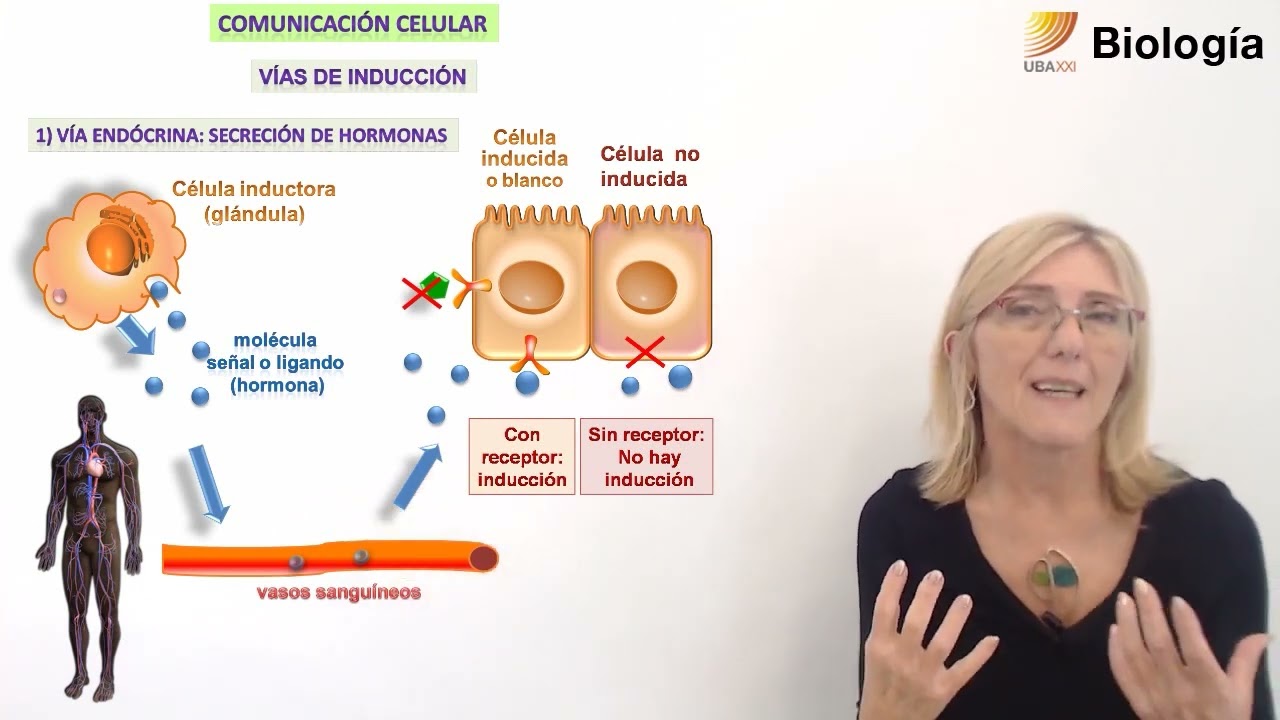
18- Biología.Comunicación celular
Communication Between Cells
Introduction to Cellular Communication
- The discussion begins with the complexity of communication between cells, highlighting how decisions like moving a finger involve intricate signaling from the brain.
- It distinguishes between voluntary and involuntary movements, setting the stage for understanding cellular interactions in multicellular organisms.
Mechanisms of Signaling
- Cells communicate through chemical signals, which include molecules such as proteins, carbohydrates, and lipids. These are essential for intercellular dialogue.
- A cell (referred to as "cell X") releases a chemical signal known as an inducer that prompts changes in another cell. This inducer is synonymous with ligands or signaling molecules.
Induction Process
- The induced cells are termed "induced cells" or "target cells," which respond to the signals released by the inducing cell.
- Ligands can be hydrophobic (lipids), allowing them to cross the plasma membrane directly and bind to intracellular receptors located in the cytosol or nucleus.
Types of Receptors
- Hydrophilic ligands cannot pass through membranes without assistance; thus, their receptors are located on the plasma membrane.
- The distinction between receptor types affects how responses are triggered within target cells.
Pathways of Induction
- Various pathways exist for ligand travel from secretion to target cell interaction. The endocrine pathway involves releasing signals into the bloodstream.
- Endocrine signaling allows widespread distribution throughout the body via blood vessels, ensuring that only target cells with specific receptors respond.
Specificity of Response
- Only those cells equipped with appropriate receptors will respond to a given signal; this specificity is crucial for effective communication.
- An analogy is drawn comparing cellular communication to language comprehension—without shared language (or receptors), no meaningful interaction occurs.
Direct Contact and Local Signaling
- Another form of induction is direct contact signaling where transmembrane proteins on adjacent cells interact directly—an example being sperm and egg recognition.
- Paracrine signaling involves nearby cells communicating within a localized area rather than across long distances.
Autocrine Signaling
- Autocrine signaling describes when a cell releases inductors that it also has receptors for, allowing it to monitor its own activity based on receptor occupancy.
Mechanisms of Cellular Regulation and Nervous Transmission
Cellular Induction and Regulation
- The ocean must continue to secrete inducers into the environment, as this process is crucial for maintaining cellular regulation. When all receptors are bound to inducers, it indicates a high concentration of inducers present in the medium.
- Many cells self-regulate through this mechanism, ensuring that their functions remain balanced despite external changes.
Nervous System Functionality
- The nervous pathway plays a significant role in nerve transmission, involving neurons that communicate with each other at synapses.
- Neurotransmitters are released during synaptic transmission; these act as inducers within the nervous system.