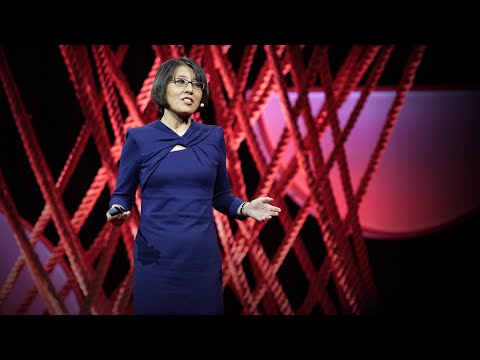
Management lessons from Chinese business and philosophy | Fang Ruan
The Love for Dumplings and Mom's Cooking
The speaker expresses their love for dumplings and explains that they rarely eat them in restaurants because their mom's cooking is the best.
Dumpling Xi's Flavor of Home
- One day, the speaker tries a dish from Dumpling Xi and is pleasantly surprised by its flavor, which reminds them of home.
- They describe the dumplings as fresh, chewy, and unexpected.
Exploring New Ways of Management in China
The speaker introduces themselves as a management consultant with a full-time job. They express their curiosity about the reasons behind the delicious dumplings and how it led to an exploration of new management approaches in China rooted in ancient Chinese philosophies.
Gāo Défú's Approach to Management
- The speaker mentions that if they were advising Gāo Défú (founder of Dumpling Xi) at the time when online food delivery services were affecting store visits, they would have suggested hiring venture managers or having a Chief Digital Officer.
- However, Gāo took a different approach by implementing a two-hat model. He invited successful regional heads to take on additional roles at headquarters while still managing their regions.
- Despite initial skepticism, this approach proved successful as sales eventually increased.
- After the transition period, more talents with start-up dreams were attracted to the company.
- The company began translating individual new capabilities into company policies, setting itself apart from competitors.
Challenging Traditional Management Practices
The speaker discusses how Gāo Défú's approach goes against traditional Chinese management practices rooted in Confucianism, which values seniority and authority.
Confucianism and Traditional Management
- The speaker explains that Gāo's approach, such as allowing frontline managers to make mistakes and encouraging new ideas from within the organization, is not common in China.
- They attribute this to the dominance of Confucianism in China for the past 2,000 years, which emphasizes seniority and authority for order and harmony.
- While this traditional approach ensures precise execution at a large scale, it may not be suitable for rapidly changing business environments.
- The speaker expresses gratitude for studying these new management approaches while enjoying delicious dumplings.
Miranda Qu's Approach at Xiaohongshu
The speaker introduces Miranda Qu, founder of Xiaohongshu (a thriving internet company), and discusses her unique approach to challenging hierarchy within the organization.
Challenging Hierarchy at Xiaohongshu
- Miranda Qu wanted the whole organization to be ready to spot necessary changes and challenge authority.
- She noticed interns referring to senior staff as "teachers," which indicated a hierarchical problem.
- This hierarchical thinking contradicted Qu's belief in ownership and breaking boundaries.
- To address this issue, she created the "Signature Program" where employees choose avatar characters that appear alongside digital communication channels.
Due to limitations on available content from the transcript, further sections could not be summarized.
Avatars and Empowering Frontline Staff
This section discusses how avatars from the same story come together to discuss their favorite characters and how this community fosters a collaborative environment. It also highlights the importance of empowering frontline staff.
Avatars from the same story discussing favorite characters
- In the "Slam Dunk" community, people from different cities, departments, and levels of the organization gather to talk about how characters inspire them at work.
- The community shares best practices on motivating diverse teams and inspiring them to reach their full potential.
Signature program fostering collaboration
- Xiaohongshu's signature program plays a pivotal role in creating a collaborative environment.
- The company has been ranked as one of the most innovative Chinese companies by Forbes for two consecutive years.
Examples of empowering frontline staff
- Gāo's two-hat approach and Qu's signature program are examples of empowering frontline staff.
- However, these methods may not always be suitable for every company.
Centralized approach for grassroots innovation
- Ping An, a successful insurance company with 400,000 employees, couldn't adopt a bottom-up innovation approach due to its size and complexity across multiple sectors.
- Ping An uses a centralized approach for innovations such as AI-enabled loss assessment, which simplifies claim processes and reduces waiting time for customers.
Taoism vs Confucianism in management mechanisms
- Unconventional management mechanisms like Gāo's two hats, Qu's signature program, and Ma's steering wheel are similar to Taoism rather than Confucianism.
- Confucianism emphasizes organizing and regulating things, while Taoism supports natural transformation and shaping the context rather than control.
Effective leadership in different contexts
- Confucianism works best in stable contexts, while Taoism is more effective in dealing with uncertainty.
- A leader's effectiveness is when people barely know they exist and say "We did it ourselves" when work is done.
Turn any video into a summary like this
YouTube links, meetings, lectures. With transcripts, search, and chat.