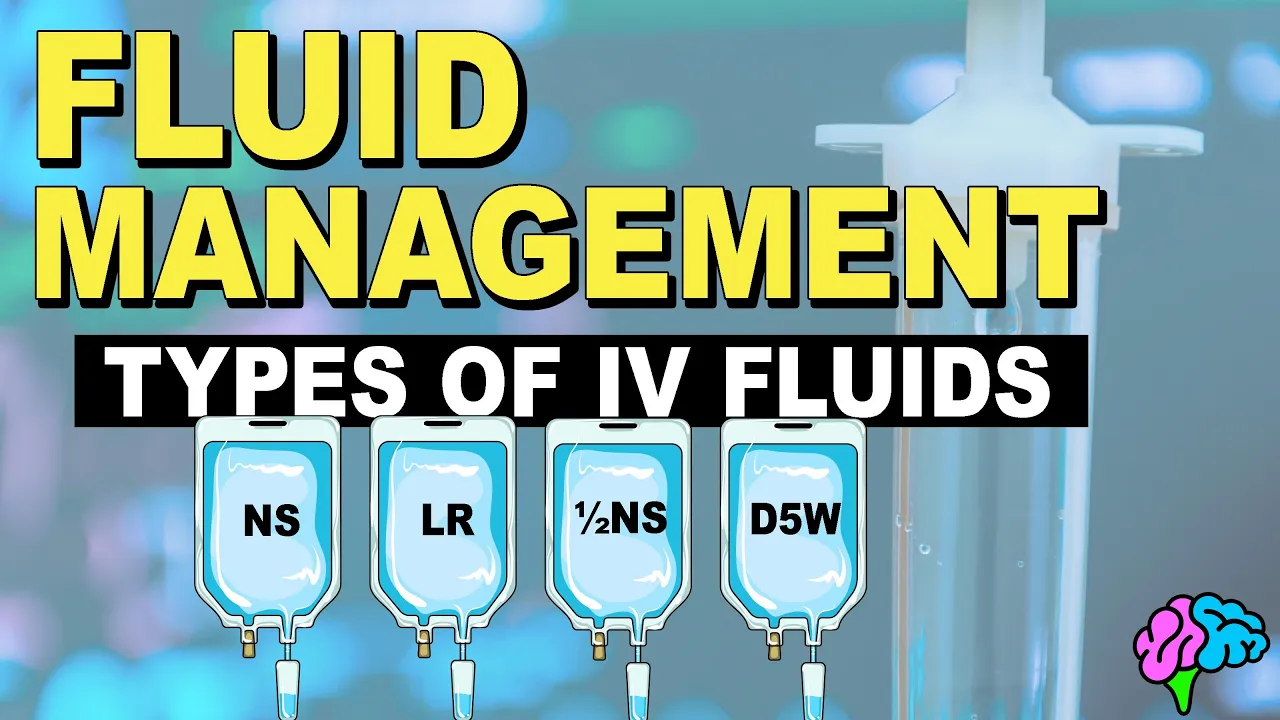
Types of IV Fluid - Fluid Management
Introduction
In this section, Eddie Watson introduces himself and the topic of fluid management strategies in ICU patients. He also mentions the importance of managing fluid and electrolytes in critically ill patients.
Introduction to Fluid Management Strategies
- Eddie Watson introduces himself and the topic of fluid management strategies in ICU patients.
- Managing fluid and electrolytes is crucial for critically ill patients.
Website Announcement
In this section, Eddie Watson announces his website where viewers can access more critical care educational content and take a free quiz.
Website Announcement
- Eddie Watson announces his website where viewers can access more critical care educational content.
- Viewers can take a free quiz on the website.
Types of IV Fluids
In this section, Eddie Watson discusses the different types of IV fluids available for fluid management in ICU patients.
Types of IV Fluids
- Different types of IV fluids are available for fluid management in ICU patients.
- The selection of fluids may vary from one provider to another.
- Understanding the impact of different fluids requires a baseline understanding of fluid distribution in the body.
Fluid Distribution in the Body
In this section, Eddie Watson explains how water is distributed throughout our bodies and how it moves between compartments.
Fluid Distribution in the Body
- Our bodies are composed mostly of water (50% - 60%).
- We have two major compartments: extracellular fluid (ECF) and intracellular fluid (ICF).
- ECF composes about a third of our total body water.
- Plasma makes up 20% while interstitial fluid makes up 80%.
- Electrolytes move freely between vasculature and interstitial space but cannot enter the intracellular fluid.
- ICF makes up the majority of our total body water and is all the fluid inside our cells.
- Water moves passively between compartments driven by osmotic and hydrostatic pressure gradients.
Electrolytes in Fluid Distribution
In this section, Eddie Watson discusses the role of electrolytes in fluid distribution and how they differ in concentration between extracellular and intracellular fluids.
Electrolytes in Fluid Distribution
- Major electrolytes include sodium, magnesium, potassium, calcium, chloride, and bicarb.
- Electrolytes can move freely between vasculature and interstitial space but cannot enter the intracellular fluid without active transport.
- Concentrations of electrolytes are roughly the same in extracellular fluid while concentrations differ strikingly between extracellular and intracellular fluids.
- Balance of electrolytes and fluid is crucial for proper body homeostasis.
Proteins in Fluid Distribution
In this section, Eddie Watson explains the role of proteins such as albumin in maintaining proper osmotic balance within plasma.
Proteins in Fluid Distribution
- Proteins such as albumin help maintain osmotic balance within plasma.
- These proteins are found only within plasma inside vasculature but not normally found within interstitial space.
Fluid Types and Categories
In this section, the speaker discusses the two broad categories of fluids: crystalloids and colloids. They also explain the benefits and drawbacks of each category.
Crystalloids vs Colloids
- There are two broad categories of fluids: crystalloids and colloids.
- Crystalloids contain water, electrolytes, and other small water-soluble molecules. They are simple, cost-effective, have a multitude of different combinations available for different purposes, and have a relatively non-existent immune response.
- Colloids are large insoluble molecules that often contain proteins. Blood itself is a colloid but there are other forms as well. They benefit from having higher osmotic pressure in the blood but they are more expensive than crystalloids and have potential complications with immune response.
Types of Crystalloids
- There are three main types of crystalloids based on their osmolality compared to plasma: isotonic, hypertonic, and hypotonic.
- Isotonic fluids have roughly the same osmotic concentration as extracellular fluid or plasma. This means they won't shift between extracellular fluid and intracellular fluid.
- Hypertonic fluids have greater concentrations of particles giving them more osmotic concentration. This leads to fluid being pulled from intracellular fluid inside cells to extracellular fluid.
- Hypotonic fluids have less concentration of particles giving them less osmotic concentration. This leads to fluid moving from extracellular fluid to intracellular fluid.
Common Isotonic Fluids
- Normal saline has an osmolality of 308 and is slightly hypertonic. It contains 154 of sodium and 154 of chloride, but no other electrolytes. This makes it an unbalanced fluid that can lead to hyperchloremic metabolic acidosis and negative effects on GFR.
- Lactated Ringer's solution has an osmolality of 273 and is isotonic. It contains sodium, potassium, calcium, magnesium, bicarb, and lactate in concentrations similar to plasma. This makes it a balanced fluid that is often used for resuscitation.
Conclusion
In this section, the speaker concludes the lesson by summarizing the main points discussed in the previous sections.
- Crystalloids and colloids are two broad categories of fluids with different benefits and drawbacks.
- There are three types of crystalloids based on their osmolality compared to plasma: isotonic, hypertonic, and hypotonic.
- Normal saline is a commonly used unbalanced fluid that can have negative effects on GFR while lactated Ringer's solution is a balanced fluid often used for resuscitation.
Types of Fluids Used in Medicine
In this section, the speaker discusses different types of fluids used in medicine and their compositions.
Isotonic Solutions
- Normal Saline:
- Contains 154 mEq/L of sodium and chloride
- Used for fluid resuscitation, dehydration, and hypernatremia
- Lactated Ringer's Solution (LR):
- Contains sodium, potassium, chloride, calcium, and lactate
- Considered a balanced fluid but may worsen cerebral edema in patients with head injuries or hepatic hypoperfusion
- Plasmalite:
- Contains sodium, potassium, chloride, magnesium, acetate, and gluconate
- Also considered a balanced fluid but has lower risk for hyperchloremic metabolic acidosis compared to LR
Hypertonic Solution
- Three Percent Normal Saline:
- Contains high concentration of sodium (513 mEq/L)
- Used to treat cerebral edema and severe symptomatic hyponatremia
Hypotonic Solution
- Half Normal Saline (0.5 NS):
- Contains half the amount of sodium and chloride compared to normal saline
- Used for maintenance fluids or to treat hypernatremia
Types of IV Fluids
This section covers the different types of IV fluids and their characteristics.
Basic Common Types of IV Fluids
- Intracellular fluid shifts from outside to inside cells, so hypotonic solutions should not be used for patients with head injuries.
- Hypertonic solutions can lead to increased cerebral edema and intracranial pressure. Half NS is a good option for replacing free water deficit, but rapid administration can lead to hemolysis and cardiovascular collapse.
Dextrose Containing Fluids
- Dextrose-containing fluids add calories as dextrose is metabolized. The two main concentrations are 5% dextrose (170 calories per liter) and 10% dextrose (340 calories per liter).
- Five different types of fluids are discussed, starting with isotonic fluid (D5W), which becomes hypotonic after dextrose metabolism. The remaining four start hypertonic and become isotonic over time.
Colloids
- Colloids are volume or plasma expanders that work by pulling fluid into the vasculature due to their high oncotic pressure. They stay within blood vessels, preventing peripheral edema and keeping more fluid available in the vasculature for pressure support.
Conclusion
This section concludes the video by summarizing key points about IV fluids.
- Be aware of where dextrose-containing fluids start and end up, as well as the calorie content they provide.
- Use hypertonic solutions cautiously, especially in patients with head injuries.
- Colloids are volume or plasma expanders that work by pulling fluid into the vasculature due to their high oncotic pressure.
Physiology of Fluid Compartments and Types of Fluids
In this section, the speaker discusses the physiology of fluid compartments and types of fluids. The speaker explains how different fluids affect the body and reviews some common categories and types of fluids.
Colloids for Volume Expansion
- Albumin is a human protein derived from large pools of plasma that can be used as an adjunct to other fluids when treating patients with hypovolemia. It has potential to preserve renal function in critically ill patients.
- Hydroxyethyl starches (HES) such as Hespan and dextran are molecules that behave like colloids for volume expansion. They work like albumin by not leaving the vasculature into the interstitial space, giving us that same oncotic pressure.
Crystalloids vs Colloids
- Crystalloids are solutions containing small molecules that can easily cross cell membranes, while colloids contain larger molecules that remain within the intravascular space.
- Crystalloids are cheaper than colloids but have a shorter duration of action. They are useful for maintenance therapy or resuscitation in mild cases.
- Colloids have a longer duration of action but are more expensive than crystalloids. They are useful for resuscitation in severe cases or when there is significant capillary leak syndrome.
Different Categories and Types of Fluids
- Normal saline is a crystalloid solution commonly used for fluid resuscitation, but it has been associated with hyperchloremic metabolic acidosis.
- Lactated Ringer's solution is another crystalloid solution that contains electrolytes similar to those found in plasma. It is useful for resuscitation and maintenance therapy.
- Plasma-Lyte is a crystalloid solution that has a composition similar to Lactated Ringer's but with less lactate. It may be associated with better outcomes than normal saline.
Conclusion
In this section, the speaker concludes the lesson and encourages viewers to leave comments and feedback.
- Understanding the differences between different types of fluids is important because they have different effects on the body depending on which one you're using.
- If you enjoyed this lesson, please leave a like and comment down below. Subscribe to the channel for more lessons in this series.