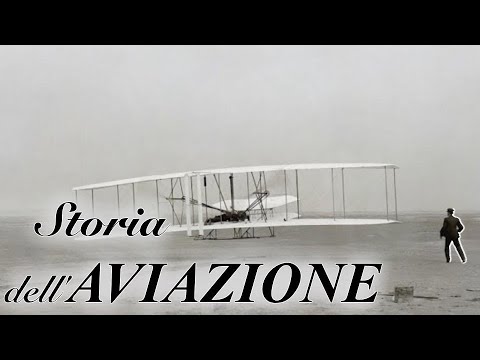
STORIA dell'AVIAZIONE
The Desire to Fly: A Historical Perspective
Early Aspirations and Myths of Flight
- William Thomson Kelvin's assertion that a heavier-than-air flying machine is impossible highlights humanity's long-standing fascination with flight.
- Throughout history, humans have sought ways to overcome their inability to fly, from creating weapons to building tall structures as symbolic gestures of rising above birds.
- Ancient myths often depicted humans attempting to fly, such as the story of Icarus, illustrating the dangers and hubris associated with this desire.
Understanding Flight Mechanics
- The concept of flight can be understood as a delayed fall; birds manage to fall slowly due to aerodynamic principles.
- Galileo's discovery that air has weight laid the groundwork for understanding buoyancy in flight; lighter objects can float in air like they do in water.
- Three methods for achieving flight are identified: falling slowly (parachuting), using lighter-than-air materials, and generating enough energy for aerodynamic lift.
Historical Attempts at Flight
Early Innovations
- The first known flying devices were kites used since the 5th century AD, which utilized wind energy for elevation.
- Armand Firmann attempted to create artificial wings but failed due to neglecting essential features like tail stabilization found in birds.
Leonardo da Vinci’s Contributions
- Leonardo da Vinci designed a prototype flying machine that could potentially achieve flight if constructed correctly, marking an early theoretical success.
Progression Towards Powered Flight
Development of Hot Air Balloons
- The first hot air balloon was created in China around 400 BC; it demonstrated basic aerodynamics by lifting through heated air.
- Henry Cavendish's experiments with hydrogen balloons in 1766 led to successful flights but also public panic when one landed unexpectedly.
The Wright Brothers' Breakthrough
- Orville and Wilbur Wright revolutionized aviation by applying scientific methods and focusing on controlled takeoff and landing techniques.
- Their persistence paid off on December 17, 1903, when they achieved powered flight after correcting previous design flaws related to stability.
Advancements in Aviation Technology
Italian Innovations During War
- Giovanni Battista Caproni pioneered military aviation during the Italo-Turkish War, producing advanced aircraft designs that influenced global aviation standards.
Visionary Designs by Caproni
- Caproni envisioned commercial aviation for transporting people and goods; his CA.60 design was ambitious yet ultimately flawed due to human error during its final test flight.
Space Exploration: From Dreams to Reality
The Race into Space
- Jules Verne’s ideas about space travel foreshadowed future advancements; however, initial attempts faced significant challenges regarding astronaut safety upon impact with celestial bodies.
Soviet Achievements vs. American Responses
- The Soviet Union led early space exploration efforts with milestones like launching Sputnik and sending Yuri Gagarin into orbit before the U.S. could catch up.
Modern Developments and Future Prospects
Current State of Aviation Technology
- Today’s advancements include jetpacks and portable flying devices aimed at making personal flight more accessible despite high costs associated with development.
Reflection on Human Ingenuity
- Kelvin's statement serves as a reminder that perceived limitations may stem from misunderstandings rather than absolute truths about physics; innovation often arises from reinterpreting these boundaries.
Turn any video into a summary like this
YouTube links, meetings, lectures. With transcripts, search, and chat.