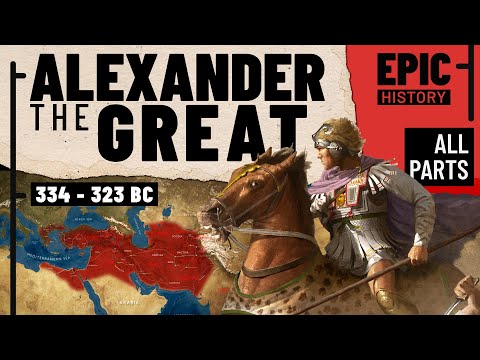
The Greatest General in History? Alexander the Great (All Parts)
Alexander the Great (All Parts)
This section provides an introduction to Alexander the Great and his military campaigns against the Persian Empire.
Alexander's Military Campaigns
- In 334 BC, Alexander, King of Macedonia, embarked on one of history's greatest military campaigns against the Persian Empire.
- At just 20 years old, Alexander displayed brilliant and fearless leadership, winning battle after battle.
- Over a span of 10 years, he expanded his empire to the edge of the known world, creating one of the largest empires in history.
- Alexander's impact on history is considered massive and few men have had such influence.
The Legacy of Alexander
- To the Persians, he was known as Alexander the Accursed, but in the west he became immortalized as Alexander the Great.
- Epic History TV and Invicta produced a series on Alexander called "Aleksander the Great Part I."
Ancient Greece
This section explores Ancient Greece and its significant contributions to art, philosophy, and warfare.
Development in Ancient Greece
- Ancient Greece witnessed remarkable developments in art, philosophy, and warfare around 500 BC.
- Athens emerged as a naval power where democracy, art, drama, and philosophy flourished.
- Sparta stood out as an austere militaristic society renowned for its formidable army.
Greek Resistance Against Persia
- In 480 BC, Athens and Sparta joined forces to resist an invasion by the mighty Persian Empire.
- The Battle of Thermopylae saw a small Greek force, led by 300 Spartans, hold off the Persian army for three days.
- The Greeks achieved victory in the Battle of Salamis but couldn't prevent the Persians from burning the Athenian acropolis.
- At Plataea, the Greeks won a decisive land battle against the Persians, forcing them to abandon their invasion.
Macedonia's Rise
This section focuses on Macedonia's rise as a formidable military force under King Philip II.
Perception of Macedonia
- For centuries, sophisticated Greeks viewed Macedonia as a backwater kingdom with little Greek influence.
King Philip II and Military Reforms
- Under King Philip II, Macedonia emerged as a powerful military force.
- Philip introduced the sarissa, an 18-foot pike wielded by infantry fighting in close formation known as a phalanx.
- In 338 BC, at the Battle of Chaeronea, Philip's army crushed forces from Thebes and Athens.
Unification and Plans for War
- Following his victory at Chaeronea, Philip united all Greece in an alliance known as the Hellenic League or League of Corinth.
- Only Sparta remained outside this alliance.
- Philip planned a Panhellenic war against the Persian Empire.
Alexander's Reign
This section covers Alexander's ascension to power and his preparations for war against Persia.
Succession and Consolidation
- After King Philip II's assassination, Alexander, his 20-year-old son, succeeded him.
- Alexander secured his position as king by eliminating potential rivals and crushing rebellions.
Launching the War
- In 334 BC, Alexander led his army across the Hellespont into Asia Minor to begin his war against the Persian Empire.
Conclusion
This comprehensive summary provides an overview of Alexander the Great's military campaigns, Ancient Greece's contributions, Macedonia's rise under King Philip II, and Alexander's preparations for war against Persia. The timestamps provided allow for easy reference to specific parts of the transcript for further study.
Alexander's Army
This section provides an overview of Alexander's army and its composition.
Composition of the Army
- The army consisted of approximately 40,000 soldiers from various parts of Greece.
- The infantry was led by Parmenion, a veteran Macedonian general.
- The front rank consisted of 9,000 Macedonian phalangites armed with 18-foot sarissas. They formed up in a phalanx formation, 16 ranks deep.
- The phalanx presented a solid wall of iron spear-tips but was difficult to maneuver and vulnerable to attacks on its flanks or rear.
- The flanks were guarded by 3,000 elite infantry called hypaspists, commanded by Nikanor, Parmenion's son.
- The second line included 7,000 Greek allies and 5,000 mercenaries armed as hoplites. They carried shorter spears and large round shields called hoplons.
- Skirmishers such as the Agrianes from southern Bulgaria and others armed with javelins, slings, and bows provided additional support.
- The shock troops were the Companion Cavalry consisting of 1,800 elite horsemen armed with spears and swords. Philotas commanded them while Alexander led the royal squadron personally. Additional cavalry units came from Thessaly and other parts of Greece along with mounted scouts from Thrace and Paeonia under Kassander's command.
The Battle at Granicus
This section focuses on the battle at Granicus between Alexander's army and the Persian forces.
Persian Army Formation
- The Persian army formed up behind the Granicus River, with a front line consisting of approximately 10,000 cavalry from various regions of the empire.
- Greek mercenaries formed the reserve infantry, armed with round shields and short spears. They were placed at the rear, possibly due to concerns about their loyalty in fighting against fellow Greeks.
Alexander's Strategy and Troop Placement
- Alexander aimed to attack and destroy the Persian force before it could retreat. He positioned Thessalian, Greek, and Thracian cavalry on his left wing under Parmenion's command.
- The center consisted of the massed spears of the phalanx divided into six divisions commanded by different leaders.
- Alexander himself led the right wing, which included Companion Cavalry under Philotas' command along with elite hypaspists, Agrianes javelin-throwers, and archers.
Battle Commencement
- Despite advice to wait until dawn to cross the river, Alexander ordered an immediate assault. A squadron of Companion cavalry crossed first followed by hypaspists and Paeonian light cavalry.
- As they reached the middle of the river, they faced a barrage of javelins, darts, and arrows from the Persian line. Those who made it to the far bank were immediately charged by Persian cavalry.
Alexander's Desperate Conflict
This section describes Alexander's involvement in a fierce battle against the Persians, where he strategically attacked their cavalry and leaders to buy time for his army to cross the river.
Alexander's Reckless Attack
- Alexander launched an attack on the Persian cavalry and leaders.
- A desperate conflict ensued, with horses and men clashing against each other.
- The Macedonians aimed to drive the Persians away from the river bank, while the Persians were determined to prevent them from crossing.
Buying Time for His Army
- Despite appearing reckless, Alexander's attack was a strategic move to buy time.
- He wanted his army, including the powerful Macedonian phalanx, to safely cross the river.
Facing Danger
- During the battle, Alexander found himself fighting for his life when charged by two Persian nobles.
- Rhoesaces struck him on the head but failed to penetrate his helmet. In response, Alexander defeated him with his lance.
- Spithridates attempted another attack from behind but was intercepted by Black Cleitus who severed his arm.
Victory Achieved
- With the Greek army successfully crossing the river, most of the Persian cavalry retreated in face of Macedonian spears.
- The speed and shock of Alexander's attack prevented Persia's Greek mercenaries from joining the battle.
- These mercenaries were surrounded and massacred by Alexander's forces.
Conquering Asia Minor
This section highlights how Alexander secured victory in Asia Minor but faced challenges as he confronted a wealthy and powerful Persian Empire.
Ignoring Appeals for Mercy
- Despite pleas for mercy from Greek mercenaries aligned with Persia, Alexander ignored them.
- He viewed these Greeks as traitors or a potential threat and showed no mercy.
Victory in Asia Minor
- Alexander's triumph in Asia Minor granted him control over the region.
- However, the Persian Empire still possessed immense wealth and power.
Mobilizing Resources
- The Persian Empire began mobilizing its vast resources to face Alexander.
- They prepared to confront him and defend their empire under the leadership of King Darius III.
Neutralizing Persian Naval Power
This section focuses on Alexander's strategy to neutralize Persian naval power by targeting their naval bases in Miletus and Halicarnassus.
Challenging Persian Naval Power
- Persia possessed a powerful fleet with significant naval bases across the eastern Mediterranean.
- These naval forces could potentially disrupt Alexander's communication lines back to Greece.
Attacking Greek Coastal Cities
- Instead of engaging Persia at sea, Alexander decided to attack their nearest bases: Miletus and Halicarnassus.
- Both cities resisted fiercely but eventually fell during winter.
Advancing into Lycia and Phrygia
This section highlights Alexander's continued advance into Lycia and Phrygia after conquering Miletus and Halicarnassus.
Continuing the Campaign
- In the spring of 333 BC, Alexander pressed forward into Lycia and Phrygia.
- His conquest aimed to expand his control over these regions.
The Legendary Gordian Knot
- At Gordium, Alexander encountered the legendary "Gordian Knot."
- According to prophecy, whoever could untie it would rule all of Asia. Alexander simply sliced it in half with his sword.
Persian Naval Offensive
- Memnon of Rhodes, a skilled Greek general serving Persia, led Persian warships into the Aegean.
- They captured the islands of Chios and Lesbos but halted their offensive after Memnon's death.
The Battle of Issus
This section focuses on the Battle of Issus, where Alexander faced King Darius III and his vast Persian army.
Alexander's Army Trapped
- After 18 months since invading the Persian Empire, Alexander entered Cilicia and prepared to cross the Nur Mountains into Syria.
- However, King Darius III positioned his main army behind Alexander's forces, blocking their escape route.
Outnumbered but Strategic Advantage
- Darius aimed to trap and destroy Alexander's outnumbered army.
- The battlefield near Issus was narrow, only 6 miles wide from mountains to sea. It forced both sides into battle but limited Darius' numerical advantage.
Strength of the Persian Army
- The Persian army numbered up to 100,000 soldiers and included elite troops like the Immortals.
- Their best cavalry was concentrated on their right flank towards the sea for better maneuverability.
Persian Infantry and Alexander's Army Deployment
This section discusses the positioning of Persian infantry and Alexander's army for battle.
Persian Infantry Formed Left Wing
- Persian infantry formed the left wing of their army.
Alexander Entrusts Left Wing to Parmenion
- Alexander entrusted his left wing, nearest the sea, to Parmenion.
Greek Cavalry and Infantry with Parmenion
- Parmenion commanded the Greek cavalry and infantry on the left wing.
Macedonian Phalanx in the Centre
- The Macedonian phalanx was positioned in the center of Alexander's army.
Alexander Positions Himself on Right Wing
- Alexander positioned himself and his best troops on the right wing, towards the mountain slopes.
Troops on Alexander's Right Wing
- On Alexander's right wing were his elite Agriane javelin-throwers, archers, Hypaspists, and Companion cavalry.
Antipater's Rebellion in Thrace
This section discusses the rebellion in Thrace that Alexander's commander, Antipater, was dealing with.
Antipater's Challenges
- Antipater, Alexander's commander in Greece, was already dealing with rebellion in Thrace.
Battle near Megalopolis
This section describes the battle between Alexander and Agis near the city of Megalopolis.
Clash with Agis
- Alexander quickly marched south and met Agis in battle near Megalopolis.
- The Spartan army, including the legendary Spartans, were no match for Macedonian military power.
- The Spartan army was crushed and King Agis himself fell in battle.
Advancing towards Persian Heartlands
This section highlights Alexander's advance towards the Persian heartlands after securing his base in Greece.
Towards Persia
- With his base in Greece secure once more, Alexander advanced towards the Persian heartlands.
- His goal was to have a final showdown with Darius, seeking to rule the world.
Rejecting Darius' Offer
This section discusses how Alexander rejected Darius' offer for peace and decided to take over the entire empire.
Darius' Offer Rejected
- Darius sent a letter offering Alexander a fortune in gold, his daughter's hand in marriage, and half of his empire for peace.
- However, Alexander believed that his destiny was to rule the world and rejected the offer.
Alexander's Invasion of Persia
This section introduces Alexander's invasion of the vast Persian Empire.
The Invasion Begins
- In 334 BC, Alexander, the 21-year-old ruler of Macedonia, led an invasion of the Persian Empire.
- Despite facing seemingly impossible odds, Alexander won two great battles against the Persians at Granicus and Issus.
Battle of Gaugamela
This section focuses on the Battle of Gaugamela between Alexander and Darius III.
Showdown at Gaugamela
- Hearing about a great Persian army led by Darius at Gaugamela, Alexander made his way there.
- Darius saw this as his last chance to stop Alexander and for Alexander to crush Persian power once and for all.
The Persian Army at Gaugamela
This section provides details about the Persian army assembled at Gaugamela.
Persian Forces
- The Persian Army consisted of infantry from Syria and Babylonia, cavalry from Armenia, India, and Central Asia, scythed chariots, and war elephants.
- Estimates suggest that the Persian Army outnumbered Alexander's forces by as much as two to one.
Deployment and Formation
This section describes how Alexander deployed his units in preparation for the battle.
Unit Placement
- Parmenion commanded Thracian and Thessalian cavalry on the left flank.
- The Macedonian veterans of the phalanx armed with sarissa pikes formed the center.
- Alexander led his elite cavalry, the Companions, and his best infantry, the hypaspists, on the right flank.
Alexander's Main Attack
This section highlights Alexander's main attack strategy during the battle.
Main Attack Plan
- Alexander planned to launch his main attack with his elite cavalry and best infantry units.
- Greek hoplites formed a second line to support both wings and guard against encirclement by the Persians.
Alexander's Trap
This section reveals how Alexander set a trap for the Persians during the battle.
Trapping the Persians
- Alexander surprised the Persians by leading his wing out to the right, making them believe he was trying to encircle their army.
- The Persians mirrored his movement, weakening their center and allowing Alexander to launch his main attack.
Battle Developments
This section discusses key developments during the battle.
Giant Cavalry Battle
- A massive cavalry battle unfolded on the right wing between Alexander's forces and Persian troops.
- Darius unleashed chariots at what he believed was a decisive moment in the battle.
Defeating Darius' Chariots
This section describes how Alexander's forces neutralized Darius' chariots.
Neutralizing Chariots
- Expert Agrianes javelin throwers took out horses and crews of the Persian chariots.
- Greek infantry opened lanes, allowing the chariots to pass harmlessly through.
Alexander's Charge
This section highlights Alexander's charge towards the weakened Persian center.
Headlong Charge
- Alexander led his Companion cavalry and parts of the Macedonian phalanx in a headlong charge towards Darius himself.
The summary has been provided in English as requested.
The Battle of Gaugamela
This section provides an overview of the Battle of Gaugamela, focusing on the events and outcomes.
The Battle Unfolds
- The centre of the army broke and ran, with King Darius himself leading the rout.
- Alexander's left wing, led by Parmenion, faced a huge onslaught by Persian cavalry and was virtually surrounded.
- Indian and Scythian horsemen rode through a gap in the Greek line but instead of attacking from behind, they looted the Greek camp.
- Parmenion sent a desperate appeal to Alexander for help.
- Alexander abandoned his pursuit of Darius, regrouped, and charged the Persian right wing.
- The fighting was intense and claimed the lives of sixty of Alexander's Companions.
- As news spread of Darius's flight, the last Persian horsemen turned and fled.
Victory for Alexander
- The Battle of Gaugamela was a stunning victory for Alexander.
- According to ancient sources, he lost only a few hundred men while the Persians lost thousands.
- With this victory, Alexander had routed Darius's great army and gained access to Babylon.
Alexander's Conquest
This section highlights key moments in Alexander's conquest after his victory at Gaugamela.
Triumph in Persia
- After his triumph at Gaugamela, Alexander entered Babylon as its new rightful ruler.
- He also took his seat upon the royal throne of Persia in Susa.
- In the Persian Gates, a courageous Persian force held up Alexander's army for a month before being defeated.
Reaching Persepolis
- The Greeks found a mountain path to bypass the defenders at the Persian Gates and wiped them out.
- In early 330 BC, Alexander reached Persepolis, the empire's ceremonial capital.
- Despite wanting to appear as a liberator, Alexander ordered Persepolis to be pillaged and burnt as retribution for past Persian invasions.
Pursuit of Darius
- Alexander headed north into Media to capture Darius, who had fled east in hopes of raising a new army.
- As Alexander closed in on Darius, the Persian king was murdered by one of his own governors, Bessus.
- Alexander ordered Darius to be buried in the royal tombs of Persepolis.
Organizing the Empire
This section focuses on how Alexander organized his vast new empire after dealing with Darius's death.
Appointing Viceroys
- Alexander appointed viceroys to rule the provinces on his behalf.
- Several Persians who had sworn loyalty were kept in their posts.
Continuing Eastward
- After organizing his empire, Alexander resumed his march eastward.
- His goals were to find and kill Bessus, subjugate the empire's eastern provinces, and reach the far edge of the world.
Alexander's Eastern March
This section covers Alexander's continued march eastward and his encounters with various Persian governors.
Pursuit of Bessus
- In 330 BC, Alexander continued his march east to find and kill Bessus, a Persian usurper claiming to be the rightful king.
- His goal was also to subjugate the empire's eastern provinces.
Aria and Satibarzanes
- Alexander headed first for Aria, where the Persian governor Satibarzanes had launched a revolt.
- The rebellion was crushed, and Satibarzanes was killed in single combat by a Greek cavalry officer.
Founding Alexandria Ariana
- Near Aria, Alexander founded Alexandria Ariana (modern Herat), one of many cities he would establish bearing his name.
Plot Against Alexander
This section focuses on a plot against Alexander and its consequences.
Threat from Within
- The Macedonian court had a history of plots and assassinations.
- Philotas, commander of Alexander's Companion Cavalry, uncovered a plot to assassinate him but kept it secret.
Consequences for Philotas
- When informed about Philotas' knowledge of the plot, Alexander considered it treasonous.
- Both Philotas and his father Parmenion were among Alexander's respected commanders.
Alexander's Pursuit and Execution
This section focuses on Alexander's pursuit of Bessus and the execution of Philotas.
Pursuit of Bessus
- Alexander resumed his pursuit of Bessus in 329.
- He founded the city of Alexandria Arachosia in southern Afghanistan.
- Bessus was betrayed by his own men and handed over to Alexander in chains.
- Alexander sent him back to Persia for execution as a king-slayer.
Sogdian Resistance
- The Sogdians rose up against Alexander in modern Tajikistan.
- He had to fight off attacks by local tribes and take several towns by assault.
- On the banks of the Jaxartes River, he founded the city of Alexandria-Eschate, marking the limit of the Persian Empire.
- The frontier was frequently raided by nomads known as Scythians.
- Alexander lured them into a decisive battle near the Jaxartes, resulting in a crushing victory.
Guerilla Warfare
- Fighting against Bactrian and Sogdian tribes continued, frustrating Alexander.
- He faced difficulties in a guerilla war that tied him down.
Unrest Among Macedonian Troops
This section highlights growing discontent among Macedonian troops towards Alexander.
Dissatisfaction with Conquest
- Many Macedonian troops were unhappy with Alexander.
- They had not seen their homes in years, and they felt that he pursued conquest without end.
Adoption of Persian Customs
- Alexander began adopting rituals and dress associated with their defeated Persian enemy.
- The troops viewed these customs as effeminate and decadent.
Killing Cleitus the Black
- In Maracanda (modern Samarkand), Alexander killed Cleitus the Black, one of his best generals.
- Cleitus had previously saved Alexander's life at the Battle of the Granicus.
- This act further alienated old comrades and showcased Alexander's growing arrogance.
Persian Ritual Controversy
- When Alexander tried to make his countrymen perform the traditional Persian ritual of proskynesis (prostrating before the king), it was viewed as blasphemy by Greeks.
- Only a god was considered worthy of such respect, leading to backlash against Alexander.
Plots and Betrayals
This section discusses plots and betrayals against Alexander.
Assassination Plot
- Another plot to assassinate Alexander was uncovered in Bactria.
- The ringleader was Hermolaus, a royal page who had become bitter towards Alexander over a perceived injustice.
- Hermolaus and his accomplices were tortured and stoned to death.
Implication of Callisthenes
- Callisthenes, Alexander's official historian, was implicated in the conspiracy.
- He was thrown into prison where he later died.
Marriage and Further Conquest
This section focuses on Alexander's marriage to Roxana and his continued conquest into modern Pakistan and India.
Marriage with Roxana
- In 327, according to legend, Alexander became captivated by Roxana, daughter of a Bactrian lord.
- Their marriage helped end local revolt against his rule and facilitated his advance into modern Pakistan and India.
Subduing Eastern Provinces
- To subdue the eastern provinces that had yet to recognize his kingship, Alexander prepared to cross the Hindu Kush mountains.
- His army won skirmishes against various tribes as they fought their way into what is now northern Pakistan.
- After a fierce siege, Alexander took the Assacenian capital of Massaga.
Battle of the Hydaspes
- Alexander formed an alliance with the ruler of Taxila and together they faced Porus, king of Pauravas, at the Battle of the Hydaspes.
- This battle inflicted terrible casualties on the Greeks due to Porus's war elephants.
Alexander the Great: The Death of a Conqueror
This section covers Alexander's desire to push into India, his army's mutiny at the River Hyphasis, and his journey back to Persia.
Alexander's Ambition to Reach the Edge of the World
- Alexander wanted to push on into India in order to reach the great river that ancient Greek geographers believed formed the edge of the world.
Mutiny at the River Hyphasis
- At the River Hyphasis (Beas), Alexander's army mutinied after marching thousands of miles, fighting countless battles, and being away from their homes for 8 years.
- The soldiers had heard rumors of gigantic armies waiting for them in India and refused to go any further.
- Despite his fury, Alexander had no choice but to turn the army around.
Journey Back to Persia
- Alexander followed the rivers of Punjab to reach the sea, which took 10 months.
- On this journey, he defeated the Mahlians but was wounded in the chest during an assault on their capital.
- Part of his army under Nearchus boarded ships and returned by sea to Persia through Hormuz Strait and Persian Gulf, while Alexander led the rest back by land through Gedrosian desert (today southern Pakistan).
- Extreme heat and shortages of food and water caused terrible suffering and many deaths among his troops in Gedrosian desert.
Alexander's Return and Legacy
This section covers Alexander's return to Persia, execution of unjust rulers, mass-marriage of Macedonian officers to Persian noblewomen, and the mutiny of his Macedonian troops.
Return to Persia and Execution of Unjust Rulers
- Upon returning to Persia, Alexander executed several viceroys and governors accused of ruling unjustly and robbing temples and tombs during his absence in the east.
Mass-Marriage and Reconciliation
- At Susa, Alexander arranged a magnificent mass-marriage between Macedonian officers and 80 Persian noblewomen to strengthen bonds between the two kingdoms.
- Alexander himself married two Persian princesses.
- He paid off all his soldiers' debts and ordered 30,000 youths from across the empire to be trained in the Macedonian art of war.
- However, at Opis, his Macedonian troops mutinied due to their offense at Alexander's apparent preference for Persian advisors and ways. The ringleaders were executed, but eventually an emotional reconciliation was achieved through Alexander's speech reminding them of their shared glories.
Hephaestion's Death and Mourning Period
- At Ecbatana, Alexander's closest friend Hephaestion died of fever, causing great grief for the king who went days without eating. A period of public mourning was ordered across the empire.
Alexander's Final Campaigns
This section covers Alexander's successful campaign against mountain raiders in Cossaea, meetings with embassies from distant peoples upon returning to Babylon, Roxana's pregnancy, sudden fever leading to death at a young age.
Successful Campaign Against Mountain Raiders
- Alexander waged a successful campaign against the mountain raiders of Cossaea who even the Persian kings had failed to subdue.
Meetings with Distant Peoples
- Returning to Babylon, Alexander was met by embassies from distant peoples such as Aethiopians, Libyans, European Scythians, Lucanians, Etruscans, Gauls, and Iberians who came to recognize his greatness.
Roxana's Pregnancy and Alexander's Death
- Alexander's Bactrian wife Roxana was pregnant at this time. However, as he planned his next campaign to Arabia and beyond, he developed a sudden fever and died days later at the age of 32. The cause of his death remains unknown.
The Successors
This section highlights the aftermath of Alexander's death and the struggles among his generals for power.
Legacy of an Undefeated Conqueror
- Alexander died undefeated in battle and left behind a reputation as a brilliant military commander. His decade-long campaign created one of the largest empires ever known, stretching from Greece to Pakistan.
Struggles Among the Generals
- With no plans for succession, Alexander's generals began fighting among themselves to carve out their own empires in the Wars of the Successors.
- During this period, Alexander's widow Roxana and his young son were murdered.
- His gold sarcophagus intended for burial in Macedonia was hijacked and ended up in Alexandria, Egypt. Its current location remains a mystery today.
Conclusion: Impact on History
This section emphasizes the significant impact that Alexander the Great had on history.
- Few men have had such a profound impact on history as Alexander the Great. His breathtaking achievements during his short life ushered in the Hellenistic Age, spreading Greek ideas across his former empire and fusing them with local traditions.
New Section
Some of the successor kingdoms to his great empire were short-lived, while others endured for centuries. However, all would eventually fall to new forces, including the rising power of Rome.
Successor Kingdoms
- The successor kingdoms to Alexander's empire had varying lifespans.
- Some kingdoms were short-lived, while others lasted for centuries.
- Ultimately, all these kingdoms succumbed to new forces.
- In the west, the rising power of Rome played a significant role in their downfall.
New Section
Research and artwork for this video come from Osprey Publishing's extensive range of books on ancient history.
Osprey Publishing
- Osprey Publishing provides research and artwork for this video.
- They have an extensive range of books on ancient history.
- Each book examines a particular battle, campaign, or combat unit in detail.
- With over 3,000 titles available, they cover various topics from ancient warfare to modern conflict.
New Section
Thank you to all the Patreon supporters who made this video possible and to the channel 'Invicta'. Find out more about key moments from the past in their 'Moments in History' series.
Acknowledgments
- This video was made possible by Patreon supporters.
- Special thanks to the channel 'Invicta'.
- Check out their 'Moments in History' series for more insights into key moments from the past.
Turn any video into a summary like this
YouTube links, meetings, lectures — with transcripts, search, and chat.