Schwitzgebel on the Unreliability of Introspection
Philosophy of Mind: Introspection and Its Reliability
Introduction to Introspection
- Matt McCormick introduces the topic of introspection in his philosophy of mind course, referencing Descartes' view on infallible self-awareness.
- He mentions empirical research by Nisbet and Decamp Wilson regarding the reliability of verbal reports on higher-order mental processes.
The Unreliable Nature of Introspection
- Eric Schweitzgabel's article discusses the paradox that while introspection is essential for understanding consciousness, it is also highly untrustworthy.
- Schweitzgabel argues against Descartes' belief that introspective awareness is the most reliable form of knowledge about oneself.
Comparing Internal and External Awareness
- Schweitzgabel posits that individuals can more reliably report external facts (e.g., car wheels or tree colors) than their internal states.
- He claims that people are generally poor at accurately assessing their ongoing conscious experiences, leading to significant misunderstandings about their mental states.
Skepticism About Self-Knowledge
- Schweitzgabel's skepticism extends beyond previous researchers, suggesting we often misjudge even basic features of our conscious experience.
- He emphasizes a need for greater skepticism among philosophers regarding the reliability of introspection compared to other forms of judgment.
Infallibilism vs. Fallibilism
- A distinction is made between infallibilism (the belief that one cannot err in self-assessment) and fallibilism (the idea that careful introspection can yield reliable insights).
- Schweitzgabel challenges both positions, arguing even fallibilists overestimate the accuracy achievable through introspection.
Emotional Infallibilism Examined
- The lecture explores emotional infallibilism—the belief that individuals can always accurately identify their emotional states.
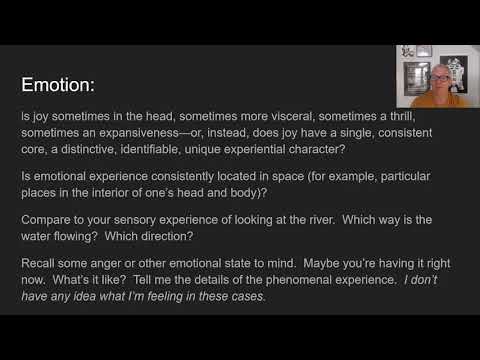
- Questions arise about whether emotions like joy or anger are consistently felt as part of one's conscious experience or if they vary in phenomenology.
Implications for Understanding Emotions
- If emotional infallibilism were true, questions about the nature and consistency of emotional experiences would be meaningless; however, Schweitzgabel asserts these questions are valid.
Exploring Emotional Experience and Infallibilism
The Nature of Joy and Anger
- The speaker questions whether joy feels the same in every instance, noting that different types of anger have distinct characteristics. This diversity raises doubts about the idea of emotional infallibility.
- There is a discussion on whether joy has a consistent core or if it varies significantly in experience, with the speaker aligning with the view that emotions are not consistently identifiable.
- The speaker contrasts emotional experiences with sensory experiences, suggesting that emotions like joy lack the clarity found in visual observations, making them harder to articulate.
Challenges of Introspection
- Reflecting on anger reveals difficulties in describing emotional states; individuals often struggle to connect feelings to specific causes or details.
- If emotional infallibilism were true, understanding one's emotions would be straightforward. However, introspection often yields vague and unclear insights into our feelings.
Doubts About Emotional Reporting
- Questions arise about genuine enjoyment of activities (e.g., Christmas), highlighting discrepancies between reported feelings and actual experiences.
- The gap between feeling an emotion and accurately reporting it suggests uncertainty in self-assessment regarding enjoyment or displeasure.
Argument Against Emotional Infallibilism
- Schweitzgible presents leading questions aimed at challenging beliefs about emotional infallibility by prompting reflection on current emotional states.
- The speaker emphasizes that one cannot be wrong about ongoing conscious experience but can misinterpret their emotions. This leads to questioning the reliability of introspection.
Sensory State Infallibilism
- A long quote from Schweitzgible prompts listeners to reflect on their current emotional state and its clarity compared to visual perception.
- The difficulty in discerning internal experiences (like anger or pleasure) highlights potential errors in self-reporting emotions over clear sensory perceptions.
Conclusion: Mistakes in Understanding Emotions
- Individuals may misidentify the sources of their emotions, indicating a lack of infallibility when assessing personal feelings.
Exploring the Nature of Perception and Pain
The Complexity of Dreams and Sensation
- Discusses the experience of dreams where impossible sensations occur, such as perceiving a red carpet that isn't red. This suggests anomalies in sensory perception.
- Introduces morphine patients who report pain without unpleasantness, challenging the notion that pain is inherently negative. This raises questions about the nature of pain itself.
The Paradox of Pain Perception
- Highlights the contradiction where morphine patients acknowledge their pain but do not find it distressing, indicating a potential separation between sensation and emotional response to pain.
- Mentions Daniel Dennett's card experiment demonstrating how one can perceive movement without color, questioning traditional views on sensory experiences.
Illusions in Visual Experience
- Explains how individuals can see movement in their peripheral vision without recognizing its color, contradicting infallible perceptions proposed by philosophers like Descartes.
- Suggests that visual clarity is an illusion; our brains trick us into believing our visual experiences are sharper than they are.
Foveal Vision and Attention
- Describes how focusing attention on specific objects enhances perceived clarity while surrounding areas remain vague until directly attended to.
- Emphasizes that clarity is only achieved through direct focus; everything outside this focus remains indistinct.
Training Visual Awareness
- Introduces "unattended looking," a practice allowing individuals to separate foveation from introspection by moving their eyes while reflecting on non-focal areas.
- Encourages practicing this technique to understand better how visual perception works beyond immediate focus.
Reevaluating Perceptual Certainty
- Raises critical questions about the reliability of visual experiences; participants often realize their initial beliefs about clarity were incorrect after conducting experiments.
Understanding Introspection and Conscious Experience
The Nature of Thought and Perception
- The speaker reflects on their initial thoughts about the "Prince of Wales," indicating that their introspection was influenced by an external prompt from Schweitzel, suggesting a reliance on external cues for thought processes.
- A question arises regarding whether there is a distinctive phenomenology of thinking beyond mere imagery, challenging the listener to consider if the answer is so obvious that it precludes alternative interpretations.
- The speaker contrasts clear claims about the external world (e.g., physical objects like desks and shirts) with the murkiness of personal thoughts, emphasizing a lack of certainty in subjective experiences compared to objective observations.
Limitations of Introspection
- The introspection of conscious experience is described as faulty and untrustworthy, suggesting that individuals often misinterpret or misunderstand their own mental states.
- The speaker argues that most people have limited confidence in accurately reporting their current phenomenology, positing that Descartes' view may be fundamentally flawed; we know more about external realities than our internal experiences.
Epistemological Implications
- The discussion flips Cartesian epistemology on its head by asserting that while one can confidently identify what they are consuming (like food), articulating one's sensory experience (like taste) remains elusive and indirect.