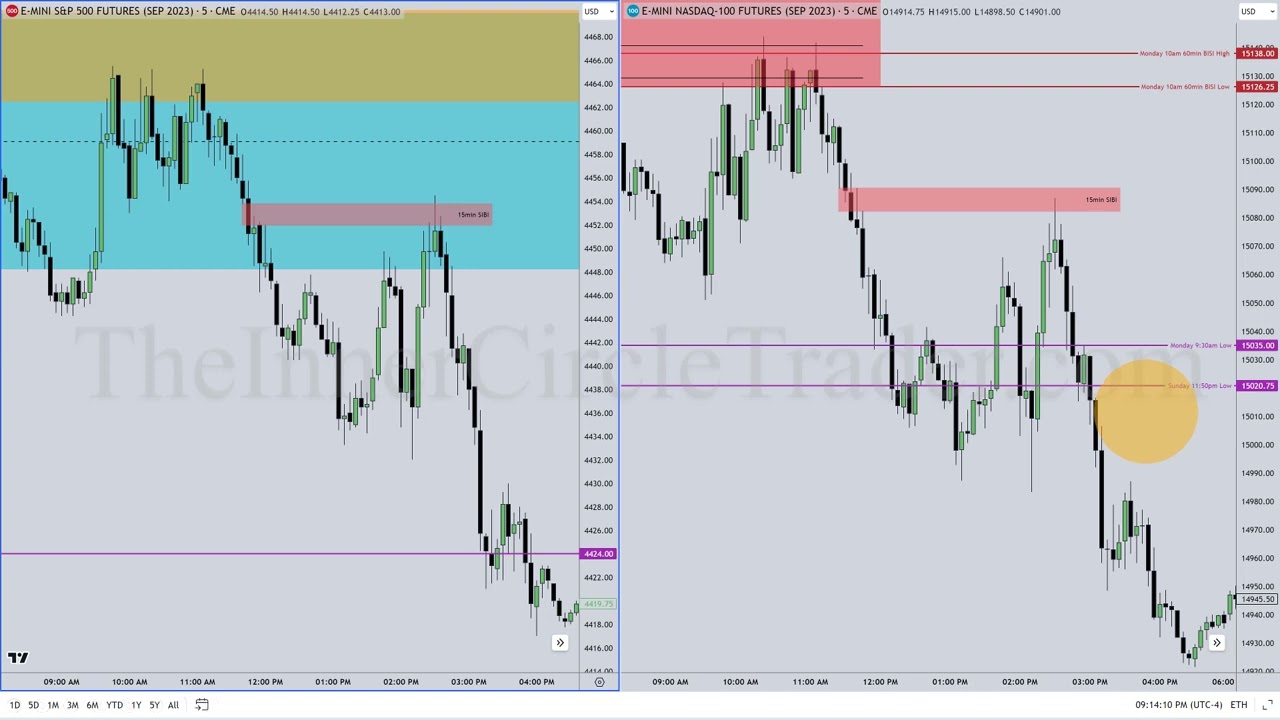
ICT Mentorship 2023 - August 16, 2023 ES & NQ Futures Review
Market Analysis and Trading Insights
Overview of S&P Futures and NASDAQ Movement
- The left chart represents the S&P Futures Contract, while the right shows the NASDAQ daily chart. Recent trading indicates movement outside of an imbalance, with a subsequent trade up into a due to swing before declining.
- The analysis focuses on identifying daily bias through weekly drawn liquidity, which frames buy or sell programs. A bearish outlook has been established for both S&P and NASDAQ.
Daily Bias and Market Structure
- The opening price is positioned near the high; any price above this is considered a judo swing—a false rally designed to lure traders into long positions before a drop occurs.
- An hourly chart reveals that after reaching an inefficiency area, the market broke lower. This shaded area framed the daily high, indicating shifts in market structure.
Fair Value Gaps and Inefficiencies
- August tends to exhibit less predictable market behavior compared to other months. A small inefficiency exists as a fair value gap that should be monitored.
- Current trading activity reflects consequent encroachment patterns observed in previous sessions, highlighting areas of interest for potential trades.
Price Action Dynamics
- The discussion critiques simplistic views of support and resistance, emphasizing that true market dynamics involve understanding inefficiencies rather than just static levels.
- Anticipation of significant sell-offs around specific price points (14,853.5), particularly during FOMC minutes when volatility typically increases.
Intraday Trading Strategies
- On a 15-minute timeframe, notable confluence was observed at key levels leading to aggressive sell-offs post-FOMC announcements.
- Transitioning to a five-minute chart illustrates intraday movements where higher time frame PD arrays are crucial for maintaining perspective amidst rapid price changes.
Conclusion on Market Behavior
Understanding Market Movements and Analysis
The Importance of Milestones in Trading
- Recognizing milestones in trading is crucial; they serve as reference points for future observations, helping traders understand market movements.
- Traders should anticipate initial price movements that oppose their analysis, which can provide insights into the market's direction.
- Many retail traders misinterpret market signals, expecting upward trends where none exist; this highlights the importance of thorough analysis before making decisions.
Utilizing Social Media for Trading Insights
- Following key analysts on platforms like Twitter can enhance understanding of market dynamics by providing real-time updates and predictions.
- Traders are encouraged to document tweets related to specific levels on their charts to visualize and assess the accuracy of predictions made at those times.
Building a Strong Foundation in Trading
- Consistent practice and observation are essential for developing a trader's intuition; this involves daily engagement with market data and analysis.
- It’s important not to rush the learning process; building understanding takes time, and patience is key to mastering trading strategies.
Linking Time with Price Movements
- Every price movement is connected to a timing mechanism; recognizing this relationship helps traders make informed decisions based on historical patterns.
Turn any video into a summary like this
YouTube links, meetings, lectures. With transcripts, search, and chat.