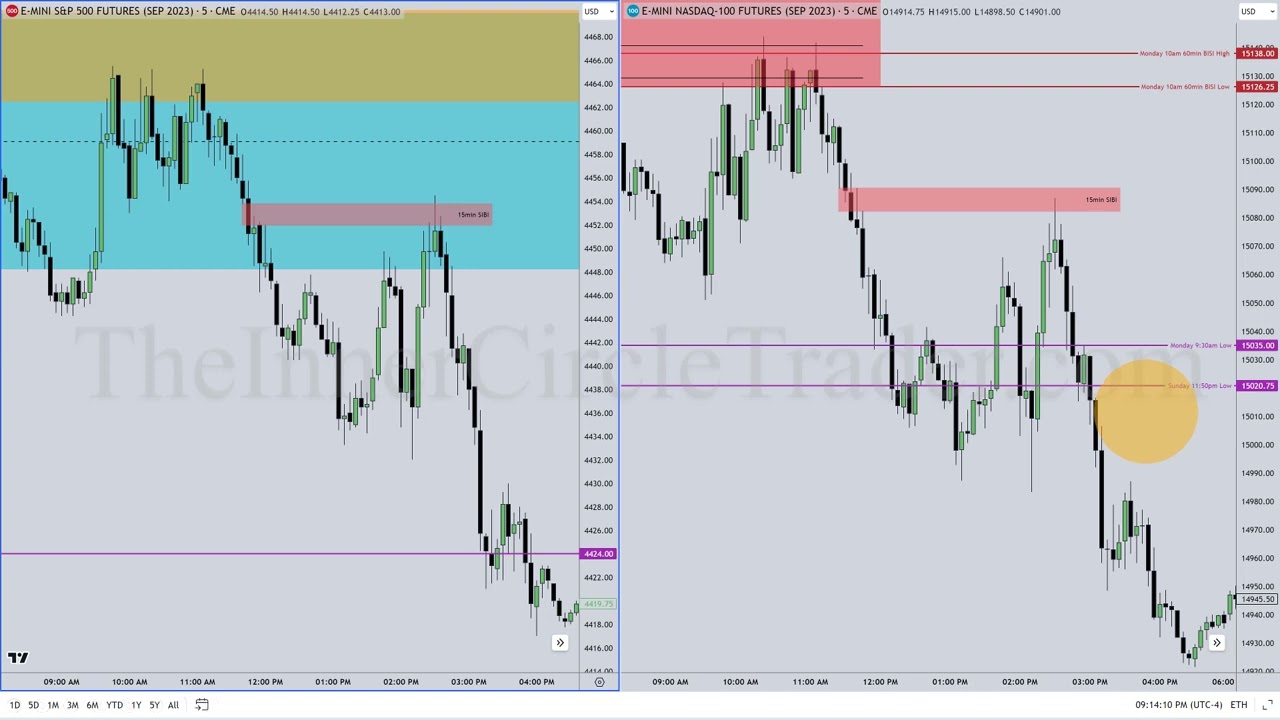
ICT Mentorship 2023 - August 16, 2023 ES & NQ Futures Review

ICT Mentorship 2023 - August 16, 2023 ES & NQ Futures Review

Market Analysis and Trading Insights

Overview of S&P Futures and NASDAQ Movement

  • The left chart represents the S&P Futures Contract, while the right shows the NASDAQ daily chart. Recent trading indicates movement outside of an imbalance, with a subsequent trade up into a due to swing before declining.
  • The analysis focuses on identifying daily bias through weekly drawn liquidity, which frames buy or sell programs. A bearish outlook has been established for both S&P and NASDAQ.

Daily Bias and Market Structure

  • The opening price is positioned near the high; any price above this is considered a judo swing—a false rally designed to lure traders into long positions before a drop occurs.
  • An hourly chart reveals that after reaching an inefficiency area, the market broke lower. This shaded area framed the daily high, indicating shifts in market structure.

Fair Value Gaps and Inefficiencies

  • August tends to exhibit less predictable market behavior compared to other months. A small inefficiency exists as a fair value gap that should be monitored.
  • Current trading activity reflects consequent encroachment patterns observed in previous sessions, highlighting areas of interest for potential trades.

Price Action Dynamics

  • The discussion critiques simplistic views of support and resistance, emphasizing that true market dynamics involve understanding inefficiencies rather than just static levels.
  • Anticipation of significant sell-offs around specific price points (14,853.5), particularly during FOMC minutes when volatility typically increases.

Intraday Trading Strategies

  • On a 15-minute timeframe, notable confluence was observed at key levels leading to aggressive sell-offs post-FOMC announcements.
  • Transitioning to a five-minute chart illustrates intraday movements where higher time frame PD arrays are crucial for maintaining perspective amidst rapid price changes.

Conclusion on Market Behavior

Understanding Market Movements and Analysis

The Importance of Milestones in Trading

  • Recognizing milestones in trading is crucial; they serve as reference points for future observations, helping traders understand market movements.
  • Traders should anticipate initial price movements that oppose their analysis, which can provide insights into the market's direction.
  • Many retail traders misinterpret market signals, expecting upward trends where none exist; this highlights the importance of thorough analysis before making decisions.

Utilizing Social Media for Trading Insights

  • Following key analysts on platforms like Twitter can enhance understanding of market dynamics by providing real-time updates and predictions.
  • Traders are encouraged to document tweets related to specific levels on their charts to visualize and assess the accuracy of predictions made at those times.

Building a Strong Foundation in Trading

  • Consistent practice and observation are essential for developing a trader's intuition; this involves daily engagement with market data and analysis.
  • It’s important not to rush the learning process; building understanding takes time, and patience is key to mastering trading strategies.

Linking Time with Price Movements

  • Every price movement is connected to a timing mechanism; recognizing this relationship helps traders make informed decisions based on historical patterns.
Video description

Government Required Risk Disclaimer and Disclosure Statement CFTC RULE 4.41 – HYPOTHETICAL OR SIMULATED PERFORMANCE RESULTS HAVE CERTAIN LIMITATIONS. UNLIKE AN ACTUAL PERFORMANCE RECORD, SIMULATED RESULTS DO NOT REPRESENT ACTUAL TRADING. ALSO, SINCE THE TRADES HAVE NOT BEEN EXECUTED, THE RESULTS MAY HAVE UNDER-OR-OVER COMPENSATED FOR THE IMPACT, IF ANY, OF CERTAIN MARKET FACTORS, SUCH AS LACK OF LIQUIDITY. SIMULATED TRADING PROGRAMS IN GENERAL ARE ALSO SUBJECT TO THE FACT THAT THEY ARE DESIGNED WITH THE BENEFIT OF HINDSIGHT. NO REPRESENTATION IS BEING MADE THAT ANY ACCOUNT WILL OR IS LIKELY TO ACHIEVE PROFIT OR LOSSES SIMILAR TO THOSE SHOWN Trading performance displayed herein is hypothetical. Hypothetical performance results have many inherent limitations, some of which are described below. No representation is being made that any account will or is likely to achieve profits or losses similar to those shown. In fact, there are frequently sharp differences between hypothetical performance results and the actual results subsequently achieved by any particular trading program. One of the limitations of hypothetical performance trading results is that they are generally prepared with the benefit of hindsight. In addition, hypothetical trading does not involve financial risk, and no hypothetical trading record can completely account for the impact of financial risk in actual trading. For example, the ability to withstand losses or to adhere to a particular trading program in spite of trading losses are material points which can also adversely affect actual trading results. There are numerous other factors related to the markets in general or to the implementation of any specific trading program which cannot be fully accounted for in the preparation of hypothetical performance results and all of which can adversely affect actual trading results. U.S. Government Required Disclaimer – Commodity Futures Trading Commission Futures and Options trading has large potential rewards, but also large potential risk. You must be aware of the risks and be willing to accept them in order to invest in the futures and options markets. Don’t trade with money you can’t afford to lose. This is neither a solicitation nor an offer to Buy/Sell futures or options. No representation is being made that any account will or is likely to achieve profits or losses similar to those discussed on this web site. The past performance of any trading system or methodology is not necessarily indicative of future results. Trade at your own risk. The information provided here is of the nature of a general comment only and neither purports nor intends to be, specific trading advice. It has been prepared without regard to any particular person’s investment objectives, financial situation and particular needs. Information should not be considered as an offer or enticement to buy, sell or trade. You should seek appropriate advice from your broker, or licensed investment advisor, before taking any action. Past performance does not guarantee future results. Simulated performance results contain inherent limitations. Unlike actual performance records the results may under or over compensate for such factors such as lack of liquidity. No representation is being made that any account will or is likely to achieve profits or losses to those shown. The risk of loss in trading can be substantial. You should therefore carefully consider whether such trading is suitable for you in light of your financial condition. If you purchase or sell Equities, Futures, Currencies or Options you may sustain a total loss of the initial margin funds and any additional funds that you deposit with your broker to establish or maintain your position. If the market moves against your position, you may be called upon by your broker to deposit a substantial amount of additional margin funds, on short notice in order to maintain your position. If you do not provide the required funds within the prescribed time, your position may be liquidated at a loss, and you may be liable for any resulting deficit in your account. Under certain market conditions, you may find it difficult or impossible to liquidate a position. This can occur, for example, when the market makes a “limit move.” The placement of contingent orders by you, such as a “stop-loss” or “stop-limit” order, will not necessarily limit your losses to the intended amounts, since market conditions may make it impossible to execute such orders.