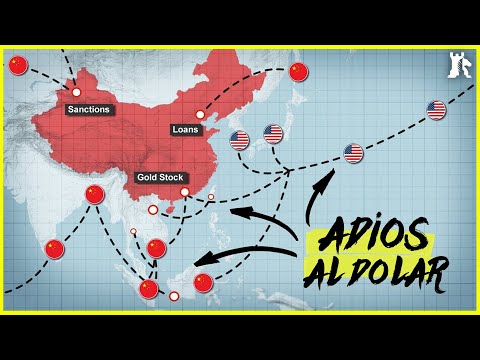
China planea destronar al dólar
CIA and Global Financial Power
The Geopolitical Significance of Financial Control
- The CIA's location in Langley, Virginia, is strategically positioned near the White House and the Swift data center, emphasizing the intertwining of financial power and geopolitical strategy.
- Since 1944, U.S. financial dominance has served as a geopolitical weapon, with the U.S. dollar being central to global transactions involving vital commodities like hydrocarbons and precious metals.
Challenges to Dollar Hegemony
- Many nations view dollar hegemony as an outdated remnant of U.S. supremacy and are actively seeking alternative financial infrastructures, primarily looking towards China as a counterbalance.
- The trend of de-dollarization is gaining momentum through various bilateral and multilateral agreements aimed at reducing dependency on the dollar for international trade.
The Evolution of Monetary Power
Historical Context of Money
- Rafael González introduces the concept that money historically derives its social power from state backing rather than intrinsic value tied to precious metals.
- In an anarchic global system without a world government, monetary systems reflect national interests rather than universal standards.
Post-War Economic Dynamics
- After World War II, U.S. monetary power solidified as Europe was devastated; Washington leveraged its position as a creditor to reshape global trade dynamics by controlling post-war reconstruction loans.
- Fixed exchange rates linked to gold initially stabilized this system until military expenditures led to unsustainable deficits for the U.S., culminating in a crisis over dollar convertibility in 1971 when Nixon abandoned gold backing for the dollar.
Consequences of Dollar Abandonment
Shifts in Global Financial Relations
- By severing ties between the dollar and gold, Washington effectively insulated itself from foreign pressures while maintaining control over international monetary legitimacy despite rising debts.
- Foreign banks were compelled to recycle their dollars into U.S. Treasury securities due to fears that abandoning dollars would lead to significant losses in value for their reserves.
Military Spending Without Limits
- This new monetary framework allowed unrestricted military spending abroad since dollars sent overseas would return home through purchases of Treasury bonds, creating a self-sustaining economic loop beneficial for U.S. military strategy against rivals like Russia and China.
The Impact on Global Economics
Structural Inequities Created by Dollar Dominance
- The perpetual renewal of U.S debt acted as an implicit subsidy for American military endeavors while simultaneously constraining other nations under austerity measures imposed by institutions like the IMF and World Bank when they faced similar debts.
- An agreement with Saudi Arabia in 1974 further entrenched this system by mandating oil sales be conducted in dollars, reinforcing America's leverage over energy markets globally while limiting hostile states' access to essential imports like food and energy through unilateral sanctions based on currency control strategies.
The Geopolitical Shift: The Decline of Dollar Hegemony
The Productive Capacity of Nations
- The true wealth of nations lies in their productive capacity, highlighting the economic shifts as North America becomes less industrialized.
- Increased reliance on imports and China's industrial growth create geopolitical tensions, particularly regarding financial dependencies.
U.S. Sanctions and Their Global Impact
- Since 2000, U.S. sanctions have surged by 900%, affecting various countries and companies, including significant actions against Russia post-Crimea annexation.
- The confiscation of $300 billion in Russian assets in 2022 marked a pivotal moment that undermined trust in the dollar's stability as a global currency.
China’s Strategic Moves Against Dollar Dependence
- In response to potential conflicts with the U.S., China is pursuing de-dollarization strategies to mitigate risks associated with American sanctions.
- Bilateral agreements allow China to reduce its dollar dependency while providing economic support to nations like Russia and Iran.
Alternatives to Dollar Transactions
- Countries such as Russia, China, India, and the EU are developing alternatives to SWIFT (e.g., SPF, CIPS), indicating a shift away from dollar transactions.
- Notable agreements include China's currency swap with Argentina and mediation between Iran and Saudi Arabia for oil trade considerations.
BRICS: A Coalition for Economic Change
- BRICS represents a significant portion of global population and GDP; it actively promotes de-dollarization among its members.
- Brazil's agreement with China for local currency trade exemplifies ambitious efforts towards reducing reliance on the dollar within international trade frameworks.
Future Monetary Dynamics
- As part of its strategy, China is increasing gold reserves while moving away from U.S. Treasury purchases, signaling a shift in monetary policy focus.
- While the yuan may not replace the dollar entirely, it reflects an emerging multipolar monetary order where the dominance of the dollar is challenged but not eliminated.