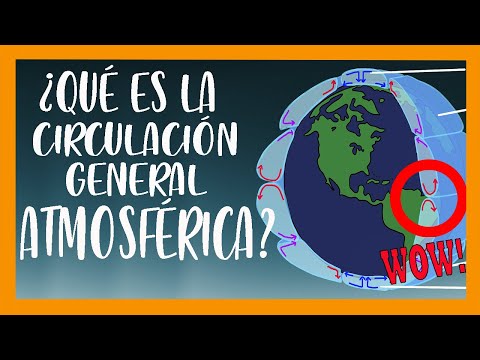
✅✅✅¿Qué es la CIRCULACIÓN GENERAL ATMOSFÉRICA?✅✅✅
Understanding Atmospheric Circulation
Introduction to Climate Patterns
- Observations of Earth reveal repeating climate patterns, with polar regions being cold and dry, contrasted by lush green areas near the equator that receive heavy rainfall.
- The distribution of these climates is not random; it follows a systematic pattern from the equator to the poles.
General Atmospheric Circulation
- The general atmospheric circulation model explains major air mass movements on a planetary scale, first articulated in the 18th century by Harley. He noted that trade winds blow towards the equator.
- Harley proposed that warm air at the equator rises due to thermal convection, cools at higher altitudes, and then descends towards the poles before returning to the equator.
Hadley Cells and Wind Patterns
- This convection current is termed an atmospheric cell; however, it is slightly deflected due to Earth's rotation—trade winds blow southwest in the northern hemisphere and northwest in the southern hemisphere.
- Harley's model suggested surface winds would veer westward while upper atmosphere currents would shift eastward, creating a compensatory cycle across the planet.
Advancements in Understanding Circulation
- Although Hadley's initial explanation was foundational, it had limitations which were later addressed by Rosby in the 20th century through a three-cell model linking Coriolis effect with wind deflection.
- Rosby recognized that for equilibrium in Earth's rotation amidst friction from trade winds, there must be opposing winds maintaining balance within this system.
Structure of Atmospheric Cells
- Rosby's model includes three atmospheric cells extending from poles to equator: Hadley Cell (5° - 30° latitude), Ferrel Cell (30° - 60° latitude), and Polar Cell (60° - pole). Each plays a distinct role in global weather patterns.
Hadley Cell Dynamics
- The Hadley Cell operates between 5° north/south latitude where intense solar radiation causes significant water vapor evaporation leading to convective air movement into higher troposphere layers.
- Daily convergence of trade winds results in warm front collisions causing frequent storms and heavy rainfall typical of equatorial climates; this area experiences some of Earth's highest precipitation levels due to high evaporation rates.
Effects on Global Deserts
- As moist air ascends and moves toward 30° latitudes, it cools and descends as dry air creating high-pressure zones that inhibit moisture ascent leading to arid conditions characteristic of major deserts like Sahara despite high temperatures promoting evaporation.
Movement of Air Masses
- Descending dry air forces remaining humid air at lower altitudes either north or south back towards the equator forming trade winds while westerlies move towards 60°, balancing out frictional effects on Earth's rotation caused by alisios (trade winds).
Ferrel Cell Characteristics
Atmospheric Circulation and Jet Streams
Overview of Atmospheric Cells
- The movement of air through the upper layers of the atmosphere is described, particularly how it ascends to 30° latitude where it meets warm, dry winds from the equator.
- At 60° latitude, fresh and humid winds collide with cold, dry polar winds, leading to a cooling process that causes some air to descend back to the surface.
- Cold and dry winds from the poles move towards 60° latitude at ground level, known as polar easterlies.
Discovery and Importance of Jet Streams
- The jet stream was discovered during World War II when American pilots reported strong eastward currents over the Pacific Ocean.
- Japanese forces had previously utilized these currents for incendiary balloon attacks on the U.S. West Coast; however, their plan ultimately failed.
- The jet stream exists at about 12 kilometers altitude in the tropopause between atmospheric cells; its tropical variant has less climatic significance compared to its polar counterpart.
Characteristics of Polar Jet Stream
- The polar jet stream is dynamic, shifting north or south depending on seasonal changes and significantly influences weather patterns in temperate regions like North America and Europe.
- It plays a crucial role in general atmospheric circulation by affecting precipitation patterns across hemispheres due to its meandering paths.
Effects on Weather Patterns
- When the jet stream retreats toward the pole, it creates ridges allowing warm air masses from the south to invade; conversely, if it moves southward excessively, trough formations can lead to colder conditions below.
- Sharp curves in the jet stream increase wind speeds as displaced air attempts to reconnect with surrounding masses, resulting in greater atmospheric instability.
Precipitation Patterns and Final Thoughts
- Mid-latitude regions experience significant rainfall due to interactions between cold polar fronts and warm mid-latitude fronts influenced by the polar jet stream.
- These areas are among those with highest precipitation globally after equatorial zones; understanding this interaction is vital for grasping global weather systems.
Recap of Atmospheric Cells' Functions
- A review emphasizes understanding three main atmospheric cells: convergence leads to low-pressure zones at equatorial latitudes where moist trade winds rise causing heavy rainfall before losing moisture aloft.
- Descending cool dry air at 30° latitude forms subtropical high-pressure zones that inhibit rain formation contributing to desert climates worldwide.
Understanding Atmospheric Circulation and Climate Irregularities
General Atmospheric Circulation
- The discussion begins with the explanation of how extremely low humidity levels occur in polar regions due to high pressure, which prevents rainfall and results in cold, dry climates.
- It highlights an anomaly where the central United States is a desert despite expectations for lush greenery similar to the East Coast, indicating that atmospheric circulation patterns can lead to unexpected climate outcomes.
Climate Anomalies
- The speaker notes that while general atmospheric circulation provides a broad framework for understanding climate, various other factors contribute to anomalies and irregularities in climate distribution across different regions.